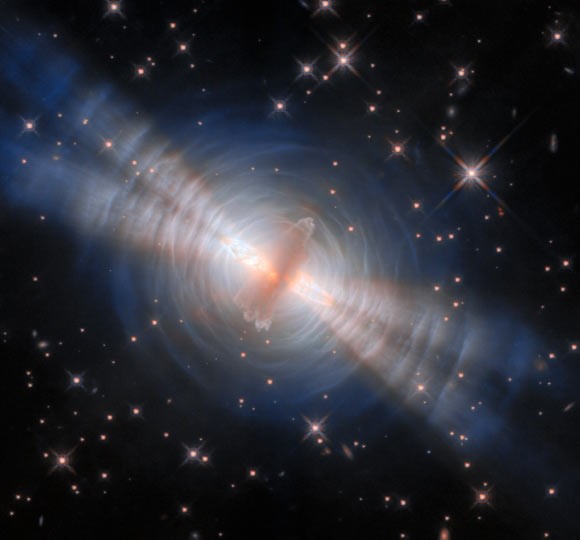
The NASA/ESA Hubble Space Telescope has captured the most detailed image yet of the Egg Nebula, a unique cosmic structure offering a rare glimpse into the final stages of a star’s life. Located approximately 1,000 light-years away in the Cygnus constellation, this bipolar protoplanetary nebula is providing astronomers with unprecedented insight into stellar evolution.
What is the Egg Nebula?
The Egg Nebula, also known as the Cygnus Egg, is a relatively young and close pre-planetary nebula. It’s about 0.4 light-years wide, and its central star is heavily obscured by a dense cloud of dust. This makes it the first, youngest, and closest example of a star transitioning into a planetary nebula ever discovered.
Why Does This Matter?
Stars like our Sun eventually run out of fuel and eject their outer layers. The Egg Nebula is caught in the act: a brief transitional phase lasting only a few thousand years, making it an ideal time to study this process. Unlike the violent deaths of massive stars in supernovas, the Egg Nebula’s death is orderly, with symmetrical patterns suggesting a coordinated series of events, not an explosion. This is crucial because it helps scientists understand how stars like our Sun shed their material… material that eventually forms new star systems.
How Hubble Captured the Details
The nebula shines by reflecting light from its central star, which escapes through a “polar eye” in the surrounding dust. This light illuminates fast-moving polar lobes piercing slower, older arcs. The arcs and lobes suggest gravitational interactions with hidden companion stars buried within the dust disk.
“The Egg Nebula offers a rare opportunity to test theories of late-stage stellar evolution,” according to the Hubble astronomers.
The symmetrical patterns seen in the image suggest that these sputtering events in the carbon-enriched core of the dying star are what shaped the nebula.
The Legacy of Dying Stars
The dust and materials expelled by stars like these aren’t lost. They seed future star systems, including our own. Earth and other rocky planets in our Solar System formed roughly 4.5 billion years ago from the remnants of older, dying stars.
The Egg Nebula’s existence proves that the orderly transition of stars can forge new planets. This reinforces the cycle of cosmic birth and death: the death of one star is the foundation for another.