For decades, the concept of “megastructures”—colossal artificial constructs built by advanced civilizations—has lived primarily in the realm of science fiction. However, a new study by engineering scientist Colin McInnes of the University of Glasgow suggests that these massive projects are not just fantasies; they may be physically achievable and, more importantly, stable.
This research shifts the conversation from “Is it possible?” to “How would it look?” providing a scientific roadmap for astronomers searching for signs of advanced life in the cosmos.
The Motivation: Why Build at a Galactic Scale?
To understand why a civilization would undertake such monumental tasks, one must look at the long-term survival of a species. According to the Kardashev Scale, which measures a civilization’s technological advancement by its energy consumption, an advanced society would eventually outgrow the energy provided by a single planet.
There are several critical reasons why a civilization might seek to harness stellar energy:
– Resource Scarcity: As planetary resources deplete, stars offer an inexhaustible power source.
– Cosmic Survival: Moving entire solar systems via “stellar engines” could allow a civilization to escape cosmic catastrophes, such as approaching supernovae or gravitational shifts.
– Terraforming and Travel: The energy required to reshape planets or power interstellar travel is far beyond what any biological or planetary process can provide.
Two Blueprints for Cosmic Engineering
McInnes’ research focuses on two primary theoretical structures: Stellar Engines and Dyson Bubbles. Traditionally, these were modeled as simple shapes, but McInnes applied complex 3D calculations to determine if they could remain stable without constant, active maintenance.
1. Stellar Engines (The “Tambourine” Model)
A stellar engine is a structure designed to use the pressure of stellar radiation to push a star, effectively moving a solar system through space.
– The Challenge: Simple flat discs are inherently unstable and would likely crash into their host star.
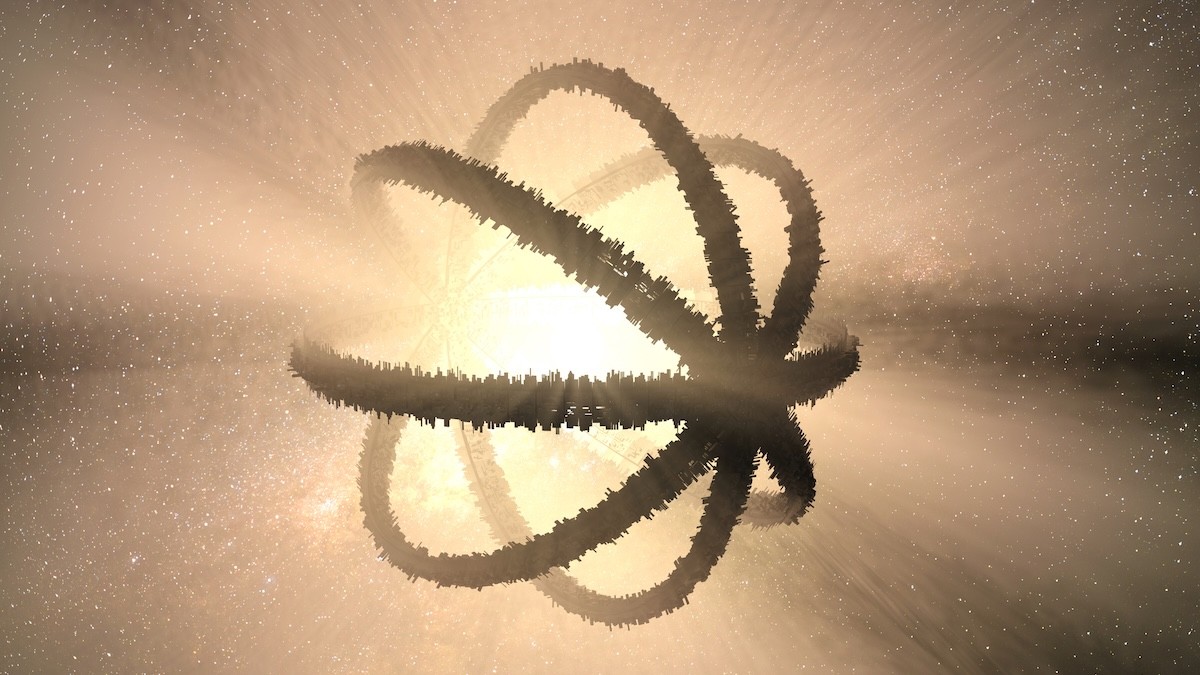
– The Solution: McInnes suggests a ring-supported configuration. By concentrating most of the mass into a ring—resembling a tambourine rather than a flat plate—the structure can achieve passive stability, remaining in place without constant correction.
2. Dyson Bubbles (The “Reflector Cloud” Model)
A Dyson bubble aims to surround a star with reflectors to capture its light.
– The Challenge: A solid, static shell is prone to instability.
– The Solution: Instead of a solid shell, the study suggests a dense cloud of low-mass reflectors. By deploying a vast number of small objects, the structure can balance its own gravity against the radiation pressure of the star, creating a stable, floating swarm.
Hunting for “Technosignatures”
If these structures are physically possible, they leave behind a “fingerprint” that our telescopes can detect. This is known as a technosignature. Because these structures would absorb and re-radiate light, they would likely cause an infrared excess —an unexpected surge in infrared wavelengths that doesn’t match the natural profile of the star.
Furthermore, these structures might appear as unusual distortions in a star’s spectral fingerprint, providing a target for SETI (Search for Extraterrestrial Intelligence) researchers.
“While such ventures are clearly speculative, understanding the orbital dynamics of ultra-large structures… can provide insights into the properties of potential technosignatures in SETI studies.” — Colin McInnes
The Legacy of Lost Civilizations
One of the most profound implications of this study is the idea of relic structures. Because these configurations can be “passively stable,” they could theoretically persist for eons. Even if the civilization that built them has vanished, their megastructures could remain as silent, orbiting monuments—remnants of a species that once mastered the laws of physics.
Conclusion
By proving that massive scale-engineering can be stable through specific geometric configurations, this research provides astronomers with concrete physical models to look for when searching for signs of advanced intelligence in the universe.