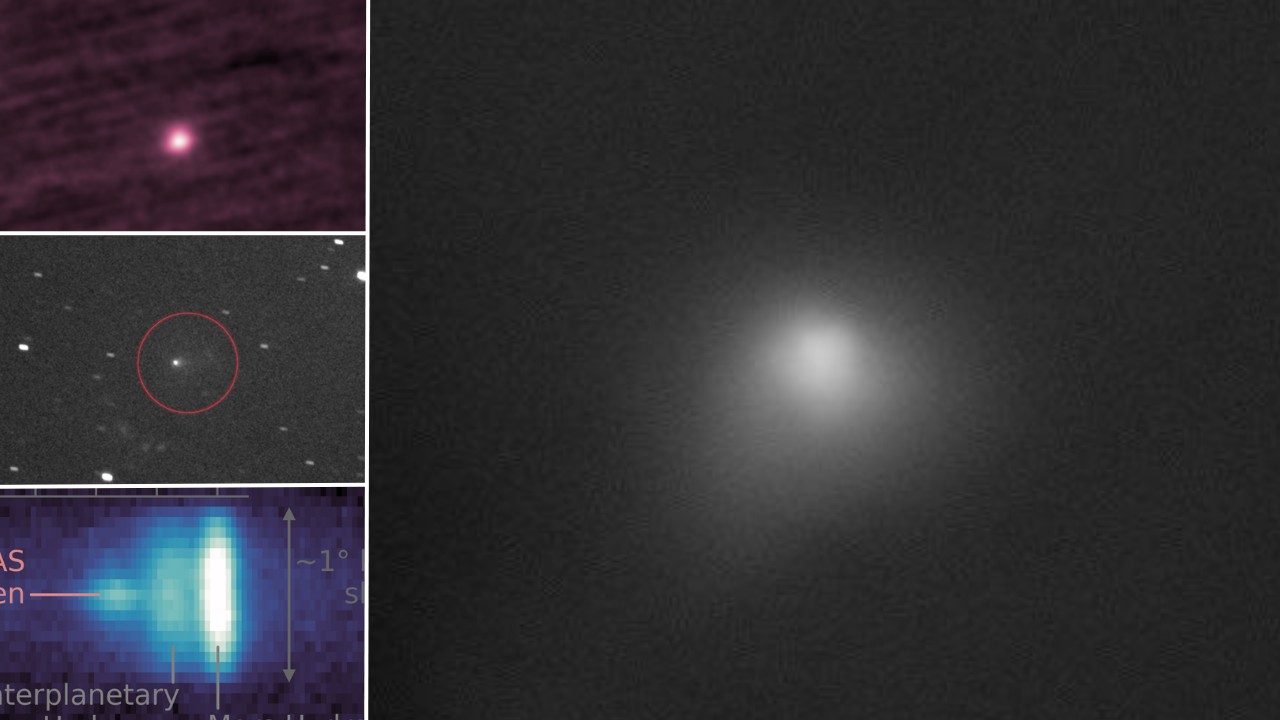
In 2025, the interstellar comet 3I/ATLAS briefly dominated headlines, sparking sensational claims and public fascination. Discovered in July by the ATLAS survey telescope in Chile, it was the third confirmed interstellar object to visit our solar system, following ‘Oumuamua (2017) and 2I/Borisov (2019). While astronomers saw a typical icy visitor, the public’s imagination ran wild, fueled by speculation of extraterrestrial origins. The frenzy was not about science, but about timing, misinformation, and a well-known figure pushing fringe theories.
The Perfect Storm: Timing and a Government Shutdown
The comet’s discovery coincided with a U.S. government shutdown from October 1 to November 12. This pause in NASA operations created a vacuum of official information, which conspiracy theorists quickly filled. During this period, NASA’s Mars Reconnaissance Orbiter captured high-resolution images of the comet. But without immediate agency responses, the lack of transparency was interpreted as a deliberate cover-up. As Larry Denneau of the University of Hawaii put it, “Unfortunately, it all came during the shutdown… and so that created its own complications, because the folks out there… thought NASA was trying to hide something.”
Avi Loeb and the Power of Speculation
The main driver of the comet’s mainstream interest was Avi Loeb, a Harvard University professor known for his controversial theories about extraterrestrial technology. Weeks after the discovery, Loeb published a non-peer-reviewed paper on arXiv suggesting 3I/ATLAS might be artificial. He then doubled down in interviews, accusing NASA of withholding data. The claims spread rapidly, landing him on major media platforms, including the Joe Rogan Experience.
As Mick West, a science writer specializing in debunking sensational claims, explained, Loeb’s credibility and Harvard affiliation gave the story traction: “His unremitting push, combined with the gravitas of his Harvard professorship, makes it an easy sensational story for the media.” The media prioritized sensationalism over scientific accuracy, running with headlines like “Harvard astrophysicist says alien probe” while ignoring more grounded analyses.
The Science vs. the Hype
Despite the hype, scientific observations showed 3I/ATLAS behaved like a typical comet. NASA’s associate administrator, Nicky Fox, stated during a press briefing, “We certainly haven’t seen any technosignatures… that would lead us to believe it was anything other than a comet.” Studies using data from interplanetary spacecraft (Psyche and Mars Trace Gas Orbiter) confirmed the comet’s outgassing patterns were consistent with ordinary comets. T. Marshall Eubanks, lead author of a study on the comet’s acceleration, noted that the results were “pretty typical… and certainly not record-breaking.”
However, Loeb dismissed this consensus, arguing that the observed acceleration could be caused by “thrusters on a spacecraft” rather than natural outgassing.
A Predictable Outcome
As more data came in, the mainstream interest faded. Earth-based and space-based observatories continued to study 3I/ATLAS, but the findings failed to generate the same media attention. The reality is that the comet’s popularity stemmed not from scientific discovery but from sensational claims by a prominent figure. As Denneau observed, “The misinformation is much easier to produce and much harder to squash… it’s just always an uphill battle.”
The case of 3I/ATLAS illustrates how easily public imagination can be captured by unverified speculation, especially when fueled by a credible source and amplified by social media. The comet itself was unremarkable, but the surrounding controversy proves that sometimes, the story isn’t about what’s in the sky, but about how we choose to interpret it.