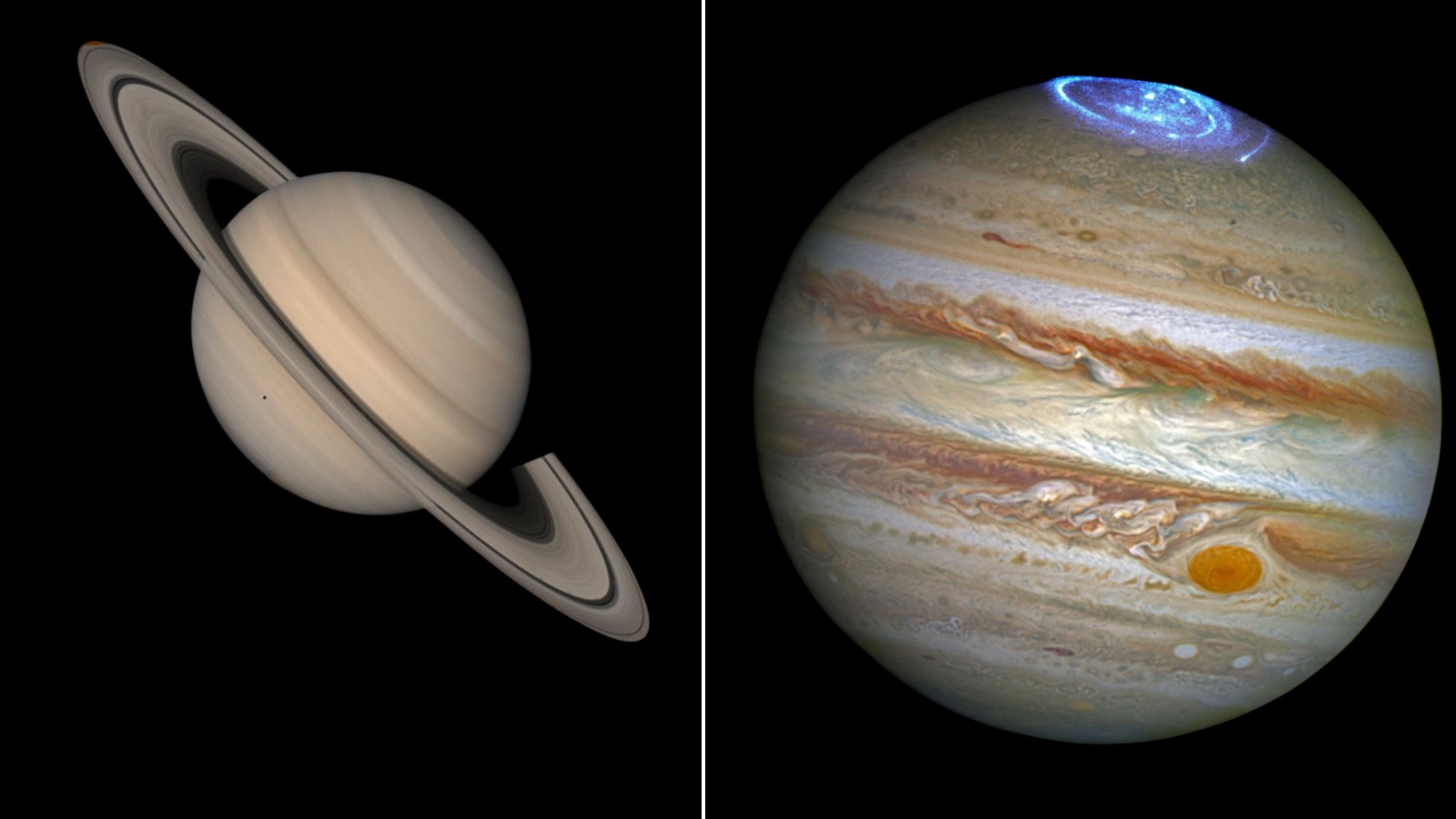
New research suggests the strikingly different weather patterns at the poles of Jupiter and Saturn – one dominated by a single, massive hexagon, the other by a central vortex surrounded by eight smaller storms – may be directly linked to the composition of their interiors. This breakthrough offers a novel way to indirectly study the deep layers of these gas giants, which are otherwise inaccessible to direct observation.
The Polar Puzzle
For decades, astronomers have puzzled over why Jupiter and Saturn, despite their similar size and chemical makeup, exhibit such contrasting polar weather. Jupiter’s north pole features a central vortex encircled by eight smaller, swirling storms, each roughly half the width of Earth. In contrast, Saturn’s north pole hosts a single, colossal hexagonal whirlpool spanning an astonishing 18,000 miles.
The discrepancy has remained unexplained, as both planets are primarily composed of hydrogen and helium. Now, simulations conducted by researchers at MIT suggest that the answer lies in the “hardness” of the gas at the base of their polar vortices.
Modeling Vortex Behavior
The team ran complex simulations, varying factors such as planetary size, rotation speed, internal heating, and the density of gas at the vortex’s base. They discovered that a softer, lighter gas base promotes the formation of multiple vortices, like those seen on Jupiter, while a harder, denser base favors a single, dominant vortex – mirroring Saturn’s hexagonal storm.
“Our study shows that the interior properties and softness of the vortex bottom influence the surface fluid patterns,” explains Wanying Kang, a member of the research team. “This connection between surface weather and planetary interiors hasn’t been made before.”
Implications for Planetary Composition
The findings suggest that Saturn may have a harder, more stratified interior than Jupiter. This could be due to a higher concentration of heavier elements like metals or condensed materials within Saturn, which would increase the density of its lower atmosphere. Jupiter, conversely, appears to be composed of softer, lighter gases.
This insight is significant because it provides an indirect method for probing the interiors of gas giants. Directly studying these planets’ depths is impossible with current technology, making this link between surface phenomena and internal structure invaluable. The research, accepted for publication in Proceedings of the National Academy of Sciences, builds upon data from NASA’s Juno and Cassini missions, which provided detailed images of Jupiter and Saturn’s polar storms over the past two decades.
Understanding the interior structure of gas giants is crucial not only for planetary science but also for refining models of planet formation and evolution. By revealing a fundamental connection between surface weather and deep-seated composition, this research opens new avenues for unraveling the mysteries of these colossal worlds.