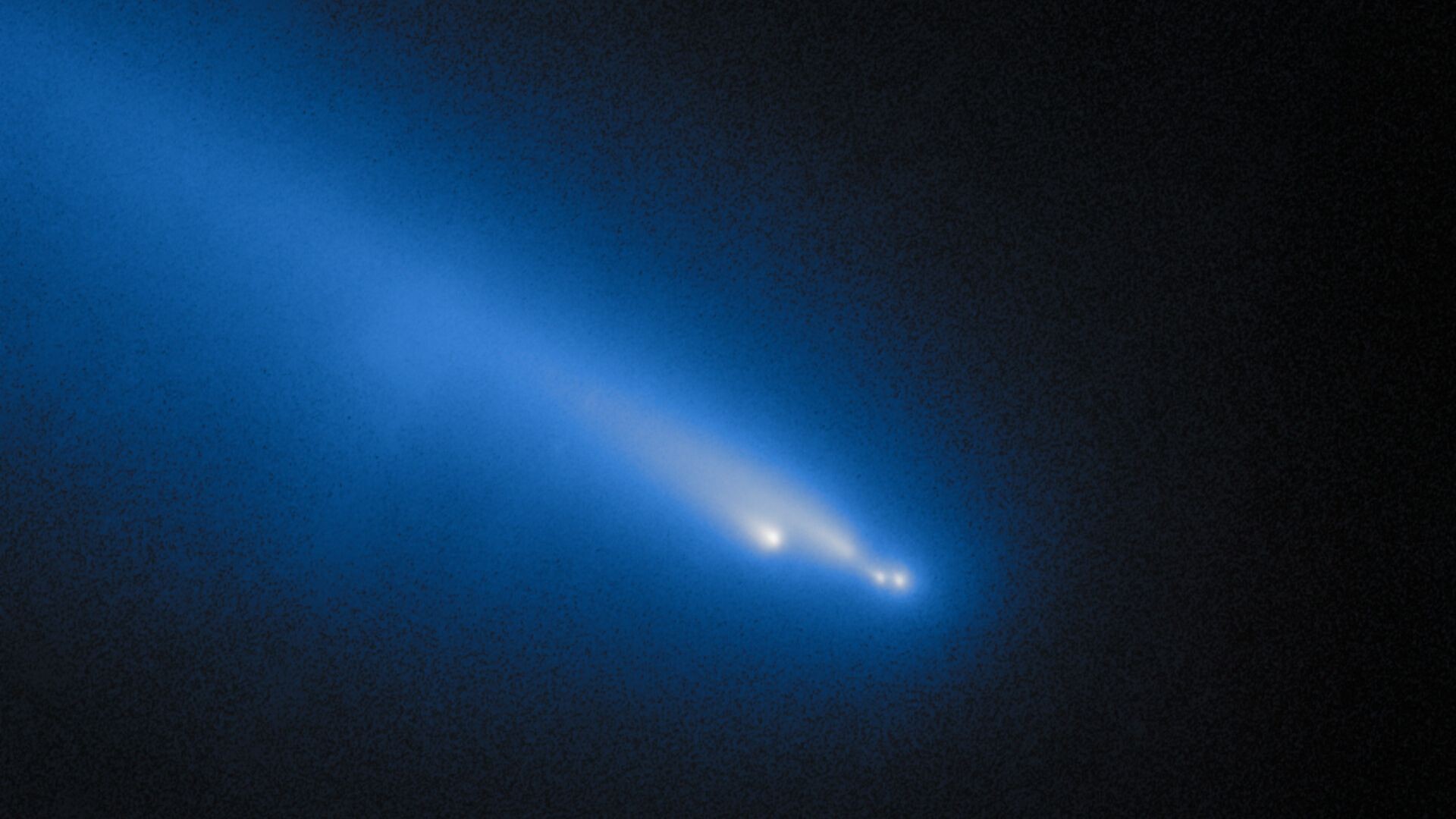
A recently discovered comet, C/2025 K1 (ATLAS), has been observed breaking apart in stunning detail thanks to powerful telescopes in Hawaii and Italy. High-resolution images reveal the comet fragmenting into multiple pieces under the intense gravity and radiation of the sun. This event provides a rare glimpse into the fragile nature of long-period comets and the dynamic forces at play in our solar system.
Comet’s Demise Captured on Camera
The disintegration of C/2025 K1 (ATLAS) was first noticed in late 2024, with observations from the Gemini North telescope in Hawaii and ground-based telescopes in Italy confirming its breakup. Images captured on November 11 and December 6 show distinct fragments separating from the comet’s nucleus, pulled apart by solar gravity and the constant stream of particles emitted by the sun – known as the solar wind.
Astronomer Gianluca Masi of the Virtual Telescope Project in Italy identified at least three major fragments, with a possible fourth, in early November. Observations from the Asiago Observatory in Italy further corroborated the fragmentation, showing two pieces roughly 1,200 miles apart.
Origins and Significance
C/2025 K1 (ATLAS) was discovered in May 2024 using the Asteroid Terrestrial-impact Last Alert System, a network designed to identify potentially hazardous objects. The comet is believed to originate from the Oort Cloud – a vast reservoir of icy bodies located far beyond Neptune’s orbit.
These long-period comets, unlike those that visit more frequently (like Halley’s Comet), are considered “pristine” by astronomers. They have spent billions of years in the frigid depths of space, relatively untouched by the sun’s influence, making them valuable for studying the composition of the early solar system.
Why This Matters
The breakup of C/2025 K1 (ATLAS) is not unusual; many comets disintegrate as they approach the sun. However, the detailed observations provide insights into how these icy bodies behave under extreme conditions.
- Understanding comet fragmentation helps scientists model the evolution of the solar system.
- It also highlights the risks posed by comets, even though this particular one does not appear to be on a collision course with Earth.
For amateur astronomers eager to witness such events, modern astrophotography equipment (smart telescopes, high-resolution cameras) is making it easier than ever to capture stunning views of distant comets.
The disintegration of C/2025 K1 (ATLAS) serves as a stark reminder of the dynamic processes shaping our solar system, and the fragile beauty of these icy wanderers.