The European Space Agency’s (ESA) Hera spacecraft has successfully completed a critical series of deep-space maneuvers, propelling it towards a November 2026 rendezvous with the Didymos binary asteroid system. This mission represents a key follow-up to NASA’s 2022 DART (Double Asteroid Redirection Test) experiment, which deliberately crashed into the smaller asteroid, Dimorphos, to test asteroid deflection techniques.
Mission Overview and Key Objectives
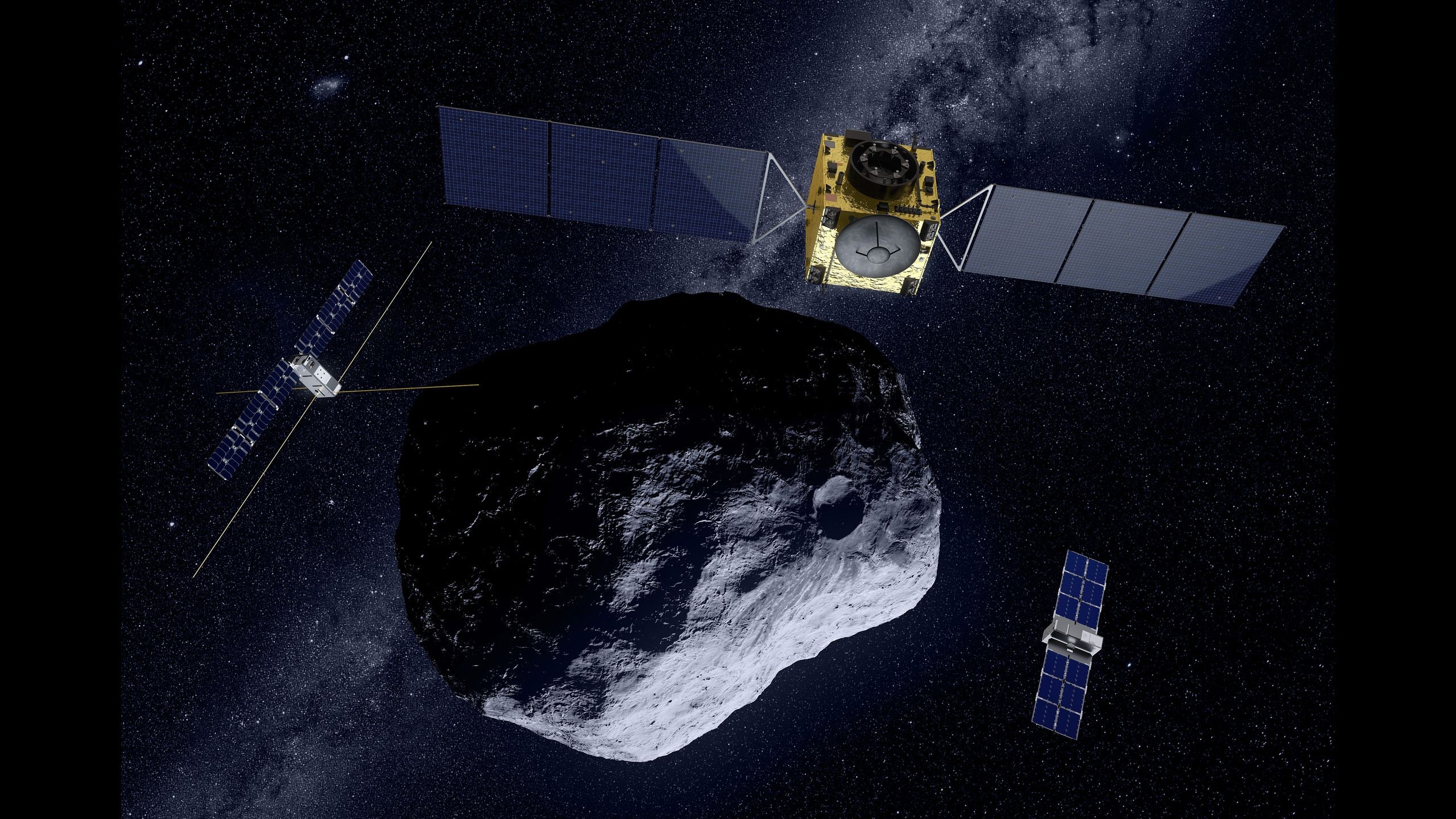
Launched in October 2024 aboard a SpaceX Falcon 9 rocket, Hera’s primary objective is to conduct a detailed post-impact assessment of Dimorphos. This includes high-resolution imaging of the crater created by DART, as well as precise measurements of the asteroid’s altered orbit. The ultimate goal is to refine kinetic impact as a viable planetary defense strategy.
The mission isn’t simply about confirming DART’s success; it’s about understanding how the impact altered Dimorphos’ structure, mass, and orbital characteristics. This data is crucial for scaling up kinetic impact as a reliable method for deflecting potentially hazardous asteroids in the future.
Deep-Space Maneuvers and Fuel Consumption
The recent maneuvers, executed in February and March, consumed 123 kilograms (271 pounds) of hydrazine fuel, increasing the spacecraft’s velocity by 367 meters per second (821 mph). ESA officials described the velocity change as equivalent to “an object accelerating from stationary to supersonic flight.” These burns also served as a vital test for the spacecraft’s braking and rendezvous systems, which will be critical upon arrival at Didymos.
Scientific Preparations and Future Operations
As the spacecraft continues its journey, scientists are loading new software updates in preparation for the final approach. Upon arrival in October 2026, Hera will execute a series of precision burns to transition into a stable orbit around the Didymos system. The following six months will be dedicated to comprehensive studies, including deploying two cubesats — Milani and Juventas — to perform detailed mapping and close-up observations of the DART impact crater from an altitude of just one kilometer (0.62 miles).
Broader Implications for Planetary Defense
Hera’s mission is unique: it’s the first survey of a binary asteroid system and complements other ongoing asteroid exploration programs such as NASA’s OSIRIS-REx (now OSIRIS-APEX), JAXA’s Hayabusa2, and China’s Tianwen-2. However, it stands out because of its direct focus on characterizing the effects of a kinetic impact, converting a one-time experiment into a replicable planetary defense technique.
The success of Hera will not only validate DART’s findings but will provide the essential data needed to refine asteroid deflection strategies, ensuring humanity’s long-term safety from celestial threats.
The mission represents a pivotal step towards establishing a robust, scalable planetary defense system, solidifying humanity’s ability to mitigate the risk posed by near-Earth asteroids.