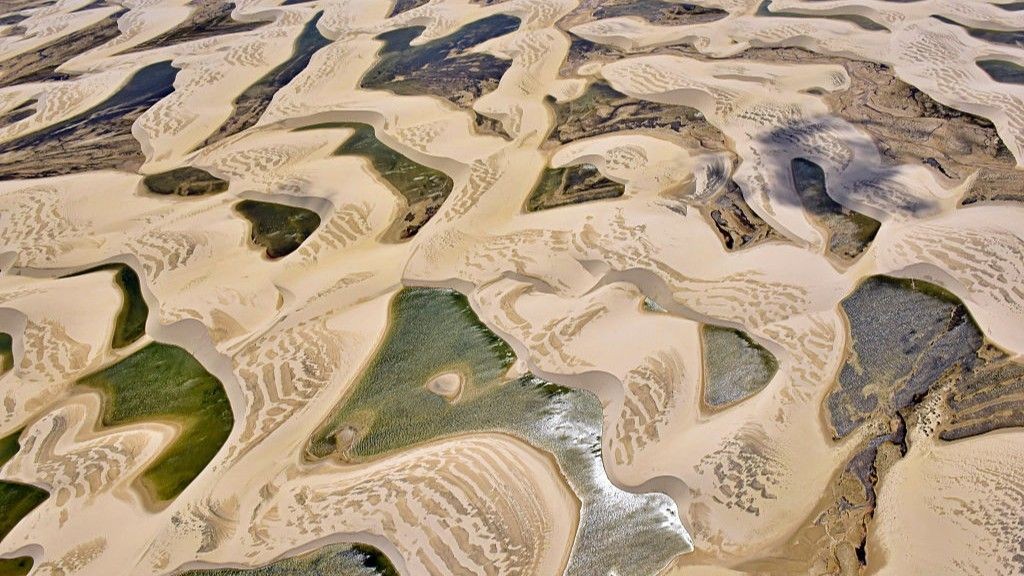
Lençóis Maranhenses National Park in Brazil is a breathtaking landscape of rolling white sand dunes punctuated by seasonal lagoons. Unlike a typical desert, this unique environment isn’t arid, but rather sits at the crossroads of three distinct biomes: the Amazon rainforest, the Cerrado savanna, and the Caatinga scrubland. This unusual position is what gives the park its extraordinary character.
The Miracle of the Lagoons
The park’s most striking feature is its temporary lagoons. Every year, from January to June, rainwater fills the natural depressions between the dunes. An impermeable sediment layer prevents drainage, creating freshwater pools that vary in size, shape, and color. This creates a surreal oasis-like effect that draws tourists from around the globe. UNESCO recognized this uniqueness in 2024, designating Lençóis Maranhenses a World Heritage Site.
A Biogeographical Crossroads
The park covers roughly 580 square miles (1,500 square kilometers). Two-thirds of this area is dominated by the sand dunes, sculpted by wind and tide. The remaining third harbors mangrove swamps and rich vegetation, providing habitat for rare species like the neotropical otter, West Indian manatee, scarlet ibis, and the oncilla—a small spotted cat.
This location matters because it highlights the complexity of ecosystems. The Cerrado, one of the world’s most important carbon sinks, borders the park. The Caatinga, a drought-resistant scrubland named “white forest” in the Tupi language, also lies nearby. Lençóis Maranhenses is not part of either of these, but instead acts as a transitional zone, demonstrating how ecosystems don’t always fit neatly into defined boundaries.
How the Dunes Form
The dunes themselves are shaped by a constant cycle of deposition and erosion. Tides deposit sand onto the coastal plain, which is then carried inland by winds. The dunes nearest the beach are smaller, only around 3 feet high, while those farther inland can reach 100 feet, growing taller with each passing year.
The park is protected by a large buffer zone to minimize human impact. The best time to visit is between June and September when the lagoons are full. Popular spots include Lagoa da Gaivota, Lagoa Azul, and Lagoa Bonita.
Lençóis Maranhenses is a rare example of a landscape that thrives on impermanence, where lagoons appear and disappear with the seasons, and dunes shift with the wind, creating a dynamic and unforgettable natural spectacle.