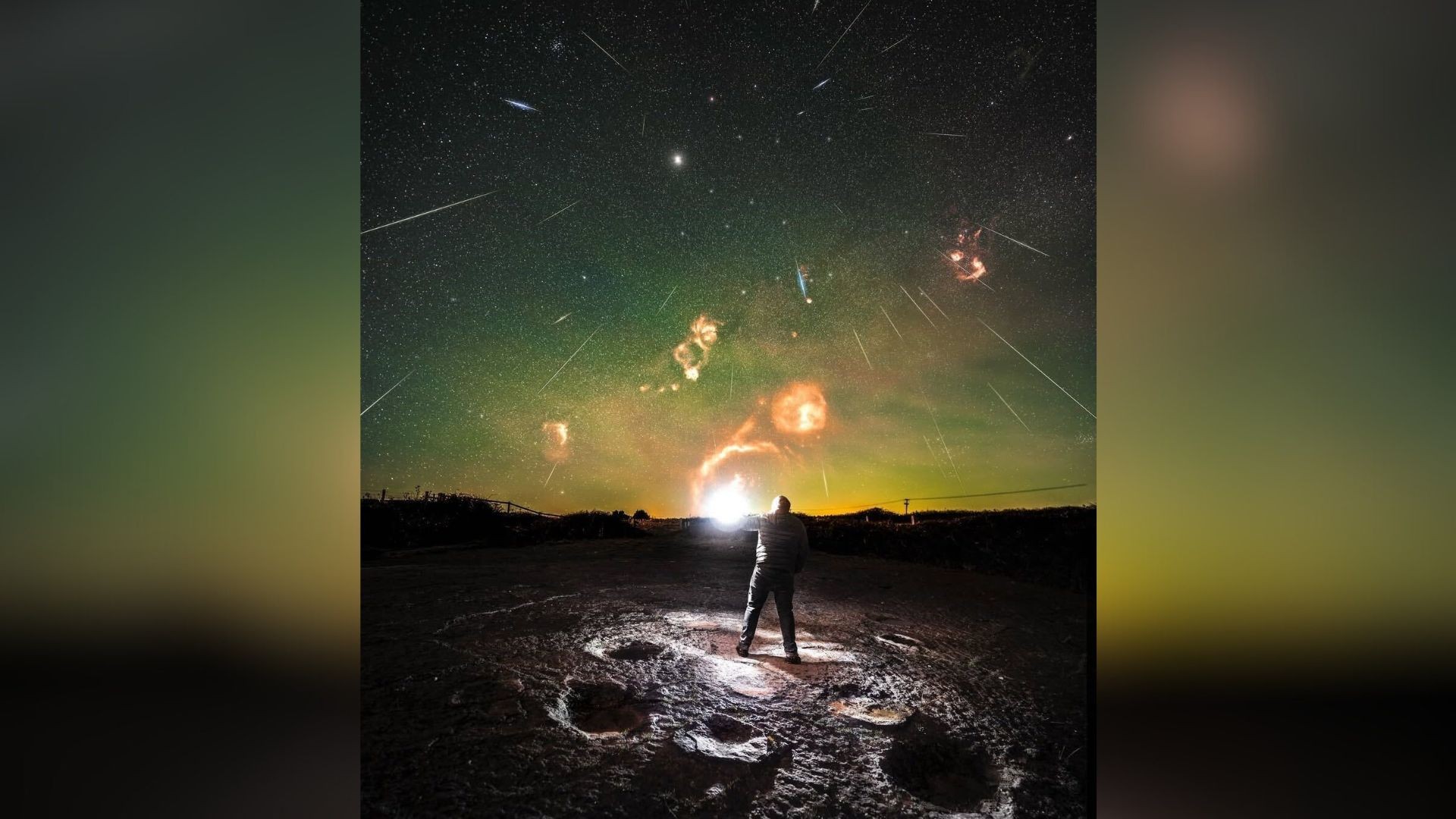
The annual Geminid meteor shower, peaking around December 13th, recently provided a spectacular celestial display. Captured by astrophotographer Josh Dury near the Yucatán Peninsula in Mexico, the image shows bright meteors streaking across a green-tinged night sky above ancient dinosaur footprints. This striking juxtaposition offers a powerful visual reminder of cosmic events that have drastically shaped life on Earth.
What Are Geminid Meteors?
These aren’t “falling stars” but tiny particles – often no larger than sand grains – entering Earth’s atmosphere at incredible speeds, burning up in brilliant flashes of light. The Geminids appear to radiate from the constellation Gemini, near the star Castor, hence the shower’s name.
Asteroid Debris, Not Comet Dust
What makes the Geminids unique is their source: not a comet, but an asteroid. Specifically, 3200 Phaethon, which exhibits comet-like behavior. This is unusual because most meteor showers originate from cometary debris trails.
A Cosmic Connection to Extinction?
Dury intentionally chose this location – over fossilized dinosaur tracks – to evoke the catastrophic impact of the Chicxulub asteroid, which triggered a mass extinction event roughly 66 million years ago. As Dury described, the meteor shower served as a visual metaphor for this ancient planetary collision.
“The narrative of asteroid fragments raining down conjured the image for me of the extinction of the dinosaurs when the Chicxulub asteroid impacted with the Earth.”
The image powerfully illustrates how seemingly harmless space debris can be linked to some of the most dramatic events in Earth’s history. The Geminids are a beautiful, annual reminder of our planet’s vulnerability to cosmic forces.