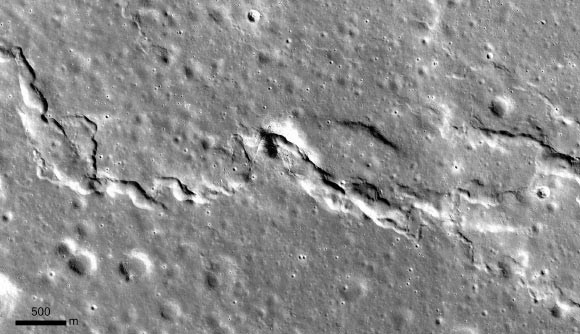
Recent research confirms that the Moon is geologically active, shrinking and reshaping its surface even today. Planetary scientists have cataloged thousands of small mare ridges (SMRs) across the lunar maria, suggesting ongoing tectonic forces that will impact future space exploration. The discovery reveals a Moon far more dynamic than previously assumed.
Lunar Tectonics: A Global Picture
Unlike Earth’s plate tectonics, the Moon doesn’t have shifting plates. Instead, its crust experiences internal stresses that create unique landforms. The most visible are lobate scarps, steep cliffs formed by the Moon contracting and pushing up the surface. These features, concentrated in the lunar highlands, have formed within the last billion years – a relatively recent period in the Moon’s 4.5 billion-year history.
In 2010, Tom Watters of the Smithsonian Institution confirmed that the Moon is slowly shrinking. This contraction explains the lobate scarps, but doesn’t fully account for all recent geological changes. That’s where the SMRs come in.
Small Mare Ridges: The New Evidence
SMRs are similar to lobate scarps in that they’re caused by the same contractional forces, but they are found exclusively in the lunar maria – the dark, basaltic plains. The new research provides the first comprehensive catalog of these features, identifying 1,114 new segments and bringing the total number of known SMRs to 2,634.
The key finding is that SMRs are geologically young, averaging around 124 million years old, roughly the same age as the lobate scarps (105 million years old). This means both formations are among the youngest structures on the Moon, indicating sustained tectonic activity well into the recent past.
Connecting the Dots: A Shrinking Moon
Researchers have observed that lobate scarps in the highlands often transition into SMRs as they extend into the maria. This suggests a common origin for both structures, driven by the Moon’s continued contraction.
“Our detection of young, small ridges in the maria… completes a global picture of a dynamic, contracting Moon,” says Dr. Watters, underscoring the importance of the discovery.
The combined data from lobate scarps and SMRs paints a clear picture: the Moon isn’t a dead world. It continues to reshape itself, potentially generating moonquakes and presenting unique challenges for long-term lunar settlements. The ongoing contraction also provides valuable insights into the Moon’s thermal and seismic history.
The research, published in the Planetary Science Journal, provides a more complete understanding of the Moon’s dynamic state, and will shape how future missions are planned and executed.