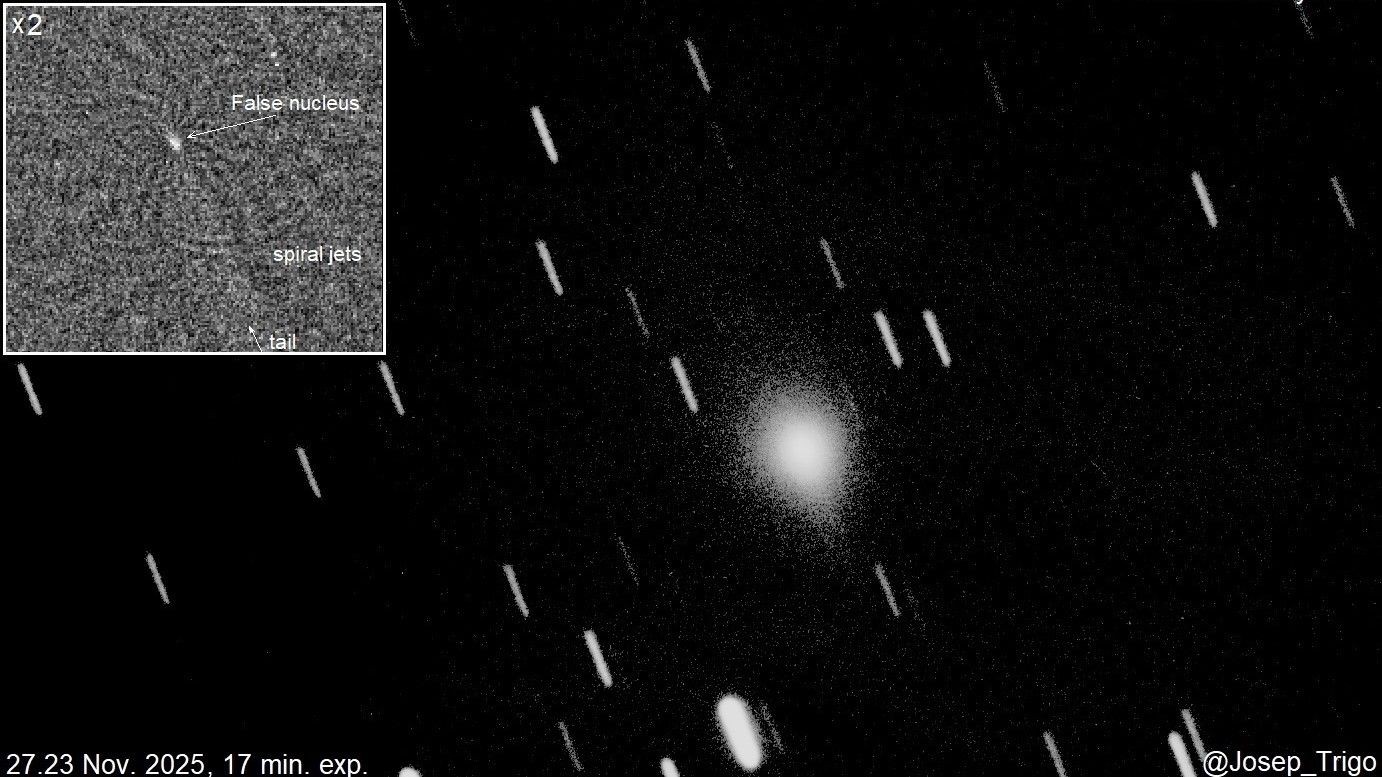
The United Nations’ International Asteroid Warning Network (IAWN) is conducting an intensive observation campaign on interstellar comet 3I/ATLAS as it approaches Earth, with its closest point on December 19. This isn’t just about tracking a comet; it’s a critical test of our ability to monitor and predict the behavior of objects from beyond our solar system—a capability that will be essential as space exploration and planetary defense efforts expand.
Why This Matters
The IAWN, coordinated by NASA, consists of over 80 observatories and citizen scientists worldwide, making it the most comprehensive network for near-Earth object (NEO) tracking. This campaign is the first to focus on an interstellar object since the network’s campaigns began in 2017. The goal is to refine techniques for precisely measuring the positions of comets and asteroids—a skill vital not just for scientific understanding, but for assessing and mitigating potential impact risks.
Refining Astrometry
The core of the IAWN’s work is astrometry, the precise measurement of celestial object positions. The current campaign with 3I/ATLAS allows investigators to test new astrometric methods. This includes refining how to track objects with variable brightness and activity, such as cometary comas that can distort apparent size and location. The improved techniques will be crucial for future missions, like potentially sending spacecraft to intercept similar interstellar visitors.
A ‘Comet’s Comet’
3I/ATLAS presents a unique opportunity because, despite its interstellar origin, it behaves remarkably like a typical solar system comet. It contains water and carbon dioxide, exhibiting the same sublimation patterns as comets born within our own star’s gravitational influence. This makes it an ideal subject for calibration and validation of tracking algorithms.
Community Involvement
The campaign has drawn record participation—171 organizations and citizen scientists joined the kickoff in October. The collaborative effort demonstrates growing public and scientific interest in planetary defense, with the IAWN actively fielding questions and providing guidance on observation protocols.
“We want the community to use the latest and greatest techniques,” said James Bauer, principal investigator at IAWN.
Looking Ahead
The findings from the 3I/ATLAS campaign will be published in a peer-reviewed journal next year. The data will refine our ability to detect, track, and potentially deflect dangerous NEOs, including asteroids and comets from interstellar space. The lessons learned will enhance our preparedness for future close encounters, ensuring that we remain vigilant in protecting Earth from celestial threats.
This campaign underscores the importance of international cooperation and continuous refinement of our planetary defense infrastructure. The more we understand about how objects move through space, the better equipped we will be to safeguard our planet.