





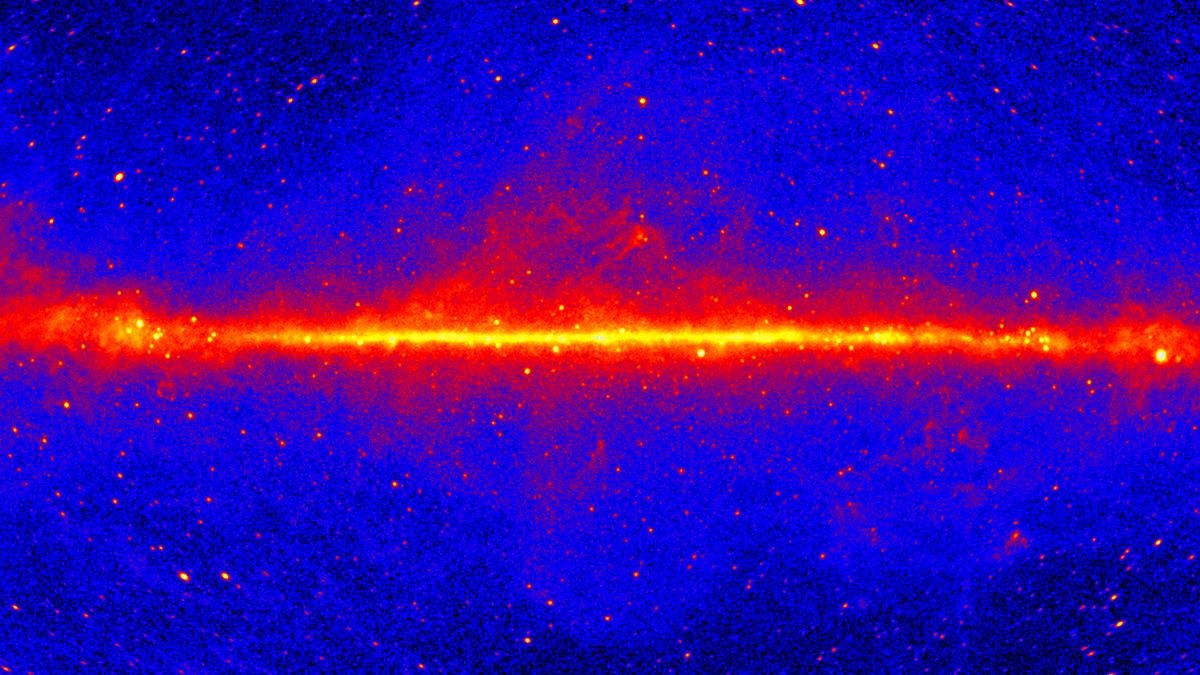
Astronomers may have detected the elusive presence of dark matter through a never-before-seen glow of high-energy gamma rays in the halo surrounding our galaxy. After analyzing 15 years of data from the Fermi Gamma-Ray Space Telescope, researchers identified an unusual emission that cannot be easily explained by conventional sources. This discovery, if confirmed, could mark the first time humanity has directly “seen” dark matter—a substance that makes up roughly 84% of the universe’s matter yet remains fundamentally unknown.
The Mystery of Dark Matter
For decades, scientists have known that visible matter accounts for only about 16% of the universe’s mass. The remaining 84% is attributed to dark matter, which reveals itself through gravitational effects but does not interact with light. One leading theory suggests that dark matter consists of Weakly Interacting Massive Particles (WIMPs). When these particles collide with their antimatter counterparts, they should annihilate, releasing detectable energy in the form of gamma rays.
A Faint Halo Glow
The newly observed glow appears as a spherical halo of gamma-ray emissions peaking at 20 billion electronvolts—an energy level consistent with theoretical predictions for WIMP annihilation. The signal originates from the galactic halo, the vast region of gas and radiation enveloping the Milky Way. Unlike the crowded galactic center, which is filled with known gamma-ray sources like pulsars, the halo offers a relatively clean environment for detecting faint signals.
Why This Matters
Detecting dark matter is a monumental challenge. Its interaction with ordinary matter is so weak that it remains invisible to direct detection experiments. The galactic halo, previously under-explored in this search, offers a unique advantage: its relative clarity reduces noise and allows for more accurate measurements. By comparing the new gamma-ray map with known emission sources, researchers isolated a residual signal that closely matches the expected shape of a dark matter halo.
Next Steps and Caveats
While promising, this discovery is not definitive. The signal is faint, and other astrophysical processes could potentially mimic dark matter annihilation. Independent verification, additional analyses, and searches in other environments—such as dwarf galaxies—are crucial to confirm the finding. If validated, this would not only represent a breakthrough in astronomy but also necessitate revisions to the standard model of particle physics, as dark matter would be a previously unknown particle.
In conclusion, the observed gamma-ray glow in the Milky Way’s halo is a tantalizing hint of dark matter’s existence. Further research is needed to confirm this signal, but it represents an exciting step toward resolving one of the universe’s most enduring mysteries.