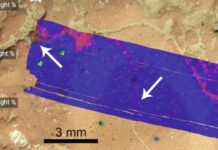
Recent findings from NASA’s Perseverance rover indicate that an ancient region of Mars, once submerged in water, possessed chemical conditions potentially suitable for life. The discovery of unusually high concentrations of nickel in the bedrock of Neretva Vallis, a dried-up channel feeding into Jezero Crater, adds weight to the growing evidence that the red planet may have once been habitable.
Why Nickel Matters on Mars
Nickel is rarely abundant on planetary surfaces; most of it sinks into the core during formation. Its presence in high concentrations suggests the rocks in Neretva Vallis underwent unique geological processes. The researchers, led by Henry Manelski of Purdue University, found nickel levels reaching 1.1% in over a third of the rocks studied – far beyond typical Martian surface concentrations.
This isn’t just about the element itself. Nickel-rich iron sulfides are common in Earth’s ancient, oxygen-poor environments, where microbial life thrived. The presence of this combination on Mars suggests similar conditions may have existed there. The finding is significant because it points to an environment where life could have potentially emerged or survived.
Ancient Water’s Role in Nickel Distribution
The rocks in Neretva Vallis show clear signs of being shaped by flowing water, which likely dissolved and redistributed the nickel. While the metal could have originated from meteorite impacts, its association with iron sulfides suggests it formed in a reducing (oxygen-poor) environment.
This aligns with what we know about early Earth: life around 3.5 to 4 billion years ago was dominated by microbes that didn’t need oxygen. The same age range applies to the rocks in Jezero Crater, raising the possibility that Mars might have supported similar life forms.
Organic Compounds and Bioavailability
The Perseverance rover also detected organic compounds in the same rocks, molecules containing carbon – a building block of all known life. While carbon can form without biological activity, its presence alongside nickel and iron sulfides strengthens the case for a potentially habitable environment.
Nickel is essential for many organisms on Earth, including microbes, and the concentrations found on Mars suggest it was available for use. The researchers don’t claim life was there, but the ingredients were certainly present.
Implications for Future Exploration
The discovery raises questions about the timing of Martian habitability. The rocks in Neretva Vallis may be younger than other parts of Jezero Crater, meaning that life-supporting conditions might have persisted later in Mars’ history than previously thought.
“Our finding of a seemingly habitable environment for ancient microbial life implies that our search for biosignatures in ever older rocks could be somewhat misplaced,” Manelski said. “We should remain open-minded to exciting discoveries wherever our rovers explore.”
The findings underscore the importance of continued exploration and suggest that the search for evidence of past life on Mars should not be limited to the planet’s earliest geological periods. The red planet may have held onto its potential for life for longer than we previously imagined.