New data from NASA’s Perseverance rover reveals unusually high concentrations of nickel in 3-billion-year-old rocks within Mars’ Jezero crater, hinting at conditions that could have supported microbial life. The discovery, published in Nature Communications, does not confirm past life, but suggests the presence of a key element that would have been essential for early organisms if they existed on the red planet.
Jezero Crater: A Martian Time Capsule
Perseverance landed in Jezero crater in February 2021 with a mission to search for signs of ancient habitable environments and collect samples for eventual return to Earth. The crater, formed by an ancient impact, once held a lake fed by rivers – evidenced by visible delta formations and inlet channels. The rover has been systematically exploring this region, focusing on Neretva Vallis, an ancient river channel, where the nickel-rich rocks were found.
Unexpected Nickel Concentrations
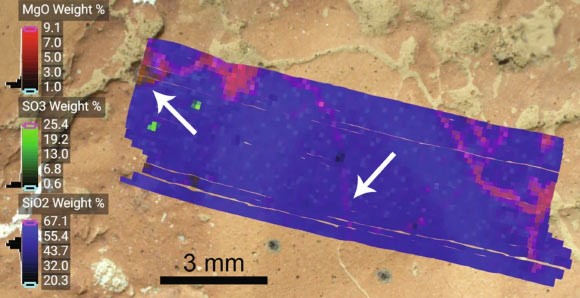
Researchers analyzed 126 sedimentary rocks and 8 rock surfaces using Perseverance’s onboard instruments. The results showed nickel concentrations up to 1.1% by weight – the highest levels detected in Martian bedrock so far. This nickel was found alongside iron sulfide compounds and sulfate minerals, forming patterns that bear striking similarities to those seen in Earth-based sedimentary rocks.
Earth Analogues: Microbial Connections
On Earth, high concentrations of nickel in iron sulfide formations are often linked to microbial activity. Some ancient archaea and bacteria require nickel for critical metabolic processes, including energy generation and organic matter decomposition. The presence of these compounds on Mars doesn’t prove the existence of life, but it suggests the building blocks were there.
What Does This Mean?
The source of the nickel remains unknown. It could come from the breakdown of igneous rocks or a meteorite impact. However, its co-occurrence with iron sulfide compounds and organic carbon (detected in previous studies) raises the possibility that microbial life could have utilized it. This finding underscores Jezero crater’s status as a prime location for seeking signs of past life on Mars.
The Perseverance rover will continue gathering samples from Neretva Vallis, with the goal of one day returning them to Earth for detailed analysis. Further investigation is needed to determine the full implications of this nickel enrichment, but this discovery significantly increases the potential that early Mars was once habitable.