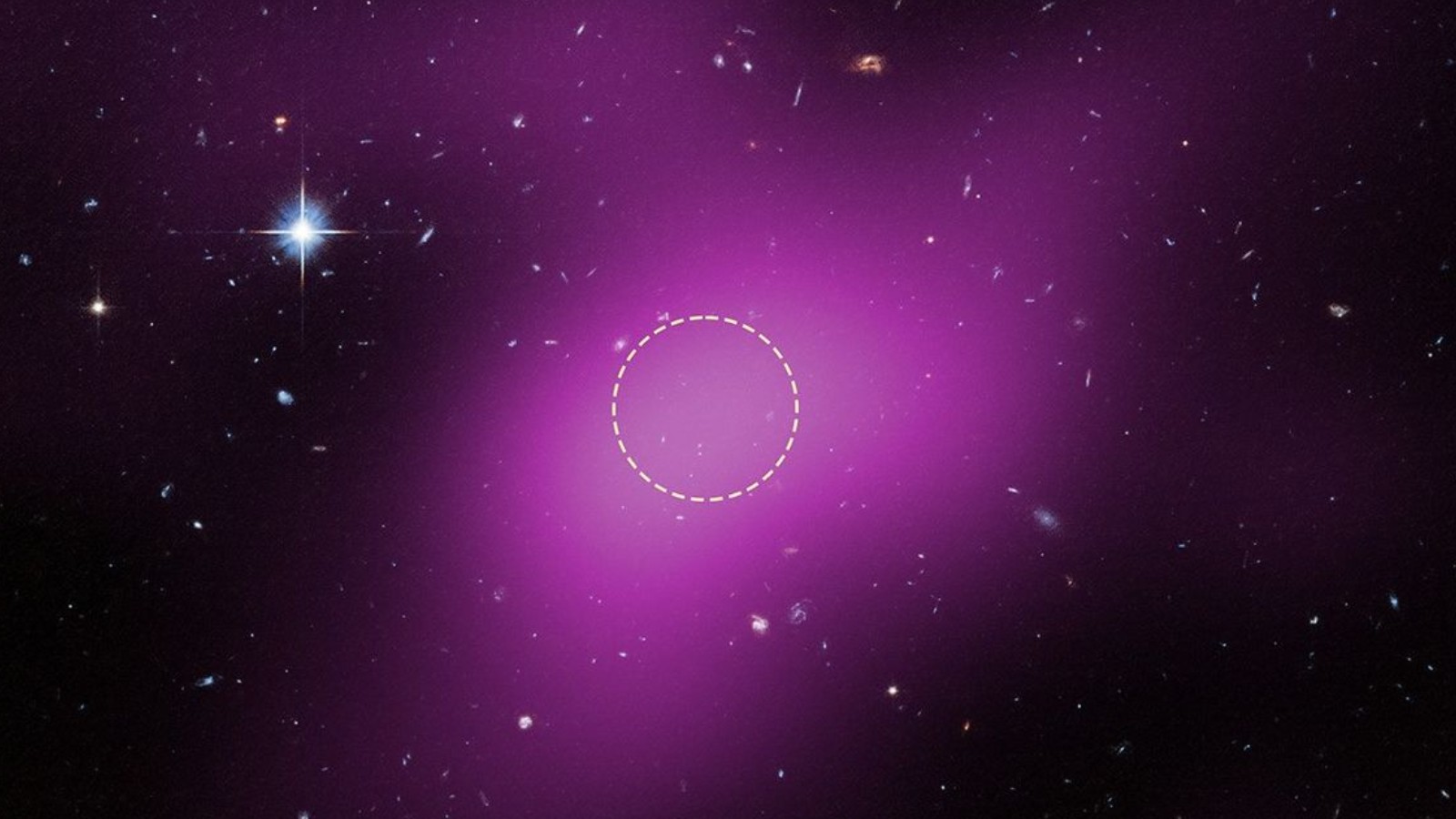
Astronomers using the Hubble Space Telescope have identified a unique cosmic structure dubbed “Cloud 9” – a massive cloud of dark matter and gas that, remarkably, contains no stars. Located approximately 14 million light-years away in the spiral galaxy Messier 94 (M94), this discovery provides a rare observational window into the elusive nature of dark matter and the processes that shaped the early universe.
Unveiling the “Dark Universe”
The significance of Cloud 9 lies in its composition. Dark matter, which makes up roughly 85% of the universe’s total mass, remains invisible because it doesn’t interact with light. Instead, scientists infer its presence through gravitational effects on visible matter. Cloud 9 is a particularly dense concentration of dark matter, estimated to contain around 5 billion times the mass of our Sun, while only containing a relatively small amount of ordinary gas. This imbalance offers a direct study opportunity for a phenomenon that is otherwise only theoretical.
“This cloud is a window into the dark universe,” explains Andrew Fox, a team member from the Association of Universities for Research in Astronomy/Space Telescope Science Institute. “We know from theory that most of the mass in the universe is expected to be dark matter, but it’s difficult to detect this dark material because it doesn’t emit light. Cloud-9 gives us a rare look at a dark-matter-dominated cloud.”
Failed Galaxy: A Window into Primordial Building Blocks
The object is classified as a Reionization-Limited Hydrogen I Cloud (RELHIC). These clouds are believed to be remnants of the early universe, where dark matter first began to clump together, forming the seeds for galaxies. In Cloud 9, hydrogen gas has begun to accumulate, but star formation has inexplicably stalled. This makes it a “failed galaxy”—a primordial building block that never fully ignited.
“This is a tale of a failed galaxy,” says team leader Alejandro Benitez-Llambay. “In science, we usually learn more from the failures than from the successes. In this case, seeing no stars is what proves the theory right.”
Implications for Future Research
The discovery suggests that similar, stalled galaxies may be more common than previously thought. Hubble’s sensitivity allowed astronomers to confirm the complete absence of stars, ruling out the possibility of a faint, previously undetected dwarf galaxy. The team believes that with enough additional gas—roughly 5 billion solar masses—Cloud 9 could eventually evolve into a fully formed galaxy. For now, it provides a unique laboratory for studying dark matter in its raw, concentrated state.
Future astronomical surveys will likely target similar structures, as the existence of RELHICs demonstrates that the early universe may contain many more such “abandoned houses” waiting to be discovered. This discovery is not just about one cloud, but about refining our understanding of how galaxies formed and what role dark matter played in the cosmos’ evolution.
This breakthrough underscores the importance of continued astronomical observation, as even “failures” in the universe can unlock fundamental truths about its origins.