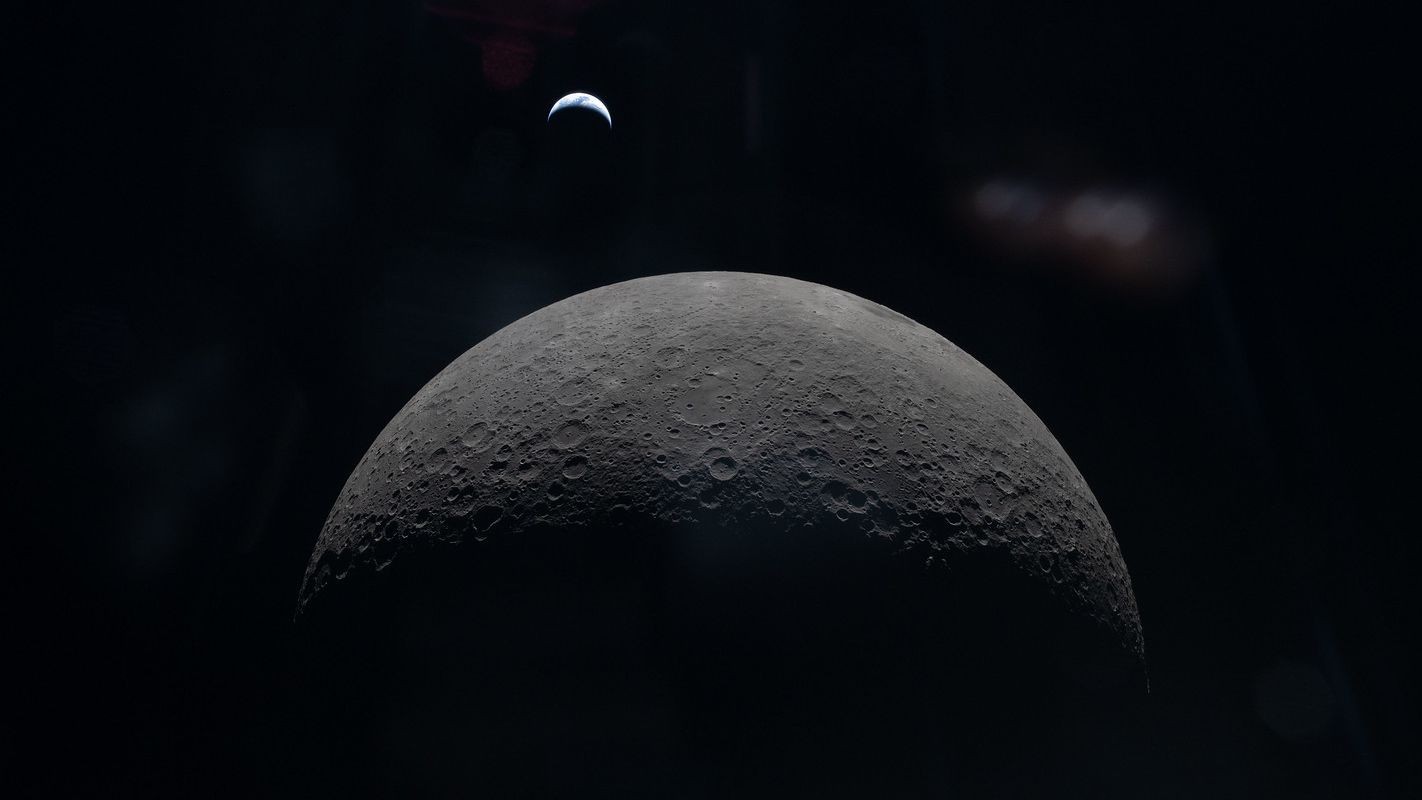
On Flight Day 6 of the Artemis 2 mission, the crew captured a striking image of a crescent Earth suspended just above the rugged edge of the Moon. Taken on April 6, the photograph depicts the moment just before our planet dipped below the lunar horizon, offering a rare perspective of Earth from the far side of the Moon.
The View from the Orion “Integrity”
The image provides a dramatic contrast between two worlds. In the upper arc, the sunlit portion of Earth reveals swirling white cloud patterns against the dark void of space. Below this celestial arc lies the Moon’s cratered surface, characterized by its stark, shadowed landscape.
Several key lunar landmarks are visible in the shot:
– The Orientale Basin: A massive impact structure, roughly 590 miles (950 km) wide, visible in the darkening upper right section of the lunar crescent.
– Major Impact Sites: The shadowed far side of the Moon is dominated by prominent craters, including Chebyshev, Vavilov, and Hertzsprung.
Breaking Records and Making History
The Artemis 2 mission is not merely a photographic success; it represents a monumental leap in human space exploration. As the crew—Reid Wiseman, Victor Glover, Christina Koch, and Jeremy Hansen —executed their flyby of the lunar far side, they achieved several historic milestones:
- The Return to Lunar Space: This mission marks the first time humans have traveled to the vicinity of the Moon since the Apollo 17 mission concluded in 1972.
- Deep Space Records: The crew has officially set a new record for the most distant crewed mission in history, surpassing the distance reached by the Apollo 13 crew in April 1970.
- Expanding Representation: Before this mission, only 24 humans had ever seen the far side of the Moon. Artemis 2 has increased that number to 28 and broken long-standing barriers: Christina Koch is the first woman to view the lunar far side, and Victor Glover is the first Black man to do so.
Why This Perspective Matters
This image is more than just a beautiful photograph; it is a profound reminder of our place in the universe. Aside from the four astronauts aboard the Orion spacecraft, every human being who has ever lived is contained within the tiny, glowing arc of the Earth visible in the frame.
The ability to capture and transmit such imagery from the lunar far side demonstrates the advanced communication and navigation capabilities required for modern deep-space exploration, paving the way for future long-term lunar habitation.
The Artemis 2 mission has transitioned from a feat of engineering to a historic milestone in human representation and deep-space endurance.
The Journey Home
As of this report, the Orion spacecraft is currently on its return trajectory toward Earth. The crew is scheduled to splash down off the coast of San Diego at 8:07 p.m. EDT on April 10, marking the successful conclusion of a mission that has redefined the boundaries of crewed spaceflight.
The Artemis 2 mission successfully bridges the half-century gap in lunar exploration, setting new records for distance and inclusivity while providing a renewed perspective on our home planet.