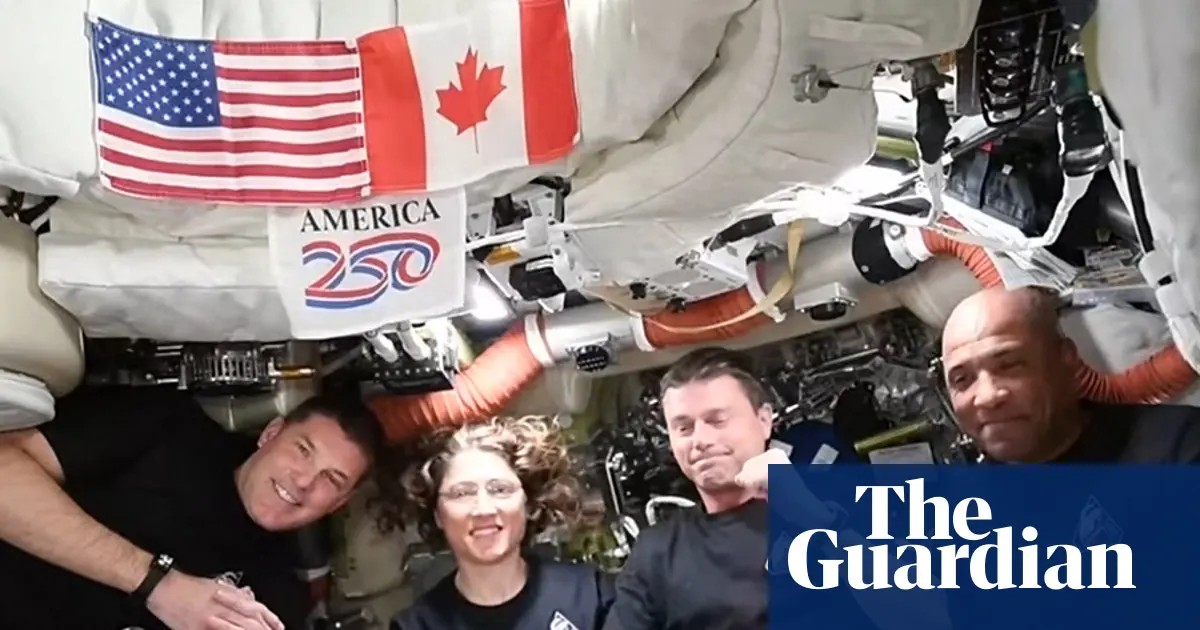
In a historic moment for space exploration, the crew of the Artemis II mission—the first humans to travel beyond low Earth orbit in over half a century—received a call from President Donald Trump while orbiting the moon. However, the 12-minute communication was marked by a striking tension between the President’s celebratory rhetoric and his administration’s aggressive fiscal policies toward the agency.
A Call from Earth to the Moon
Facilitated by NASA Administrator Jared Isaacman, the call connected the President to the four astronauts following their record-breaking journey. While the President praised the crew for their “incredible journey into the stars” and their role in inspiring the world, the conversation took an unexpected turn when Trump discussed his history with the agency.
During the call, Trump claimed that during his first term, he faced a pivotal decision regarding NASA’s future: whether to “revive” it or “close it down.” He asserted that he chose to save the agency, stating, “We’ve spent what we had to do.”
The exchange was characterized by several notable moments:
– Awkward Silences: Long pauses punctuated the call, requiring Isaacman to intervene for “comms checks.”
– Personal Anecdotes: The President frequently diverted the conversation to discuss his friendship with Canadian hockey legend Wayne Gretzky and his connections with Canadian leadership.
– Diplomatic Exchanges: Canadian astronaut Jeremy Hansen praised the U.S. for its leadership in allowing international partners to share in space exploration goals.
The Budget Paradox: Rhetoric vs. Reality
The President’s claim that he “saved” NASA stands in stark contrast to the actual budgetary battles currently unfolding in Washington. While the Trump administration has prioritized human spaceflight programs like Artemis, it has simultaneously moved to drastically reduce NASA’s overall funding.
This creates a significant friction point for the agency:
1. The 2025 Proposal: Early in his second term, the White House proposed a 24% cut to the NASA budget, aiming for $18.8 billion—the lowest level in a decade.
2. Congressional Pushback: In a rare bipartisan move, Congress rejected these cuts in January, passing a nearly fully funded $24.4 billion budget.
3. The 2027 Request: Despite the congressional victory, Trump recently unveiled a new budget request for 2027 that includes another 23% reduction.
Why this matters: While the Artemis program enjoys political visibility, the proposed deep cuts target NASA’s broader science programs. Experts have warned that these “extinction-level” reductions could cripple the agency’s long-term research capabilities and scientific infrastructure.
Navigating the Political Divide
The tension between mission success and political maneuvering is palpable within the agency. Jared Isaacman, acting as a bridge between the White House and NASA, defended the President’s fiscal policies as a mandate for “efficiency.” However, he also issued a clear directive to NASA staff: “Leave the politics for the politicians and remain focused on the mission.”
Despite the political friction, the astronauts remained professional. Commander Reid Wiseman and Pilot Victor Glover expressed gratitude for the call, with Glover noting that the mission was an “honor of a lifetime” made possible by both the American and Canadian people.
Conclusion
The Artemis II mission represents a triumph of human engineering and international cooperation, yet it takes place against a backdrop of intense domestic political conflict. As the crew prepares for their splashdown, the future of NASA remains caught between high-profile lunar ambitions and significant threats to its foundational science budget.