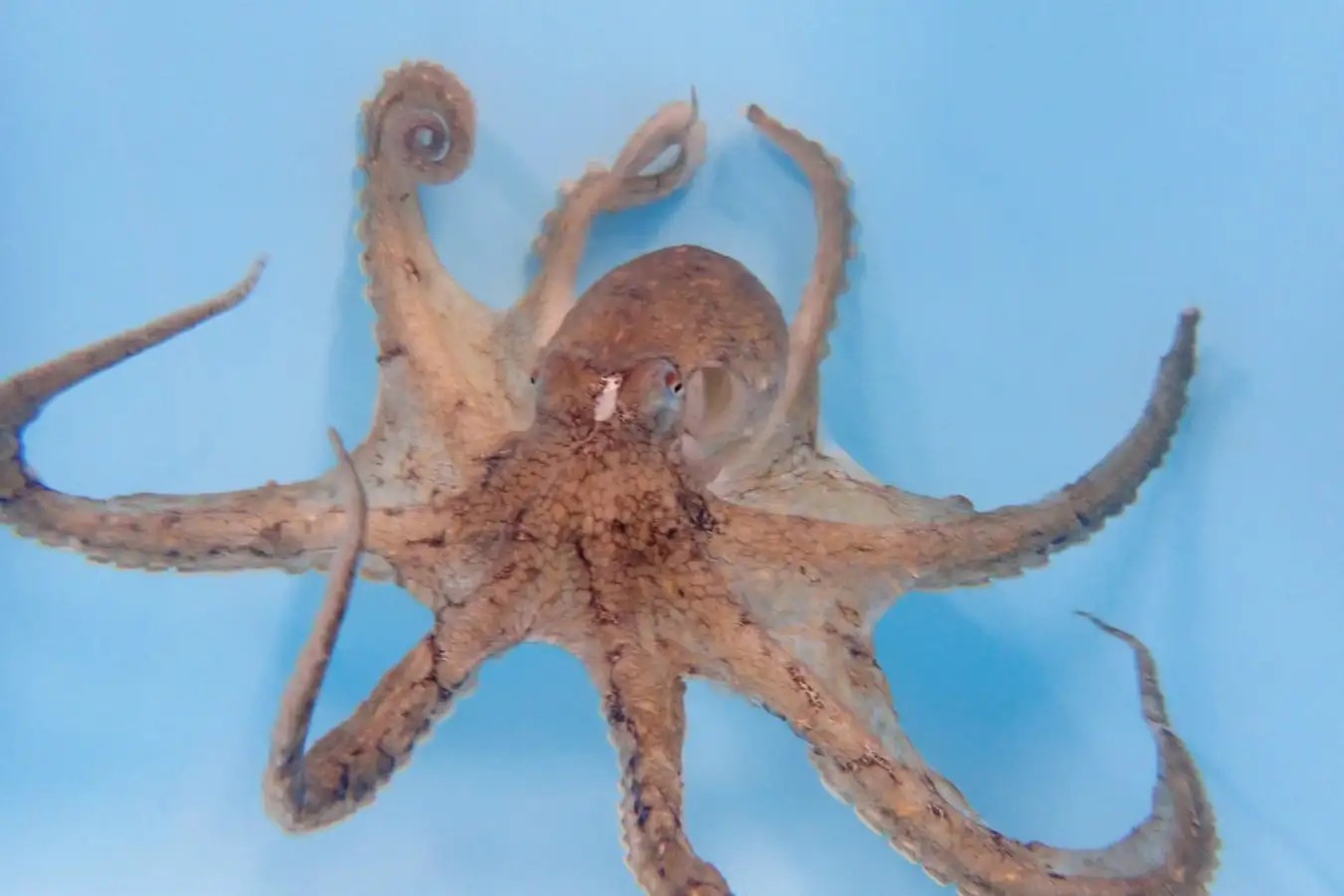
Male octopuses prioritize one arm above all others – their third right arm, known as the hectocotylus. This appendage is crucial for reproduction, and the animals actively defend it, suggesting a surprisingly strong instinct to protect their reproductive capacity. A recent study from Nagasaki University, Japan, confirms this behavior: male octopuses will aggressively resist even gentle touch on this specific arm, unlike other limbs.
The Specialized Hectocotylus
The hectocotylus is anatomically distinct from the octopus’s other seven arms. It’s not used for general movement or feeding; instead, it functions as a delivery system for sperm. Male octopuses possess a single testis where sperm are produced and packaged into spermatophores. During mating, the hectocotylus inserts into the female’s mantle, delivering these packages through a tiny penis that cannot reach the female independently.
The unique anatomy requires the male to curl the hectocotylus into a tube-like structure, then forcefully eject water through it to propel the spermatophore into the female. This process highlights the arm’s irreplaceable role.
Empirical Evidence of Protection
Researchers collected 32 male and 41 female Japanese pygmy octopuses to study this behavior. The findings were striking: only one male octopus had lost its hectocotylus, while 13 females had. Further experiments confirmed the males’ protective tendencies. When presented with an unfamiliar object (a lead sinker), females explored it more readily with their hectocotylus, whereas males cautiously probed with their other seven arms before risking their specialized appendage.
Evolutionary Trade-Off
The reason for this extreme protection is likely an evolutionary trade-off. As Keijiro Haruki, the study’s lead author, points out, specializing a single arm for reproduction and then defending it is more efficient than evolving a larger, more vulnerable penis. Losing the hectocotylus effectively ends a male octopus’s breeding life until it regrows – a process that can take months.
The study reinforces the idea that sexual selection can drive highly specific and even obsessive behaviors in animals. Octopuses clearly demonstrate that protecting reproductive tools is a fundamental survival strategy.
This behavior underscores how strongly octopuses prioritize reproduction, and the lengths they will go to ensure their ability to mate remains intact. The fact that males almost never lose this critical arm suggests that protecting it is not just a possibility, but an instinctual imperative.