




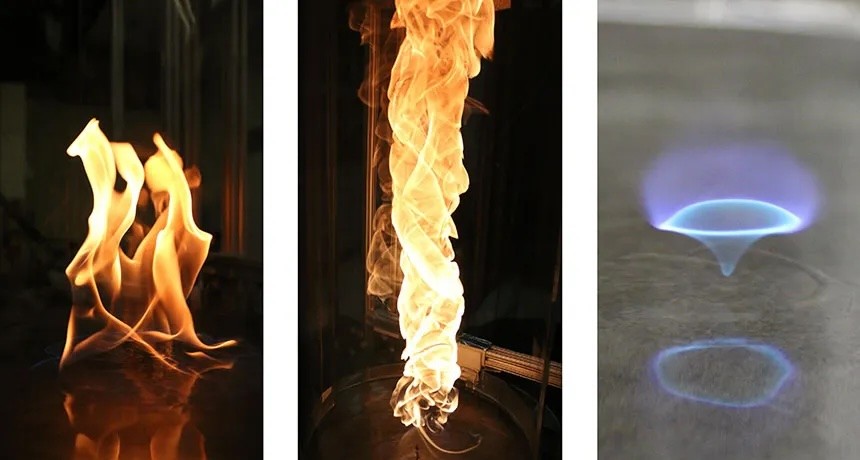
A recently discovered combustion phenomenon called the “blue whirl” is challenging our understanding of how fires behave. Unlike traditional wildfires and combustion events, these whirls burn hotter, cleaner, and more efficiently. Their discovery has implications for both controlled burns and accidental fires, potentially reshaping safety protocols and firefighting strategies.
What are Blue Whirls?
Blue whirls are intense, self-sustaining vortices of fire. They form when liquid fuels—such as oil, gasoline, or even melted plastic—vaporize rapidly and ignite. This creates a rotating column of flame that burns with an unusual blue hue, hence the name. The key difference from conventional wildfires is the vortex’s structure: it draws in surrounding fuel, continuously feeding itself and maintaining a stable, highly efficient burn.
Key characteristics:
- Higher temperatures: Blue whirls can reach significantly higher temperatures than typical fires, leading to faster and more complete combustion.
- Cleaner burns: The vortex concentrates the heat, promoting near-complete fuel consumption and reducing smoke and soot production.
- Stability: Once formed, a blue whirl can persist for extended periods, making it more predictable than erratic wildfires.
- Formation conditions: Blue whirls require a specific combination of liquid fuel, sufficient heat, and airflow.
How Do They Form?
Blue whirls form when a pool of liquid fuel is heated to the point of vaporization. The rising vapors ignite, creating a small flame. If conditions are right—specifically, a stable airflow and a sufficient fuel supply—the flame can organize into a swirling vortex. This vortex acts like a self-feeding engine, drawing in fresh fuel from the surrounding pool, mixing it with oxygen, and burning it efficiently.
The process can be broken down into three stages:
- Ignition: Fuel is heated to its flash point, initiating combustion.
- Vortex formation: Airflow causes the flame to rotate, creating a vortex.
- Self-sustenance: The vortex draws in fuel, maintaining a stable, high-efficiency burn.
Implications and Applications
The discovery of blue whirls has several potential implications:
- Improved controlled burns: Controlled burns are used in forestry and land management to clear underbrush and reduce wildfire risk. Blue whirls could make these burns more efficient and produce less smoke.
- Enhanced firefighting: Understanding how blue whirls form and behave could lead to better firefighting strategies. For example, suppressing the fuel supply or disrupting airflow might extinguish them more effectively.
- New combustion technologies: The high efficiency of blue whirls could inspire new designs for engines and industrial burners, reducing fuel consumption and emissions.
However, the phenomenon also presents challenges:
- Unpredictability: While stable once formed, the initial conditions that trigger a blue whirl can be difficult to predict.
- Fuel dependency: The intensity of a blue whirl depends heavily on the type and amount of liquid fuel present.
- Safety concerns: The high temperatures and rapid combustion rates pose significant safety risks.
“Blue whirls represent a fundamental shift in our understanding of combustion. By harnessing their efficiency, we can revolutionize fire management and energy production.”
In conclusion, blue whirls are a novel combustion phenomenon with far-reaching implications. As research continues, these whirling flames may reshape how we approach fire safety, land management, and energy efficiency.