
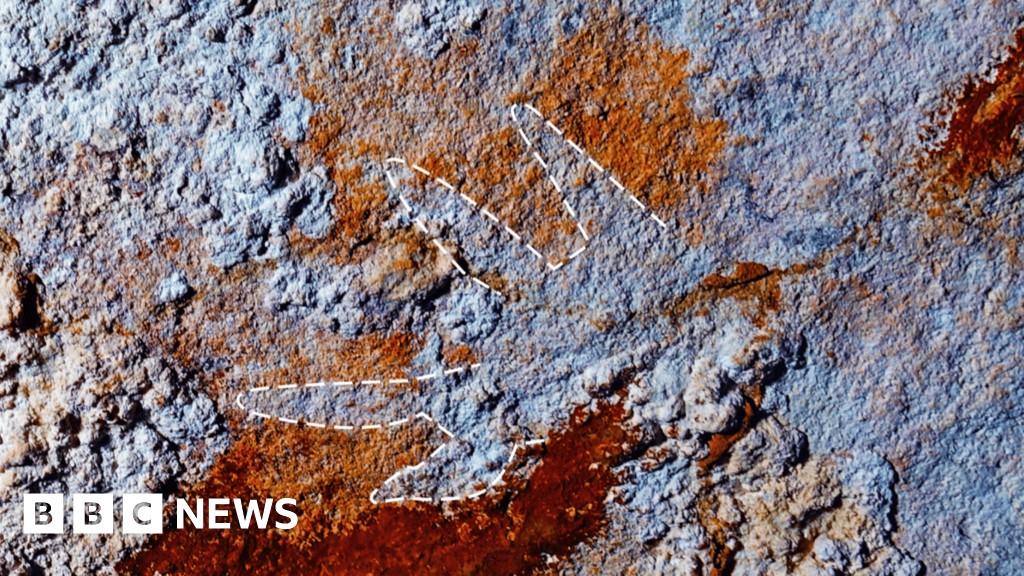
A newly discovered cave painting in Indonesia is challenging long-held beliefs about the timeline of human creativity. Researchers have dated a stenciled handprint on the island of Sulawesi to at least 67,800 years ago, making it the oldest known example of cave art in the world – over a thousand years older than previous contenders.
Rewriting the Narrative of Early Human Imagination
This finding isn’t just about age; it’s about how the art was made. The hand stencil wasn’t simply an outline, but a deliberately altered image. The artist narrowed and elongated the fingers to create a claw-like motif, suggesting an early capacity for abstract thought and symbolic representation. This level of intentional creativity is a key marker of modern human cognitive development.
For decades, many believed that the first burst of artistic expression occurred in Ice Age Europe. This theory, known as the “creative explosion,” posited that complex thought emerged suddenly in a small part of Europe before spreading elsewhere. But discoveries over the past decade, particularly in Sulawesi, have upended this idea.
Why This Matters: Beyond Europe’s Creative Monopoly
The Sulawesi finds reveal that humans were capable of symbolic thought and artistic expression much earlier, and in regions far outside Europe. This challenges the Eurocentric view of human intellectual history. The discovery suggests that creativity wasn’t a sudden “awakening” but rather an innate human trait that existed long before our species migrated to Europe.
Professor Adam Brumm of Griffiths University explains, “We’re seeing traits of modern human behavior in Indonesia that make the Eurocentric argument very hard to sustain.”
Implications for Early Human Migration
The dating of the Sulawesi painting also has implications for our understanding of early human migration patterns. The find supports the idea that Homo sapiens reached the Sahul landmass (ancient Australia-New Guinea) at least 15,000 years earlier than previously thought. Some archaeological evidence suggests human presence in Australia as early as 65,000 years ago, and the Sulawesi art strengthens the plausibility of these claims.
A Legacy of Artistic Activity
The cave, Liang Metanduno, wasn’t just a one-time canvas. Multiple layers of paintings, some dating back 20,000 years, demonstrate that this site was used for artistic expression over at least 35,000 years. This suggests that cave art wasn’t a fleeting experiment but a deeply embedded cultural practice.
The discovery in Sulawesi reinforces the idea that humans had the capacity for complex symbolic thought long before the arrival of modern humans in Europe.
The finding in Sulawesi, alongside discoveries of symbolic artifacts in Africa dating back 70,000-100,000 years, is reshaping our understanding of human cognitive evolution. The story of creativity is no longer confined to a single continent; it’s a global narrative stretching back tens of thousands of years.