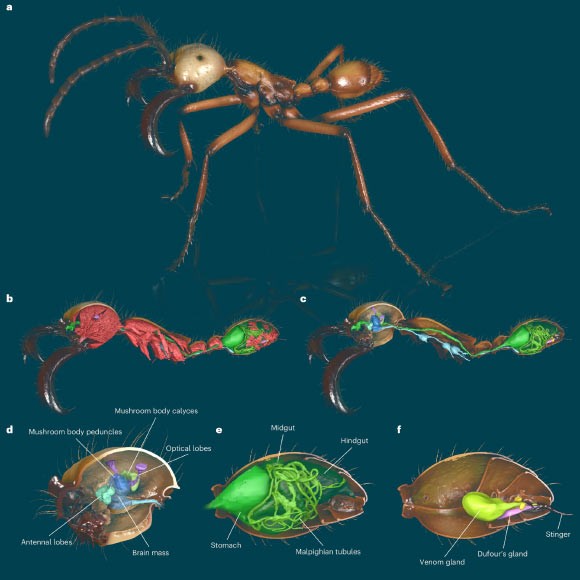
Entomologists have assembled an unprecedented digital archive of ants using cutting-edge X-ray technology and artificial intelligence. The project, dubbed Antscan, encompasses over 790 species and 212 genera, representing a significant leap forward in how we study and understand insect life.
High-Speed Scanning and 3D Reconstruction
Researchers from the Okinawa Institute of Science and Technology (OIST) collaborated with experts worldwide to collect ethanol-preserved ant specimens. These were then subjected to high-throughput X-ray micro-CT scanning at the Karlsruhe Institute of Technology (KIT) in Germany. This process, similar to medical CT scans but at much higher magnification, allowed for rapid imaging of thousands of specimens.
A synchrotron particle accelerator generated an intense X-ray beam that scanned each sample in just 30 seconds, thanks to automated robotics. The result is a collection of 2D image stacks that were then assembled into detailed 3D models. These models reveal internal structures such as muscles, digestive systems, and even stingers with micrometer-level precision.
From Contorted Poses to Lifelike Models
The initial scans produced images of specimens in unnatural positions. However, the team utilized AI to reconstruct these images into realistic, lifelike representations. This makes the models ideal for research, education, and even integration into virtual reality environments.
Why This Matters: The Future of Biodiversity Research
The scale of this project would have been impossible without advanced automation. According to Dr. Julian Katzke, the same work would have taken six years with conventional lab-based CT scanners. The team completed the scan of 2,000 specimens in just one week.
“To do this manually would have taken years, so without these computational tools it basically would never have been done,” Professor Evan Economo of OIST and the University of Maryland stated.
Antscan is not just about ants; it is a proof-of-concept for digitizing entire branches of biodiversity. The ability to create readily accessible digital libraries opens new possibilities for scientific study, educational outreach, and even entertainment applications.
The research was published in the journal Nature Methods on March 5, 2026 (DOI: 10.1038/s41592-026-03005-0). This project demonstrates the power of combining advanced imaging, robotics, and AI to accelerate biological research and make detailed data accessible to a wider audience.