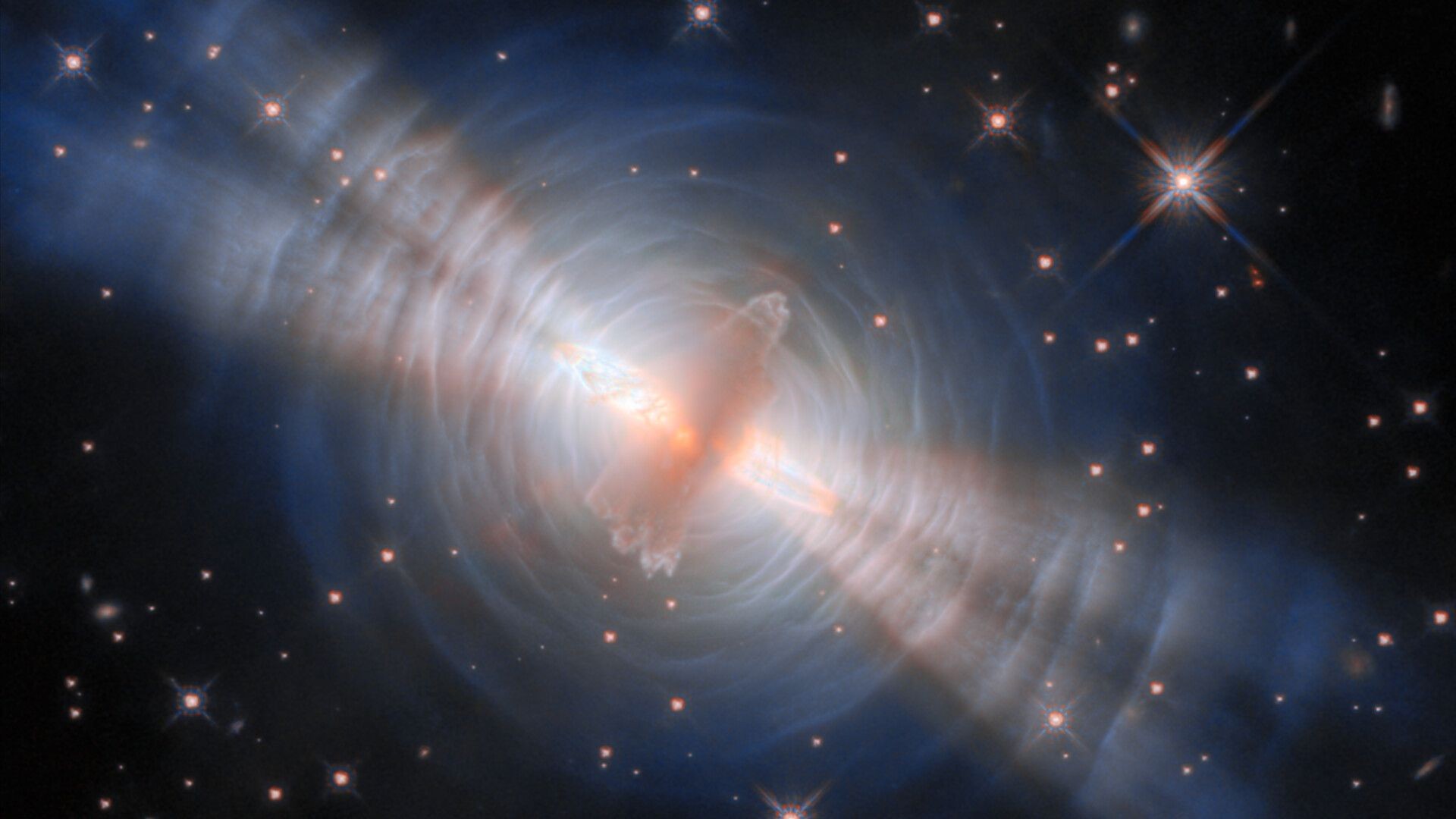
A sun-like star in its final stages of life is shedding its outer layers in a dramatic display captured by the Hubble Space Telescope. The image of the Egg Nebula, the closest known pre-planetary nebula to Earth, offers astronomers a rare look at how stars evolve when they run out of fuel.
What Are Planetary Nebulae?
Despite the name, planetary nebulas are not related to planets. Eighteenth-century astronomers coined the term because these glowing formations resembled planets through early telescopes. In reality, they’re expanding shells of gas and dust ejected by dying stars, leaving behind dense stellar remnants known as white dwarfs.
The Egg Nebula is unique because it’s one of the few pre-planetary nebulas discovered so far. This means scientists can observe a transitional phase that lasts only a few thousand years, before the nebula fully forms. Most other examples, like the Helix, Stingray, and Butterfly Nebulae, are already well-developed.
Why This Matters
Observing the Egg Nebula is critical because it shows exactly how stars like our Sun will end their lives. As a star exhausts its hydrogen and helium, it begins to shed material into space. This process isn’t violent like a supernova; instead, the star releases mass in regular pulses. The Hubble images reveal concentric arcs and symmetry, proving the star doesn’t explode chaotically but rather burps out material.
The nebula’s central star is still visible, shining through gaps in the dense disk of dust it ejected just a few hundred years ago. The light escapes through polar openings, creating twin beams that illuminate the surrounding gas and dust.
A Fleeting Phenomenon
Pre-planetary nebulas are rare because they exist for such a short time in cosmic history. Their dimness also makes them hard to find. This new image combines data from previous Hubble observations (1997, 2003, 2012) with fresh data, giving scientists the most detailed view yet of a star’s final act.
The Egg Nebula is a cosmic time-lapse, showing us the death throes of a star in real time. This is how many stars, including our own Sun, will eventually meet their end.
The observations are not just beautiful; they confirm that sun-like stars don’t die in spectacular explosions but rather fade away gracefully, shedding their outer layers before becoming white dwarfs.