In a breakthrough that touches on the very fabric of reality, an international team of physicists has captured evidence of particles emerging from seemingly empty space. This observation provides a rare, tangible look at how mass might be generated from the vacuum, potentially solving one of the most profound mysteries in modern physics.
The Mystery of the “Empty” Vacuum
To understand this discovery, one must first rethink the concept of “empty” space. According to Quantum Chromodynamics (QCD) —the theory describing the strong force that holds atomic nuclei together—a vacuum is never truly empty.
Instead, space is a restless sea of energy. It is constantly filled with virtual particles : pairs of quarks and antiquarks that flicker into existence and vanish almost instantly. Under normal circumstances, these particles are too fleeting to be detected. However, physics predicts that if enough energy is injected into this vacuum, these “ghost” particles can be promoted into real, stable particles with measurable mass.
The Experiment: Smashed Protons and Spin Alignment
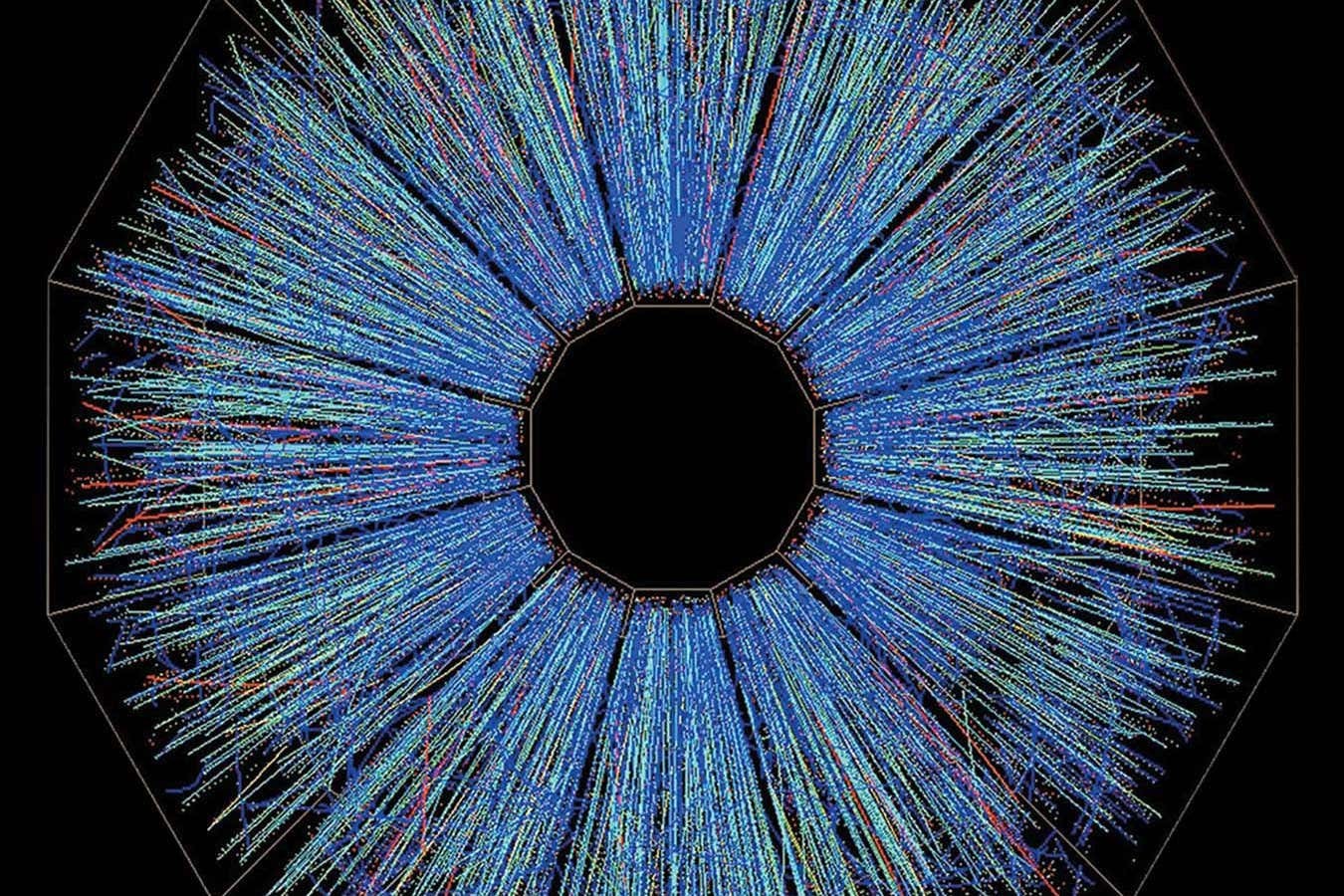
The STAR collaboration, working at the Relativistic Heavy Ion Collider (RHIC) at Brookhaven National Laboratory, successfully observed this transition during high-energy proton collisions.
The challenge in proving these particles came from the vacuum lies in the nature of quarks. Because of a phenomenon known as color confinement, quarks can never exist in isolation; they immediately bind together to form larger, composite particles.
To overcome this, researchers looked for a “quantum fingerprint”:
– When quark-antiquark pairs are pulled from the vacuum, their spins are correlated (they share a specific quantum alignment).
– Even as these quarks combine into larger particles called hyperons, they retain this shared spin alignment.
– Despite hyperons decaying in less than a tenth of a billionth of a second, the team was able to detect this persistent spin link.
By tracing this correlation, the researchers confirmed that these specific quarks did not come from the colliding protons themselves, but were pulled directly from the vacuum.
Why This Matters for Physics
This discovery is more than just a technical feat; it offers a new window into the origin of mass. While we know that particles have mass, the exact mechanism of how they acquire “heft” remains a subject of intense study.
Current theory suggests that quarks gain much of their mass through their interaction with the vacuum itself. By observing this process in real-time, scientists may finally be able to study the vacuum’s properties directly and understand the fundamental relationship between energy, space, and matter.
“This is the first time we’ve seen the entire process,” says Zhoudunming Tu, a member of the STAR collaboration.
The Road Ahead
While the results are groundbreaking, the scientific community remains cautiously optimistic. Experts note that reconstructing events from high-speed particle collisions is incredibly complex. Future research will focus on:
– Refining data reconstruction to ensure no other physical processes could mimic this signal.
– Exhaustively excluding alternative theories to confirm the vacuum origin beyond doubt.
– Exploring the “why” behind quark confinement—the reason these particles can never exist alone.
Conclusion
By successfully detecting particles born from the vacuum, physicists have moved one step closer to understanding how the universe generates mass from empty space. This milestone opens a new frontier in studying the fundamental energy that permeates our cosmos.