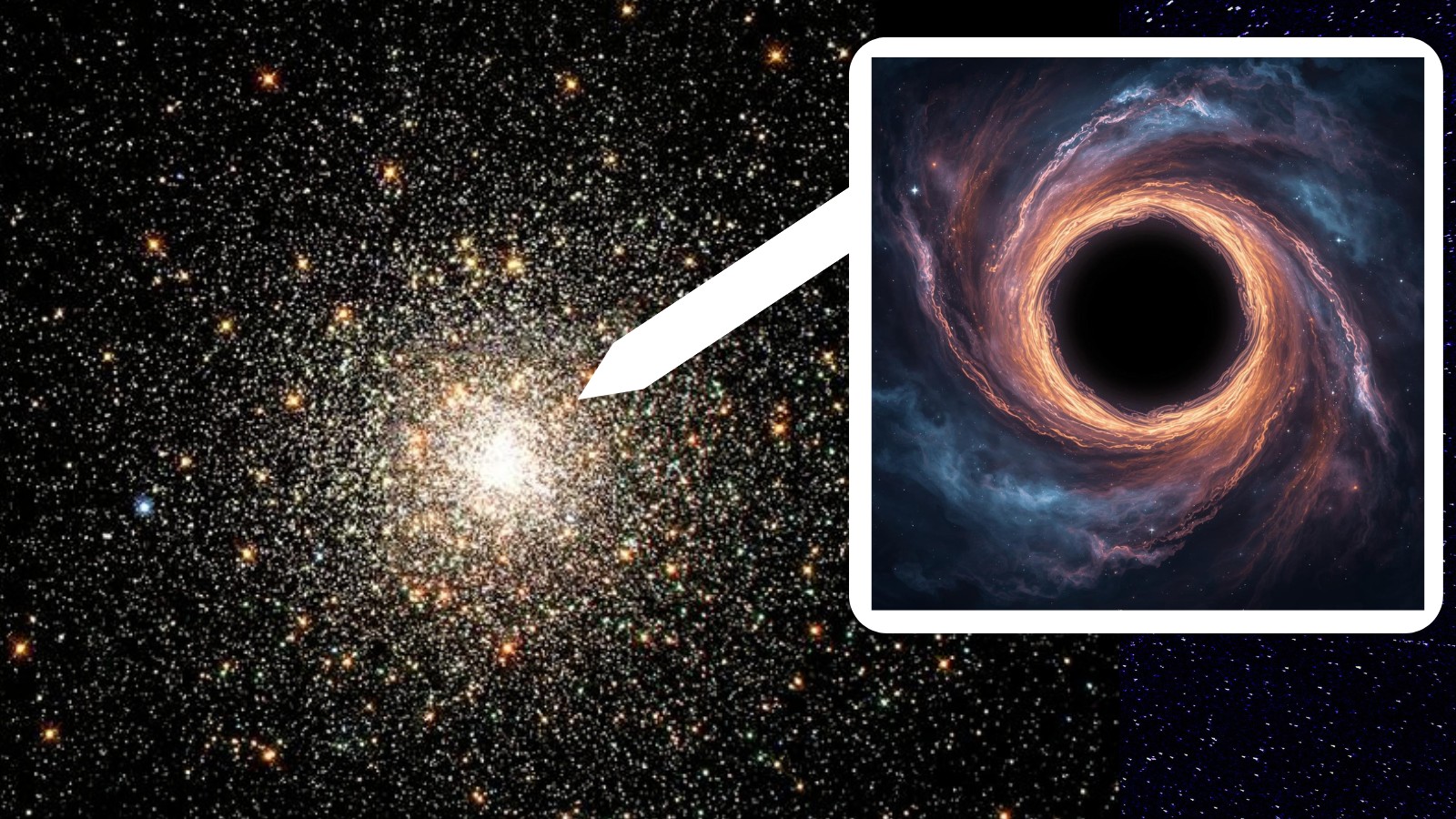
The universe’s most massive black holes likely did not form from the simple collapse of dying stars. Instead, new evidence suggests they are the result of violent, repeated collisions within dense clusters of stars.
For decades, astronomers have puzzled over the origins of the largest black holes in the cosmos. While smaller black holes are widely understood to be the remnants of massive stars that collapsed under their own gravity, the formation of “super-heavy” black holes remained a mystery.
A groundbreaking study analyzing gravitational waves—the ripples in spacetime predicted by Albert Einstein in 1915—has provided a compelling answer. These cosmic titans appear to be born in chaotic environments called globular clusters, where stars are packed so tightly that black holes frequently collide and merge, growing larger with each encounter.
Listening to the Ripples of Spacetime
The discovery was made possible by advanced gravitational wave detectors, including LIGO (Laser Interferometer Gravitational-Wave Observatory), KAGRA, and Virgo. These instruments act as cosmic ears, detecting the faint vibrations in spacetime caused by cataclysmic events like black hole mergers.
The research team analyzed 153 black hole merger detections from the latest Gravitational-Wave Transient Catalog (GWTC4). Their goal was to determine whether the heaviest black holes formed directly from massive stars or through a process of hierarchical merging —where smaller black holes repeatedly collide and combine in dense stellar environments.
“Gravitational-wave astronomy is now doing more than counting black hole mergers,” said Fabio Antonini, team leader from Cardiff University. “It is starting to reveal how black holes grow, where they grow, and what that tells us about the lives and deaths of massive stars.”
Two Distinct Populations
The analysis revealed a striking division in the data, identifying two distinct populations of black holes based on their mass and spin characteristics:
- Lower-Mass Black Holes: These appear to be the direct remnants of massive stars that died in supernova explosions. They generally exhibit slow spins, consistent with the physics of isolated stellar collapse.
- Higher-Mass Black Holes: These objects show rapid, randomly oriented spins. This specific signature is difficult to explain through standard stellar evolution but is exactly what physicists would expect if black holes had undergone multiple mergers in dense clusters.
“What surprised us most was how clearly the high-mass black holes stand out as a separate population,” noted Isobel Romero-Shaw of Cardiff University. “The higher-mass systems are consistent with having more rapid spins, oriented in seemingly random directions. This is the exact signature you would expect if black holes were repeatedly merging in dense star clusters.”
The “Mass Gap” and the 45-Solar-Mass Limit
The study provides strong evidence for the existence of the pair-instability mass gap, a theoretical range where black holes should not exist.
According to current models of stellar evolution, stars with masses between roughly 45 and 120 times that of the Sun undergo a type of supernova so violent that they obliterate themselves completely, leaving no remnant behind. This creates a “forbidden zone” for black hole formation via standard collapse.
However, gravitational wave detectors have found black holes sitting right at or near this 45-solar-mass boundary. The new research suggests these objects are not violations of stellar physics, but rather products of cluster dynamics:
- Below 45 Solar Masses: Black holes likely form from single star collapses.
- Above 45 Solar Masses: Black holes likely form through the merger of smaller black holes in dense clusters.
“In our study, we find evidence for the long-predicted pair-instability mass gap,” Antonini explained. “So, the key question now is, are these black holes telling us that our models of stellar evolution are wrong, or are they being made in another way? The data points to the latter.”
Why This Matters
This discovery shifts our understanding of cosmic history. It suggests that the largest black holes are not merely the graves of individual stars, but the survivors of a violent, crowded nursery.
The findings imply that cluster dynamics —the gravitational interactions between countless stars and black holes packed into a small space—play a crucial role in shaping the universe’s most extreme objects. As gravitational wave astronomy matures, it offers a unique window into the chaotic environments that drive the growth of black holes, challenging us to rethink how the cosmos evolves from the death of stars to the birth of supermassive giants.
In short, the heaviest black holes are not born; they are built, piece by violent piece, in the crowded heart of star clusters.