The night sky is facing a potential crisis that could fundamentally alter how we observe the cosmos. A new study warns that the proliferation of ultra-bright satellite constellations over the next decade could make the night sky three times brighter than it is today. This surge in artificial light poses an existential threat to major astronomical projects, particularly the upcoming Vera C. Rubin Observatory, which aims to conduct a comprehensive survey of the universe.
Unless strict regulations are imposed on satellite size and brightness, these massive orbital networks risk rendering critical scientific data useless, turning the heavens into a backdrop of digital noise rather than a window into the deep universe.
The Scale of the Orbital Boom
The problem stems from an unprecedented expansion in Low Earth Orbit (LEO). While thousands of satellites currently circle the planet, the pipeline is vast. According to space sustainability expert Jonathan McDowell, approximately 1.7 million satellites are scheduled for launch by April 2026.
These are not small, individual probes. Many are “megaconstellations”—groups comprising tens of thousands of satellites designed to provide global broadband internet or experimental solar power. This density creates a crowded orbital environment where satellites frequently cross the fields of view of ground-based telescopes.
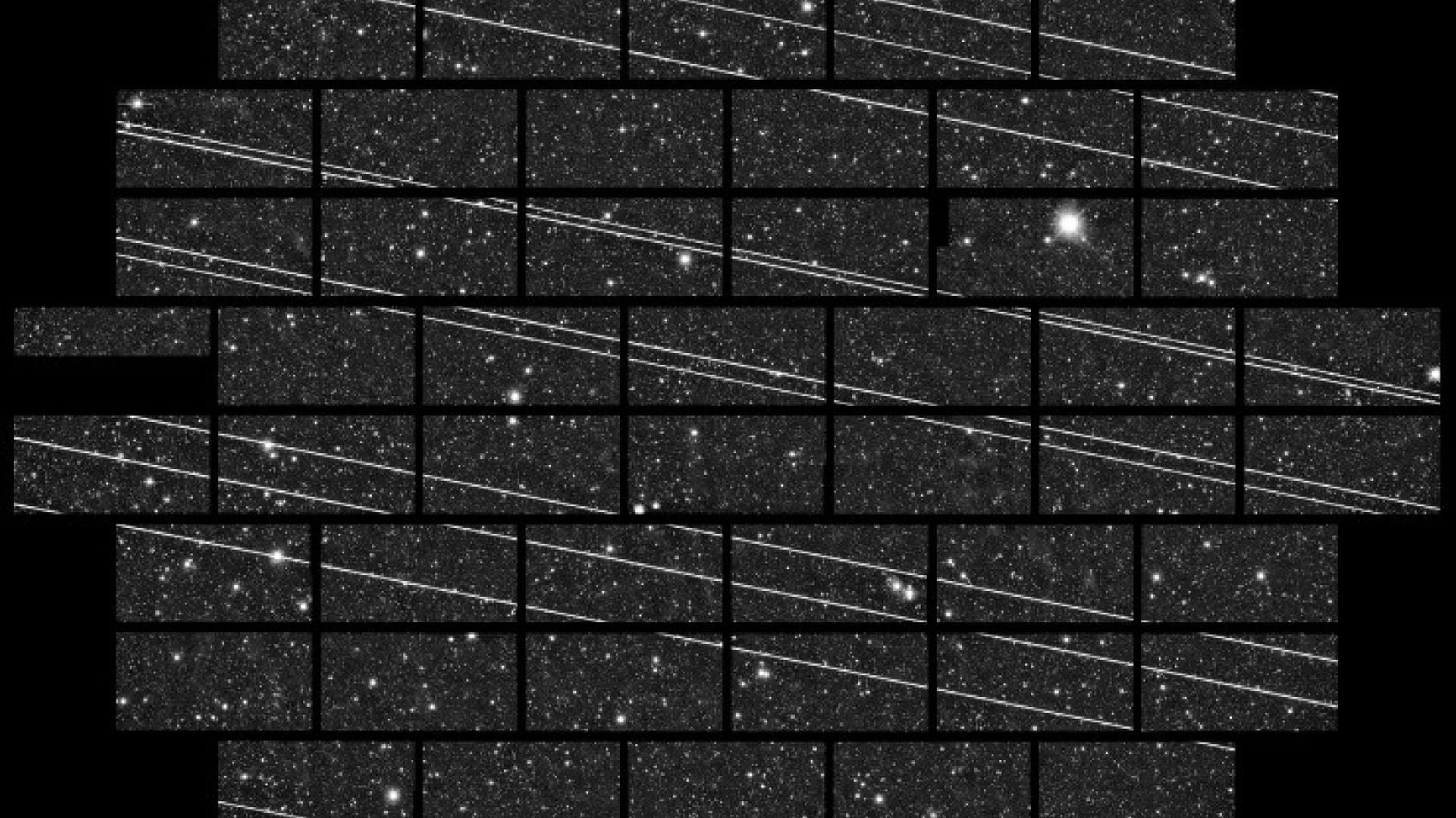
Historically, astronomers have struggled with “satellite trails”—bright streaks that photobomb long-exposure images. However, the new wave of satellites introduces a more severe problem: ambient sky brightness. Unlike previous generations, many proposed satellites are either physically massive or highly reflective, scattering sunlight across the atmosphere and creating a form of light pollution that washes out faint celestial objects.
Why Brightness Matters: The Physics of Interference
To understand the threat, one must look at how astronomical cameras work. Telescopes like the Vera C. Rubin Observatory’s Legacy Survey of Space and Time (LSST) Camera use long exposure times to capture light from distant, dim galaxies. This sensitivity makes them vulnerable to two specific effects caused by bright satellites:
- Saturation Cross-Talk: When a bright satellite passes through a camera’s field of view, it can overload the sensor. This “bleeds” light into adjacent pixels, creating streaks that can destroy entire images.
- Atmospheric Scattering: Bright satellites illuminate the atmosphere itself, scattering light across the sky. This raises the baseline brightness of the night sky, reducing the contrast needed to see faint objects.
Olivier Hainaut, an astronomer at the European Southern Observatory and author of the new study, developed a computer model to simulate these effects. By accounting for how visible light scatters in Earth’s atmosphere, Hainaut could predict exactly how different satellite configurations would impact observatories in Chile, home to some of the world’s most powerful telescopes.
The Three Tiers of Threat
The study categorizes the impact of satellites based on their design and brightness, revealing a spectrum of damage:
- Standard Megaconstellations: A constellation of 60,000 satellites, all kept dimmer than magnitude 7 (the threshold of naked-eye visibility), would contribute only 0.1% to the sky’s natural light. However, their trails would still saturate 6% to 15% of the LSST Camera’s field of view, erasing a significant portion of observational data.
- Large Mobile Broadband Satellites: Satellites like AST SpaceMobile’s “BlueBird,” which are roughly the size of a tennis court, present a greater challenge. Even a modest deployment of 243 such satellites would appear as bright blotches across the sky, severely disrupting imaging.
- Superbright Reflectors: The worst-case scenario involves concepts like those proposed by Reflect Orbital, which plans to use giant space-based mirrors to beam solar power to Earth at night. The model shows that a constellation of 50,000 such highly reflective satellites could make the night sky three times brighter than current levels. In this scenario, the LSST Camera’s images would be rendered completely worthless.
Proposed Solutions and Limits
The findings underscore an urgent need for regulatory intervention. Anthony Mallama, a researcher at the International Astronomical Union’s Centre for the Protection of the Dark and Quiet Sky, agrees that even moderate numbers of bright satellites can significantly impact astronomy.
Hainaut proposes several technical and operational constraints to mitigate the damage:
- Brightness Caps: Most satellites should be fainter than magnitude 7. Operators can achieve this by applying special mirror-like coatings to the lower surfaces of satellites, reflecting sunlight away from Earth and into space.
- Strict Limits on Bright Objects: Fewer than 10 satellites brighter than magnitude 7 should be permitted in the sky at any one time. Hainaut notes that “a single bright satellite can cause more harm than thousands of faint ones.”
- Total Population Caps: The total number of satellites should ideally remain under 100,000. While not a hard limit, this number represents a threshold where data loss from satellites equals data loss from other technical issues, such as bad weather.
“I can say exactly how bad, in terms of cost and losses,” Hainaut said regarding the impact of proposed constellations. “This is not a hard number, but 100,000 causes [astronomical data] losses at about the level of other technical losses.”
The Stakes for Scientific Discovery
This conflict highlights a growing tension between commercial space development and scientific preservation. The Vera C. Rubin Observatory is not just another telescope; it is designed to map the dynamic universe, tracking everything from near-Earth asteroids to the expansion of dark energy. If the sky becomes too bright, these surveys will fail to capture the subtle changes in brightness that reveal the universe’s secrets.
The challenge is not merely aesthetic; it is economic and scientific. Every image corrupted by satellite glare represents wasted telescope time and lost data. As the number of satellites in orbit approaches the millions, the window for establishing effective regulations is closing rapidly.
Conclusion
The race to fill Low Earth Orbit with commercial satellites threatens to obscure the very universe these technologies help us explore. Without immediate adoption of strict brightness and size restrictions, the night sky could become too bright for deep-space observation, permanently limiting our ability to understand the cosmos. Balancing technological progress with the preservation of the dark sky is no longer optional—it is essential for the future of astronomy.