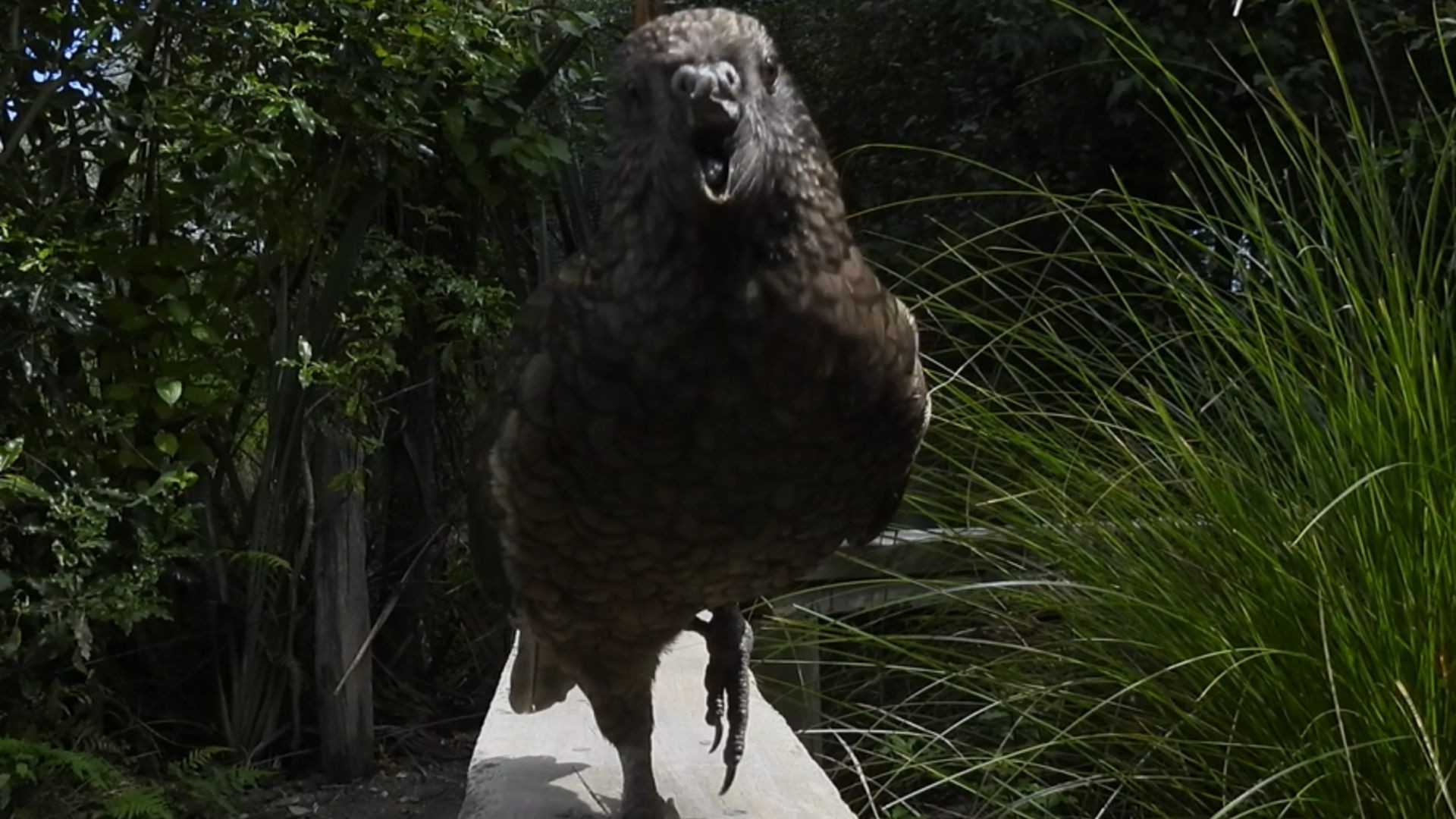
In the natural world, physical strength and intact anatomy are often the primary currencies of social status. However, a remarkable case study involving a New Zealand kea named Bruce is challenging our understanding of how animals navigate hierarchy. Despite missing his entire upper beak, Bruce has risen to become the undefeated alpha male of his group through pure behavioral innovation.
A Master of Psychological Warfare
Bruce, a kea (Nestor notabilis ) residing at the Willowbank Wildlife Reserve in Christchurch, has lived with a significant physical impairment since he was a juvenile. Researchers believe he lost his upper beak in an accident, leaving him with only a lower beak. In a species where the upper beak is essential for feeding, climbing, and defense, such a disability would typically relegate an individual to the bottom of the social ladder.
Instead, Bruce has developed a unique “jousting” technique to assert dominance. Rather than relying on physical biting or crushing, he uses competitive posturing to intimidate rivals:
- Targeted Thrusts: He uses his exposed lower beak to strike at an opponent’s head, wings, legs, or beak.
- Kinetic Force: He employs different physical approaches, such as extending his neck to increase force at close range or running and jumping to drive his beak toward other males.
- Psychological Impact: Most of these maneuvers are designed to “spook” the opponent rather than cause physical injury.
The results are statistically staggering. According to a study published in Current Biology, Bruce’s jousting moves successfully displaced his opponents 73% of the time. Out of 36 observed jousts, Bruce remained undefeated.
Breaking the Rules of Social Hierarchy
What makes Bruce’s success scientifically significant is how he achieved it. In most documented cases where a physically impaired animal reaches alpha status, they rely on social alliances to compensate for their weakness. For example:
* A chimpanzee with polio reached high rank by forming an alliance with his brother.
* A Japanese macaque with mobility issues rose to dominance through the support of an alpha female.
Bruce, however, achieved alpha status entirely on his own. His dominance is driven by his ability to innovate new behaviors that his peers simply cannot replicate. Because a standard kea’s upper beak protrudes over the lower, they are physically unable to mimic Bruce’s specific thrusting mechanics.
The Benefits of Innovation
Dominance in the animal kingdom is not just about prestige; it is a matter of survival and physiological health. By securing his position as the alpha, Bruce has gained several critical advantages:
- Reduced Stress: Analysis of fecal samples revealed that Bruce has the lowest stress hormone levels in his group.
- Resource Priority: He enjoys first access to food feeders.
- Social Care: He is the only male in the group that other males actively groom and clean.
Beyond his social standing, Bruce has also demonstrated high-level problem-solving skills. He is the first recorded instance of a kea using tools for self-care, specifically using various sizes of pebbles to preen himself in the absence of his upper beak.
Conservation and Intelligence
The story of Bruce highlights the extraordinary intelligence and adaptability of the kea. These parrots are already known for their ability to use tools and solve complex problems, but Bruce’s life offers a deeper look into their cognitive flexibility.
This intelligence is vital for the species’ survival, as keas are currently endangered, with fewer than 7,000 individuals remaining in the wild. The research underscores the importance of conservation efforts, such as those led by the Willowbank Wildlife Reserve, to protect these highly adaptable birds.
Bruce’s journey demonstrates that physical impairment does not preclude social success; rather, it can serve as a catalyst for unprecedented behavioral innovation.
Conclusion
Bruce the kea has proven that intelligence and creative adaptation can overcome significant physical disadvantages, allowing a disabled individual to dominate a social hierarchy through entirely new methods of interaction.