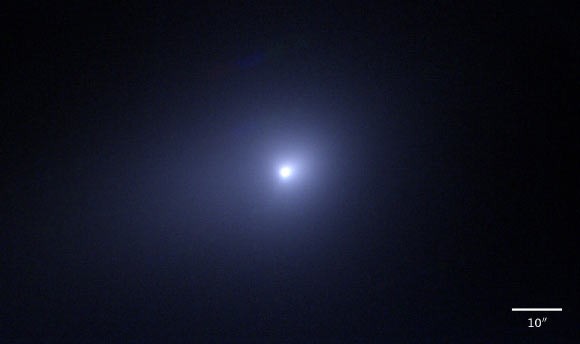
The discovery of 3I/ATLAS marks a milestone in modern astronomy: it is only the third confirmed interstellar object ever detected. Unlike the comets that reside within our own Solar System, this visitor originated from the direction of the constellation Sagittarius, traveling through the void between stars before entering our neighborhood.
Recent observations suggest that this comet is not a uniform block of ice, but a complex, layered body that changes its chemical signature as it reacts to solar heat.
A Changing Chemical Signature
On January 7, 2026, astronomers using the Subaru Telescope conducted a deep analysis of the comet’s coma—the cloud of gas and dust surrounding its nucleus. Their findings revealed a surprising discrepancy: the ratio of carbon dioxide to water was significantly lower than what had been previously recorded by the Webb and SPHEREx space telescopes.
This shift in composition is highly significant. In astronomy, the gas released by a comet acts as a “chemical fingerprint” of its solid core. The fact that the ratio changed after the comet passed its perihelion (its closest approach to the Sun on October 30, 2025) suggests a phenomenon known as compositional layering :
- Outer Layer: Initial observations likely captured gases from the comet’s surface, which may be enriched with certain volatiles.
- Deep Interior: As the comet heated up near the Sun, the intense radiation penetrated deeper, causing gases from the interior to escape.
The lower carbon dioxide-to-water ratio observed later suggests that the comet’s internal structure is chemically distinct from its outer shell.
Why Interstellar Visitors Matter
Studying objects like 3I/ATLAS provides a unique laboratory for understanding how planetary systems form. While Solar System comets tell us about the history of our own neighborhood, interstellar objects offer a “sample” of the chemistry occurring in distant protoplanetary disks—the swirling clouds of gas and dust where new stars and planets are born.
By comparing the chemical makeup of 3I/ATLAS to the comets we know well, scientists can determine if the building blocks of planets are universal or if different stellar systems produce vastly different materials.
The Future of Interstellar Discovery
The research, led by Dr. Yoshiharu Shinnaka of the Koyama Space Science Institute, highlights a growing capability in observational astronomy. The team successfully applied analytical techniques originally developed for local comets to this foreign visitor, proving that our existing tools are ready to tackle the mysteries of deep space.
As large-scale survey telescopes become fully operational in the coming years, astronomers expect the frequency of these interstellar encounters to increase. Each new visitor will provide a fresh opportunity to compare the “local” and “alien” chemistry of the universe.
“By applying our techniques to interstellar objects, we can directly compare comets from inside and outside our Solar System to explore differences in their composition and evolution.”
Conclusion
The shifting chemical profile of 3I/ATLAS suggests that interstellar bodies possess complex, layered internal structures. These observations provide a vital window into the diverse chemical environments that exist across the galaxy, helping scientists understand how planets form in systems far beyond our own.