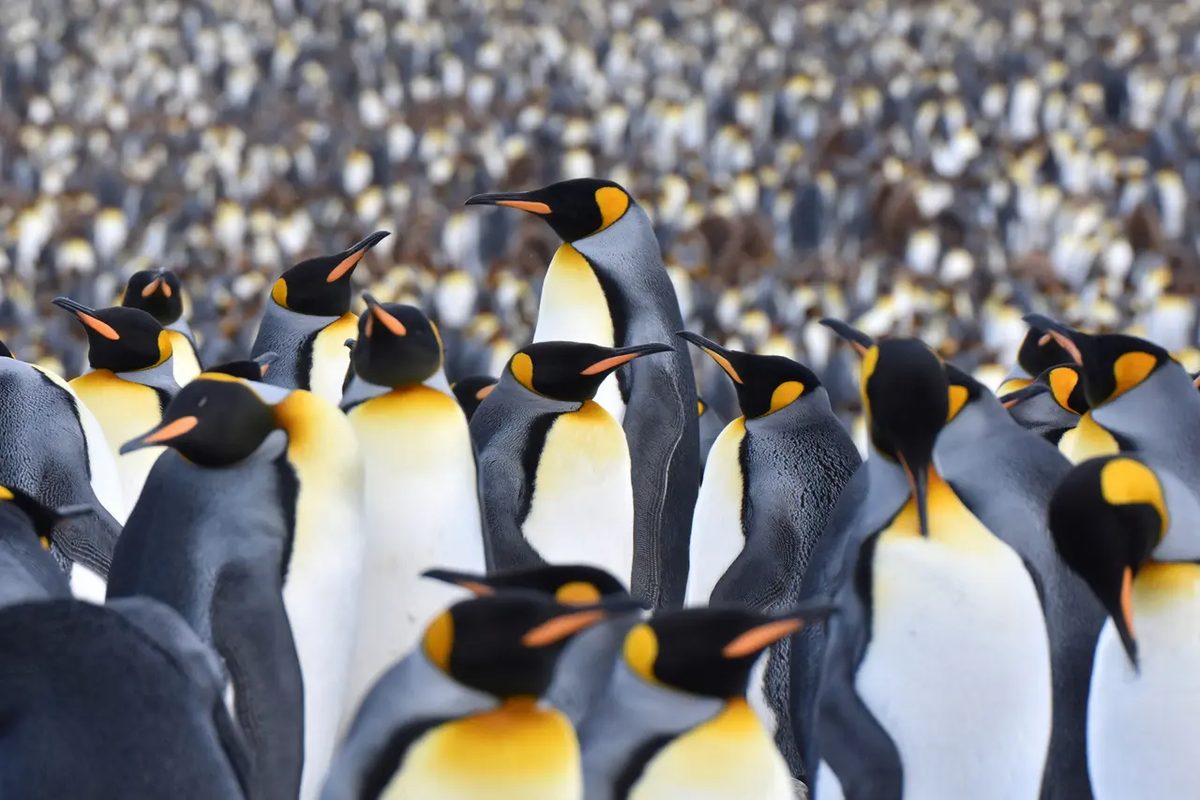
Imagine standing in the Admiral Bay, Antarctica. The air is biting. The ice is hard. And surrounding you are hundreds of thousands of Emperor penguins.
Look closely. They are identical.
Black backs. White bellies. Same silhouette. Same waddle.
To a human eye, they are a sea of monochrome. A blur of feathers.
Yet, after weeks at sea hunting for food, each adult finds its specific partner in that chaotic crowd. No GPS. No facial recognition software. Just biology working at a level of sophistication that makes our own tech look primitive.
How do they do it?
For decades, scientists puzzled over this. The work of researchers like Jouventin and Aubin on Royal and Emperor penguins cracked the code. It isn’t magic. It’s audio.
Specifically, it’s about penguin vocal recognition.
Each bird has a unique sonic fingerprint. In a colony where noise levels reach deafening peaks, they filter out the static. They hear their mate. It’s an evolutionary marvel.
The Visual Illusion of Uniformity
Penguin colonies are dense. Some contain millions of individuals. This density creates a survival problem.
If an adult loses its partner, the egg or chick dies. The incubation shift must be precise. Time is a luxury they cannot afford.
So, how does a bird distinguish its mate from millions of look-alikes?
Humans rely heavily on visual cues. We recognize faces. We notice differences in height, hair color, clothing. Penguins don’t have those luxuries. Their plumage is conserved by nature for camouflage and warmth, not distinction.
But penguins don’t rely on sight alone. They use a multi-layered system.
- Voice (Primary)
- Visuals (Secondary)
- Behavior (Tertiary)
The voice is the heavy lifter. The rest is just backup.
The Acoustic Fingerprint
Every penguin has a signature call. It’s stable throughout its life. It’s personal.
Researchers analyzed these calls using spectrographs—visual representations of sound. The results were clear. The calls vary in frequency, duration, rhythm, and modulation.
In Gentoo penguins, scientists identified up to eight distinct acoustic parameters that differ from bird to bird. That’s enough data to isolate one voice from a chorus of thousands.
Emperor penguins take it further. Their call has two parts: an initial note followed by a modulated response. This sound carries for hundreds of meters. In favorable wind conditions, it goes even farther.
The chick learns the parent’s voice at hatching. The parent memorizes the chick’s unique cry. It’s a mutual database. A biological phonebook.
Cutting Through the Noise
The colony is loud.
Hundreds of thousands of calls overlap. It’s a wall of sound.
Yet, penguins exhibit a phenomenon known as the “cocktail party effect.” This is the same ability humans have to focus on one conversation in a noisy room. Penguins do it on a massive scale.
Field experiments confirmed this. Biologists played recorded calls through speakers in colonies. The penguins ignored the random noise. They only responded to the recorded voice of their own mate or chick.
This isn’t entirely instinctual. It’s learned.
Older penguins—those with years of breeding experience—identify their mates faster and more accurately than first-time parents. Experience sharpens the ear.
So, when you look at that sea of black and white in Antarctica, don’t see a crowd. See a network of unique voices, calling out across the ice, refusing to be lost in the noise.
The question isn’t how they find each other.
It’s whether we’ve forgotten how to listen.
Voice is the first filter, but it’s not the whole story. Once the acoustic signals bring individuals closer, visual cues take over. This isn’t just about spotting a mate from afar. It happens at short range.
Individual markings serve as confirmation. Think of unique spots on the beak. Distinctive patterns in the plumage. Or the specific shape of the patches around the eyes. For royal penguins, the orange ear patches hold subtle variations. Humans might barely notice them. But these birds, with their fine-tuned vision, see them clearly at close quarters.
Site fidelity and body language
Not every species relies on the same strategy. Some penguins show site fidelity. They return to the exact spot where they nested the previous year. This cuts down the search area significantly. A bird coming in from the sea heads straight for that familiar patch of ice.
But location isn’t everything. Behavioral recognition plays a huge role. Research suggests penguins identify partners by posture or movement. It’s a specific body language. Each individual has a distinct way of walking or standing. It’s like a signature written in motion.
The reunion ritual
The reunion is never casual. It’s a ritual. Once they find each other, a duet begins. They cry out in unison. They bow. They perform parades that reinforce their bond.
Fidelity varies. Many species stick with one partner for multiple seasons. Why? Because it’s efficient. Finding a new mate takes time. Time is scarce in the Antarctic. Staying with the same partner allows them to refine their mutual recognition. Sure, failures happen. If a breeding attempt fails, the pair might split. But the default is stability.
Redundancy as survival
This system is redundant by design. If one cue fails, another steps in. Ambient noise might drown out the voice. That’s when the visual markers kick in. Or the memory of the nesting site.
This redundancy is the result of millions of years of adaptation. In Antarctica, an error is fatal. You can’t afford to raise someone else’s chick. Precision is a matter of life and death.
Multi-sensory recognition
They recognize their partner among thousands. The system is multi-sensory. Voice is primary. Every penguin has a unique vocal signature, learned at hatching. But vision and spatial memory confirm it. T spots. Posture. Location.
Combining these indices minimizes error. It’s vital for survival.
The noise in a colony of millions is deafening. Yet, each bird knows the voice of its mate and its chick. Our technology struggles to replicate this. It’s a testament to evolutionary ingenuity.
Next time you watch a documentary, listen closely. Those unique cries carry a history of fidelity. Written in ice and wind over millennia.