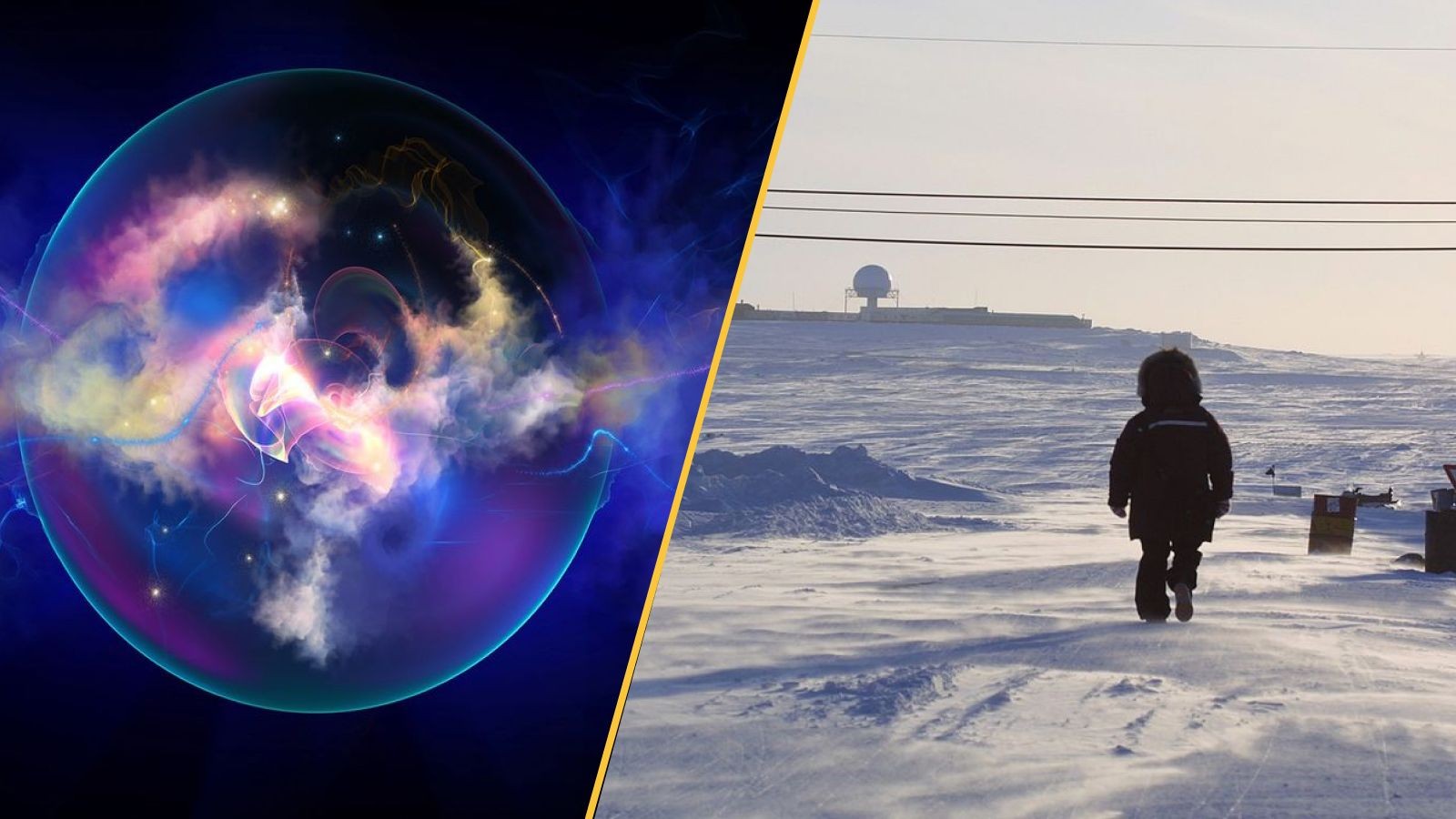
Time is tricky. Or at least it can be if you watch closely enough inside a Bose-Einstein condensate. Physicists managed to isolate a quantum system—think thousands of atoms fused into a single entity near absolute zero—and actually watched time emerge. It didn’t just tick forward. It sped up. It slowed down. It even stopped, depending on what the system decided to do.
We’ve seen mini-universes before in theory but seeing it in a lab changes things.
There’s more to this quantum news, though. NASA upgraded a refrigerator-sized lab on the International Space Station to study this same weird matter. Down here on Earth, other physicists proved you don’t strictly need complex numbers for quantum mechanics to hold up. They even used quantum computers to model rare materials essential for nuclear fusion.
And because science loves the absurd, there are tiny diving suits that turn cockroaches into search-and-resuce cyborgs. Who would have guessed? 🐜
The Arctic Is Fighting Back
The Arctic is warming fast. Way faster than anywhere else on the planet. Sea ice vanishes at a clip of 12.2 percent per decade. That’s a lot of lost reflective surface area for a planet trying not to boil.
A team of researchers tried something simple. Flooding the ice with seawater. The water freezes, adding bulk to the sheet. It’s thickening the ice manually.
Does it work? The results look promising, technically speaking. But there’s a big catch, as usual. We’re playing god with glaciers and it’s not a small experiment to scale. Still, the concept holds water.
Battery Myths
We love our chargers. Fast chargers, anyway.
But do they fry the battery inside? It’s a common fear for anyone attached to their screen. The short answer involves heat. Fast charging generates more heat, and heat is the enemy of lithium-ion cells. Slow charging is gentler, but the damage from fast charging is usually marginal for most modern devices. Don’t sweat it. Just keep your phone out of direct sunlight while it charges. That’s the real killer. ☀️
Boston: The Name Was Freedom
Sometimes history hides in plain sight. Specifically, under the snow and grime of a headstone in Boston’s Granary Burying Ground.
During a restoration, conservators found a stone with one name: Boston. No first name. Just the city.
It turned out to be Sebastian, a formerly enslaved man. He died in 1729, free, after the owner who held him died. Sebastian chose his city as his name. He worked as a handyman. He built things in the town he eventually owned himself.
“It’s been there all along,” Michelle Wu, Boston’s mayor, said during a Fourth of July speech. We just stopped looking.
It makes you wonder. How many other stories are sitting in the dirt waiting for someone to clean them off?
The Weekend Stack
Need distraction? Here is the rest of the news cycle, unfiltered.
- Sodium batteries now charge in four minutes and last for years.
- A 900-year-old button found in Norway turned out to be a coin from King Magnus Barefoot.
- The Milky Way is probably bigger and more lopsided than astronomers thought.
- Neanderthals might have shared culture with us 59,00 years ago in Turkey.
- Malaria came back roaring in the Amazon after a dam reduced it. Experts know why now.
- Antibiotic resistance is driven by social pressure, not just biology. Julia Szymczak notes that sick visits in hospitals sometimes last only 800 seconds. That’s pressure.
Also, China snapped the first close-up of Earth’s “quasi-moon,” a temporary asteroid orbiting us. It looks blurry and gray. The probe might want to land there. An hiccup made it hard. 🛰️
Science isn’t neat. It’s messy rocks and hidden graves and weird time. It doesn’t always tie up in a bow. It just happens.