Forget the bubble. That was the old story.
Now it’s more complex.
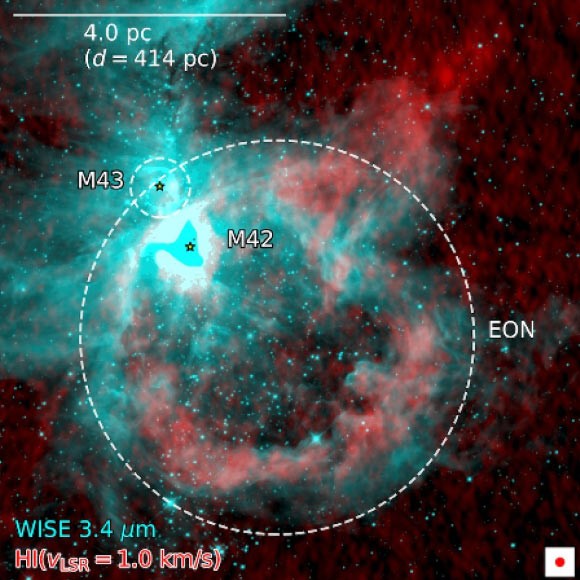
Using the Karl G. J. Jansky Very Large Array (VLA) and the Five-hundred-meter Aperture Spherical Telescope (FAST), astronomers have mapped neutral hydrogen around the Orion Nebura with unprecedented clarity. The results? Giant shells. Mysterious cavities. Long filaments. It suggests this stellar nursery wasn’t sculpted by one expanding wind. Multiple generations of massive stars did it.
Hydrogen is the most abundant element in Universe. In neutral form, it emits radio waves at 21 cm. Trace the invisible.
The Orion Nebula—M42 or NGC 1976 to the catalogs—is a diffuse patch of light. 1,350 light years away. You can see it naked-eye as a fuzz below Orion’s Belt, right around Theta Orionis. It’s small in age only. 2 million years. Young enough to show us what the Sun looked like when it was born 4.6 Billion years ago.
Dr. Juan Diego Soler and team combined data from those two giant radios. The old maps said the shell held a thousand suns mass. The new data? Nearly ten times lighter. The universe has a lighter touch than we thought.
Or perhaps it just moved the weight.
Inside the main shell. There’s another cavity expanding. An elongated protrusion of gas stretching four light-years out. It looks less like a balloon and more like a bruise. Shaped by stellar feedback in bursts. Not one single event.
Does this change how we think about stars? Yes.
Dr. Daniel Seifried calls it a challenge. To the current models. These images are the reference now for simulations trying to pin down gas evolution in the Milky Way. Dr. Claire Murray notes this demonstrates the power of new-generation tech. It’s not just clearer pictures. It’s new puzzle pieces.
We used to think we understood Orion well. Soler disagrees.
The method works. Future interferometers will apply it elsewhere. Uncover the hidden dynamics of the interstellar medium even in regions we claimed to know. The paper sits in Astronomy & Astrophysics. But the shell keeps expanding. Or maybe it stops. Or changes direction again. We don’t know yet.