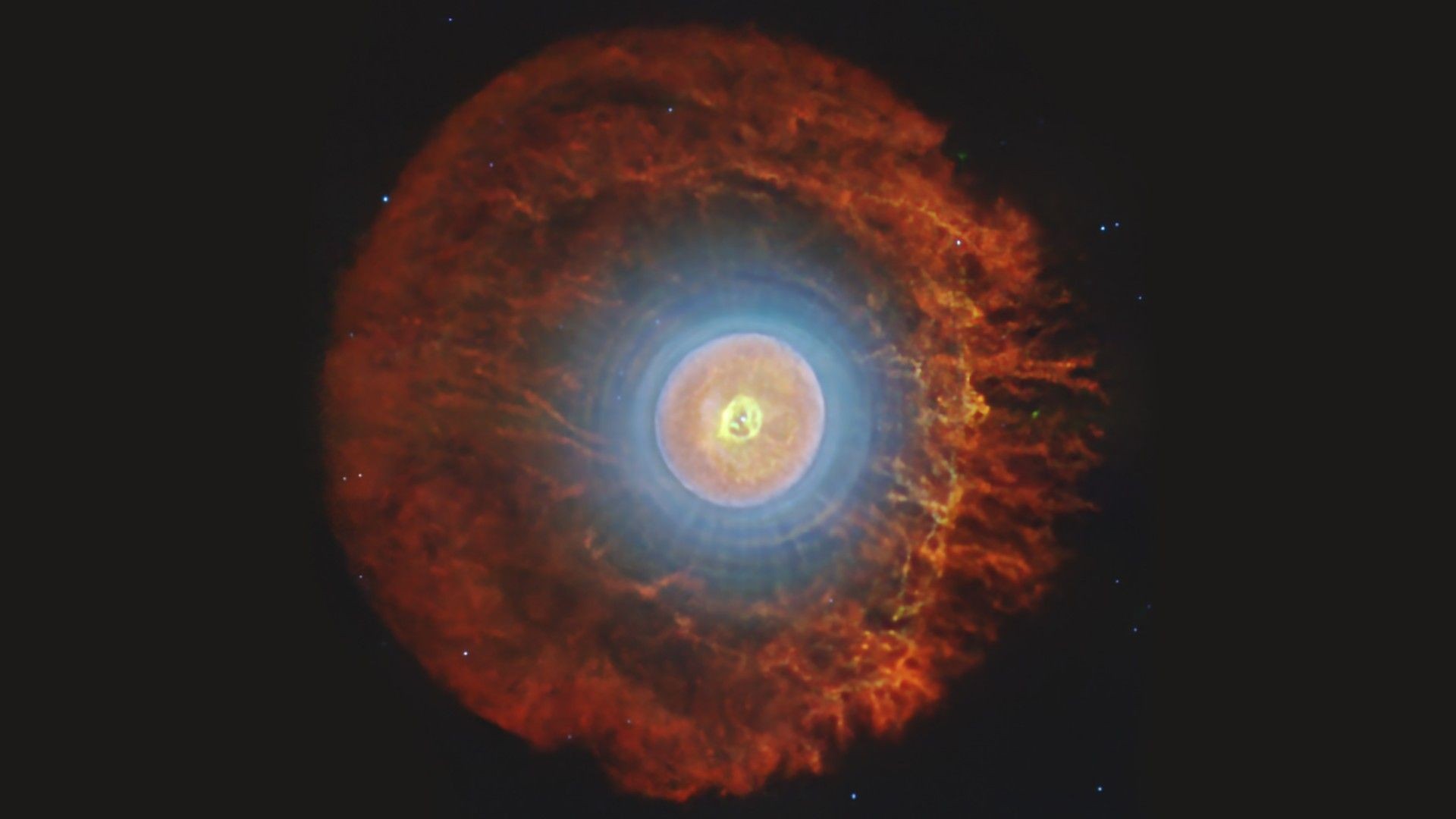
New imagery from the James Webb Space Telescope (JWST) has provided an unprecedented look into a dying star, revealing a complex landscape of mysterious carbon molecules known as “buckyballs.” The observations of the nebula Tc 1, located 10,000 light-years away in the constellation Ara, are challenging existing scientific models and raising new questions about how the building blocks of life form in the vacuum of space.
What are Buckyballs?
Buckyballs, formally known as buckminsterfullerene, are large, hollow carbon molecules that resemble a soccer ball. Named after the architect Buckminster Fuller due to their resemblance to geodesic domes, these structures are a specific type of polycyclic aromatic hydrocarbon (PAH).
This distinction is vital because PAHs are essentially the “ingredients of life”—organic compounds that serve as fundamental components in the evolution of complex chemistry. While these molecules are found in diverse environments—from young stars and interstellar clouds to meteorites—they are surprisingly rare in the planetary nebulae where they are expected to thrive.
A Deep Dive into Tc 1
The nebula Tc 1 is a “planetary nebula,” a term describing the glowing shells of gas ejected by a dying star. The star at its center is a white dwarf —the cooling, dense core of a sun-like star that has exhausted its fuel.
Using the telescope’s Mid-Infrared Instrument (MIRI), researchers have identified several striking features:
– Structural Anomalies: The nebula contains a mysterious shape resembling an upside-down question mark.
– Molecular Shells: Buckyballs appear to be concentrated in a shell surrounding the white dwarf, a configuration described by researcher Morgan Giese as being “arranged like one giant buckyball.”
– Unexpected Emissions: The way these molecules emit infrared light does not align with current scientific models, suggesting that our understanding of how radiation interacts with organic matter is incomplete.
Why This Matters for Astronomy
The ability of the JWST to peer through cosmic dust with high-resolution infrared light allows scientists to move beyond mere detection and into detailed analysis.
“The structures we’re seeing now are breathtaking, and they raise as many questions as they answer,” says Jan Cami, a physics and astronomy professor at Western University and lead researcher on the project.
This discovery is significant for three primary reasons:
- Testing Chemical Models: Current laboratory experiments and mathematical models fail to accurately predict the infrared signatures of these molecules. This suggests there are “missing processes” in our understanding of photochemistry (chemistry driven by light).
- Mapping Cosmic Evolution: By observing how buckyballs change in response to varying temperatures, densities, and radiation fields, scientists can better understand how organic matter evolves in extreme environments.
- The Rarity Puzzle: Out of hundreds of known planetary nebulae, buckyballs have only been detected in a tiny fraction (perhaps 10 or fewer). Researchers are now using JWST to study other nebulae with different radiation environments to solve this mystery.
Looking Ahead
The scientific community is awaiting a series of forthcoming papers that will detail the spectroscopic findings of this mission. With additional time granted on the JWST, Cami’s team will soon turn their gaze toward two other planetary nebulae to further investigate how different radiation fields impact the formation and behavior of these enigmatic carbon spheres.
The study of Tc 1 represents a pivotal moment in astrochemistry, offering a rare glimpse into the complex processes that shape the chemical makeup of our universe.