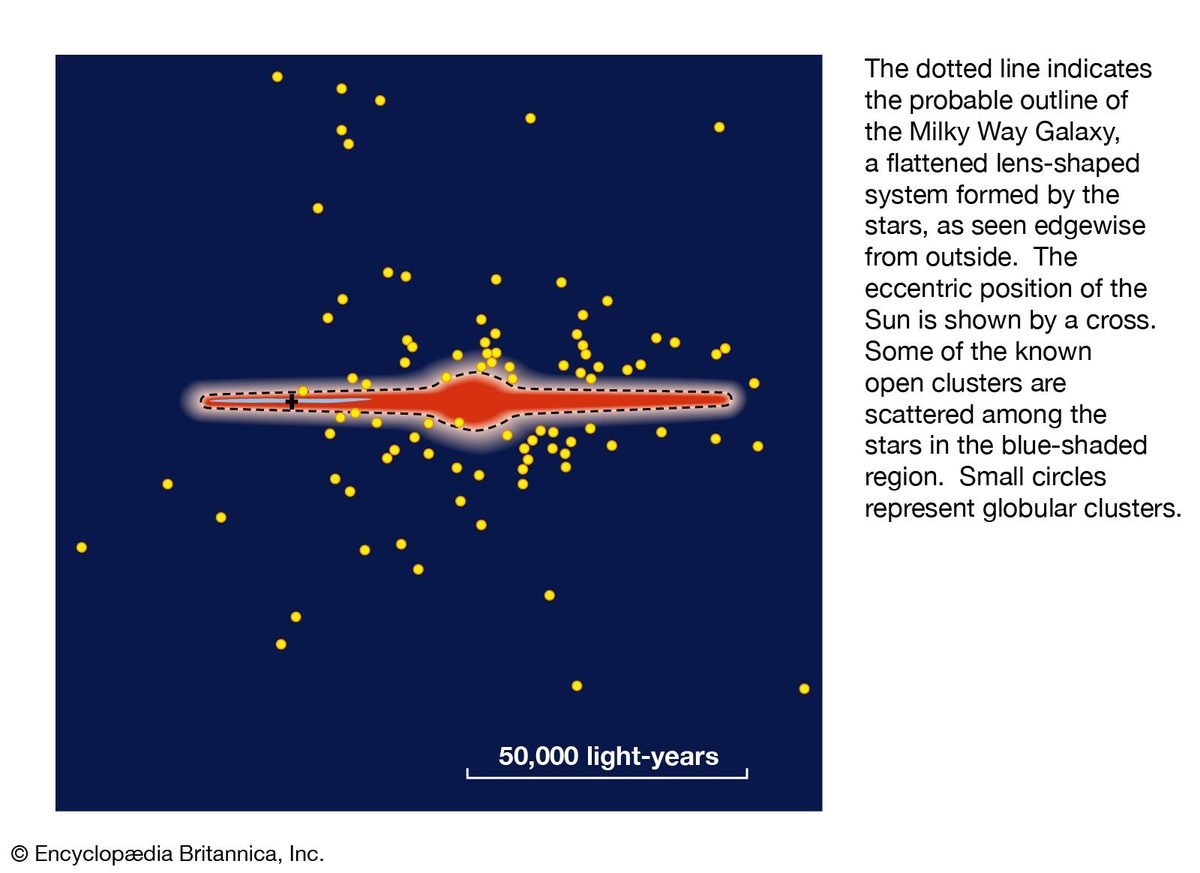
Harlow Shapley didn’t just look at the stars. He mapped the darkness between them. Born in Nashville, Missouri, in 1885, this American astronomer would eventually rewrite our understanding of where we sit in the cosmos. His work didn’t just tweak the numbers. It shifted the entire center of the Milky Way galaxy away from Earth.
Before Shapley, humanity liked to think of itself as central. We were the hub. The sun sat in the middle of the galaxy. The logic seemed sound if you only looked at the night sky from our specific vantage point. Shapley proved that was wrong. He deduced that the sun lies near the central plane of the Milky Way Galaxy but is nowhere near the center. It sits about 30,000 light-years away. That is a long way from the party.
This wasn’t a single moment of insight. It was a grind of calculation. It started in 1911. Shapley worked closely with Henry Norris Russell to crack the code on stellar dimensions. They focused on binary systems. These are pairs of stars orbiting a common center of mass. When they eclipse one another, their light dims. That dimming is measurable. It’s data.
Shapley used these measurements to find the physical size of stars. He turned light curves into physical realities. This method became the standard procedure for more than 30 years. It was the gold standard for measuring stellar sizes. If you wanted to know how big a star was, you looked at its eclipses. Shapley had built the ruler.
But there was a snag. Some stars behaved differently. They pulsed. They were known as Cepheid variables. Other astronomers thought these were just binary pairs eclipsing each other. Shapley saw the flaw. He showed that Cepheid variables cannot be star pairs that eclipse one another. The math didn’t hold up. The light variation was too complex. Too rhythmic.
So he looked deeper. He was the first to propose that they are pulsating stars. They breathe. They expand and contract. This distinction mattered. It cleared up confusion in the field. It allowed astronomers to use these stars as “standard candles” later on, tools for measuring vast distances in space. By correctly identifying their nature, Shapley didn’t just categorize a star type. He enabled the measurement of the galaxy’s true size.
He died in Boulder, Colorado, on October 20, 1972. The sun remained where it was, hanging out in the suburbs of the galaxy. We didn’t move. But our map changed. We learned we aren’t the center of anything. Just a small part of a much larger, indifferent system.
Redefining Our Place in the Cosmos
By 1914, Harlow Shapley had settled into the staff at Mount Wilson Observatory in Pasadena, California. The prize on the table was the 1.5-metre reflecting telescope. It was the biggest tool in the sky, and Shapley used it to map the Milky Way’s globular clusters. These were not just any stars. They were dense, spherical packs of up to a million suns each.
At the time, astronomers knew of about 100 such clusters. Shapley noticed something odd. One-third of them sat within the constellation of Sagittarius. This wasn’t random. He used a new trick to gauge distance. The trick involved RR Lyrae variable stars. These stars pulse with a rhythm. Their period of variation linked directly to their brightness. If you knew the pulse, you knew the true light. If you knew the true light and the apparent brightness, you knew the distance.
The data painted a picture. The clusters formed a sphere. The center of that sphere pointed toward Sagittarius. It seemed logical that the clusters orbited the galactic center. So, Shapley did the math. He placed the Sun about 50,000 light-years from the galactic core. (Later work corrected this to 30,000). This was a shock. Before Shapley, everyone thought the Sun hung near the middle of the Milky Way. He had just blown up that assumption. His calculations provided the first realistic estimate of the galaxy’s true size. This shifted galactic astronomy forever.
The Great Debate of 1920
While Shapley was expanding the Milky Way, another problem nagged at astronomers. What were the spiral nebulae? Objects like the Andromeda Nebula looked like faint smudges. Some thought they were small clouds inside our own galaxy. Others thought they were entire galaxies themselves.
This tension exploded on April 26, 1920. The National Academy of Sciences met in Washington, D.C. Two men stood at the podium. On one side was Shapley. On the other was American astronomer Heber Curtis. Their clash became known as the Great Debate. It had no clear winner, but it highlighted the stakes.
Curtis rejected Shapley’s huge Milky Way. If the galaxy was that big, he argued, the nebulae couldn’t be inside it. He believed the spiral nebulae were independent “island universes.” Shapley stood by the massive scale of the Milky Way. But he argued that the spiral nebulae were just gas clouds, similar to globular clusters, scattered within our galaxy.
History vindicated Curtis on the nebulae. They were indeed other galaxies. But Shapley was right about the size of our own. The universe was far larger than anyone had imagined. It was a messy victory for both men.
Legacy and Habitable Zones
Shapley didn’t stop at the Milky Way. He looked at nearby galaxies, focusing heavily on the Magellanic Clouds. He noticed that galaxies didn’t float alone. They clumped together. He called these clusters “metagalaxies.” This term for galactic clusters helped frame how we view large-scale structure.
In 1953, Shapley proposed a theory that still shapes our search for life. He called it the “liquid water belt.” The idea was simple but profound. A planet needs to be at a specific distance from its star. Too close, and water boils. Too far, and it freezes. Only in that belt can a planet hold an atmosphere and keep water liquid. We now know this as the habitable zone. It remains a foundational concept in astrobiology.
His career moved from Mount Wilson to Harvard University. He became a professor there. In 1921, he took over as director of the Harvard College Observatory. He held that post until 1952. After stepping down, he retained the titles of director emeritus and Paine Professor of Astronomy.
He left behind a significant bibliography. Star Clusters arrived in 1930. Flights from Chaos followed. Galaxies came out in 1943. Later works included The Inner Metagalaxy (1957) and Of Stars and Men (1958). The latter became a film in 1962. He was also the father of Lloyd Shapley, who won the Nobel Prize in economics.
The man who pushed the sun to the edge of the galaxy also helped define where life might exist elsewhere. The universe got bigger, but the search for meaning within it got more precise. We are still looking at those clusters.