Ever wonder what happens to a ball after it drops into a pocket on a commercial pool table? It doesn’t just vanish. It travels.
Inside the table, you’ll find a system of chutes linked to each of the six pockets. These chutes are angled downward from the pocket toward the ball return. When a ball lands in a pocket, gravity takes over. It rolls along the guide and drops into the return system.
That’s where the real mechanics kick in.
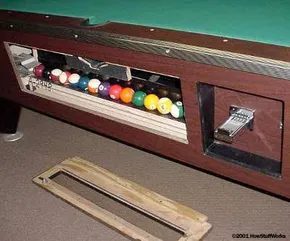
A pocketed ball ends up in a collection chamber. There, the balls line up single-file in a trough. You can see this setup behind a piece of Plexiglas. The balls stay locked in there until someone inserts coins to start a game.
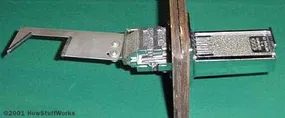
Here is the specific process. A player places coins in a slot and pushes the coin arm in. That action trips a lever. The lever releases the trough, allowing the balls to roll out into a large open access area at the foot end of the table.
The balls are ready for immediate rack-up, saving time between games.
This design keeps the game moving. You don’t have to dig through pockets or wait for a cue to hand you the balls. The table does the work.
Which part of the mechanism surprised you most?
How the cue ball gets back in play
Scratching feels like a small victory for the opponent, but the machine has a specific job to do right after. The cue ball has to come back into the game from the access area at the foot of the table. Coin-operated tables handle this retrieval using one of two distinct mechanisms, both designed to pull the cue ball out of the mixed pile of numbered balls that end up in the pockets.
Most modern machines rely on radius gauging. The cue ball in these setups is physically larger than the others. We are talking about a diameter of 2-3/8 inches (6 cm). That is roughly one-eighth of an inch (2 mm) bigger than a standard pool ball. It sounds like a negligible difference, but it is exactly what the machine needs.
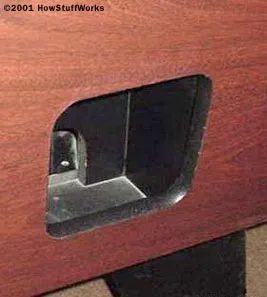
When balls drop into the pocket, they head toward the storage compartment. A gauging mechanism sits in the path. The smaller numbered balls slide right through. The oversized cue ball does not fit through that gap. Instead, the mechanism diverts it down a separate chute. The ball falls out through an opening on the side of the table, ready for the next player to retrieve.
If you hate using a larger cue ball, there is an alternative. Some coin-operated machines use magnetic cue balls. These balls have a magnet built into the core. Instead of relying on physical size, the machine uses a magnetic detector.
When the magnetic ball passes the detector, the sensor triggers a deflecting device. The cue ball is physically knocked or diverted away from the numbered balls. Like the gauging system, this sends the cue ball into the side opening. The logic is identical, just executed with magnetism rather than geometry.
Which system is better? It depends on your tolerance for handling a slightly larger ball versus the potential for mechanical failure in the magnetic sensor. The gauging system is simpler in theory. The magnetic system keeps all balls the same size, which some purists prefer. Neither method is invisible; you will always know which table you are playing on by how the cue ball is stored.
How cue ball variations affect your game
Oversized and magnetic cue balls work on most modern coin-op tables. You can swap them out without breaking anything. That flexibility comes with trade-offs.
New players probably won’t notice the difference. The larger ball feels fine. But advanced players? They notice. Those folks are used to the standard 2 1/4-inch (5.7cm) diameter. A bigger ball changes the dynamics. It disrupts the rhythm.
Magnetic balls have their own quirks. They sometimes lack a true roll. The physics feel off. Why? The magnetic material inserted inside shifts the weight distribution. It doesn’t roll straight. It wobbles.
There is a bigger risk. Drop a magnetic cue ball on hard concrete. It shatters. The internal magnet makes the shell brittle. Standard balls survive that drop. Magnetic ones do not.
The core table mechanics remain identical regardless of the return system.
Do drop pockets change the table surface?
No. The components on top of the table stay the same. Whether your machine uses drop pockets or an automatic ball return, the felt, the rails, and the playing surface are consistent. The difference is underneath. You are playing on the same plane. The only variable is how the balls get back to you.