You’ve seen it happen. A metal glows, turns black, and changes state. That isn’t just heat. It’s chemistry in action. Specifically, it’s a redox reaction, where one substance loses electrons and another grabs them. No magic involved. Just a very specific exchange of charged particles.
If you want to understand why rust forms, how batteries power your phone, or why antiseptic wipes kill germs, you have to look at electron transfer. In every redox process, at least one substance gets oxidized while another gets reduced. The oxidized species gives up electrons. The reduced species takes them in. This shift changes the oxidation state of the atoms involved.
How to spot the electron thief and the donor
Not every chemical reaction is a redox event. But when electrons move, you can identify two distinct roles.
- The oxidizing agent : This is the electron thief. It accepts electrons, causing its own oxidation state to drop. These are usually highly electronegative elements or compounds. Think oxygen (O), iodine (I), bromine (Br), or heavy hitters like potassium permanganate (KMnO4), potassium chlorate (KClO3), and potassium dichromate (K2Cr2O7).
- The reducing agent : This is the donor. It gives away electrons, which forces its oxidation state up. These tend to be less electronegative species like iron(II) (Fe2+), iron(III) (Fe3+), sodium (Na), or magnesium (Mg).
Why does this matter? Because the identity of these agents predicts how the reaction will proceed. You can’t have one without the other. One goes up, one goes down.
Breaking the reaction into halves
Chemists don’t just look at the big picture. They split redox reactions into two separate parts called half-reactions: the oxidation part and the reduction part. This makes balancing equations and predicting outcomes much easier.
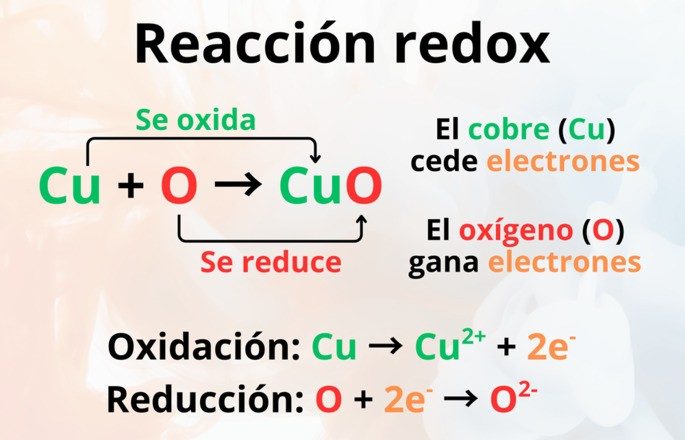
Take the formation of copper(II) oxide, also known as cupric oxide, as a concrete example. When copper reacts with oxygen, the copper atoms lose electrons. The oxygen atoms gain them. The result is a stable compound, but the journey there is purely about electron movement.
“The substance that is oxidized provides the electrons, while the one that is reduced accepts them.”
This simple rule holds true whether you’re analyzing a tiny battery cell or a massive industrial smelter. The atoms don’t care about the scale. They only care about charge balance. And that balance dictates everything from material stability to energy release.
Why copper turns green and rust actually eats iron
The copper oxide reaction isn’t just a textbook diagram. It is a visible sign that electrons are moving. When copper meets oxygen, it gives up two electrons. The copper becomes Cu2+. The oxygen grabs those electrons to become O2-.
That exchange defines the whole process. Copper is the reducing agent because its oxidation state went up. Oxygen is the oxidizing agent because its state dropped. Atoms do this to reach a stable state, similar to noble gases. They gain or lose electrons based on their electronegativity.
You see this everywhere. Iron rusts. Food spoils in your metabolism. Fuels burn in engines. Batteries work via electrochemical cells. In those cells, oxidation happens at the anode. Reduction happens at the cathode.
How different redox reactions actually behave
Redox reactions vary by speed and the specific chemicals involved. Four types stand out.
Metal oxidations
These are slow. Often very slow. Metals like iron, copper, aluminum, or zinc react with water and oxygen over time. The metal loses electrons. Oxygen accepts them.
– Copper forms CuO.
– Iron forms Fe2O3.
This is why old pipes look dirty or statues turn green.
Combustions
These are fast. Dangerous, even. Combustion releases huge amounts of energy as heat and light. Burning fuel in oxygen is the classic example. The speed makes it useful for engines and frightening in a kitchen fire.
Double displacement reactions
Here, one atom swaps places with another inside a molecule. The first atom oxidizes to join the molecule. The original atom reduces and leaves.
Take zinc reacting with copper sulfate (CuSO4). Zinc and copper swap partners. Zinc takes the sulfate ion.
Disproportionation reactions
Also called anolysis or dismutation. One element oxidizes and reduces itself at the same time. This happens when an element can exist in three or more oxidation states.
– Nitrogen
– Sulfur
– Phosphorus
– Manganese
These elements are chemically chameleons.
Concrete examples of electron transfer
Let’s look at the mechanics.
Zinc and copper sulfate
Drop zinc into copper sulfate solution. Zinc gives up two electrons. It oxidizes. It acts as the reducing agent.
Copper accepts those two electrons. It reduces. It acts as the oxidizing agent.
Zinc replaces copper to bond with the sulfate group (SO42-). The sulfate is a salt derived from sulfuric acid. The copper needed those two electrons to leave the solution. That is why the reaction happens.
Sodium and chlorine
Sodium (Na) and chlorine gas (Cl2) react to make sodium chloride (NaCl).
Sodium loses one electron. Its oxidation state becomes +1.
Chlorine gains that electron. Its state becomes -1.
They bond. You get table salt. Simple, deadly ingredients. Stable result.
Iron(III) oxidation
Iron can oxidize to +2 or +3. Iron(III) is the higher state.
Iron releases three electrons. It becomes Fe3+.
Oxygen takes two electrons. It becomes O2-.
The math is tricky. Three electrons from iron, two needed by oxygen. You need two iron atoms and three oxygen atoms to balance the transfer. That forms iron(III) oxide. The rust on your car door is this exact imbalance resolved.