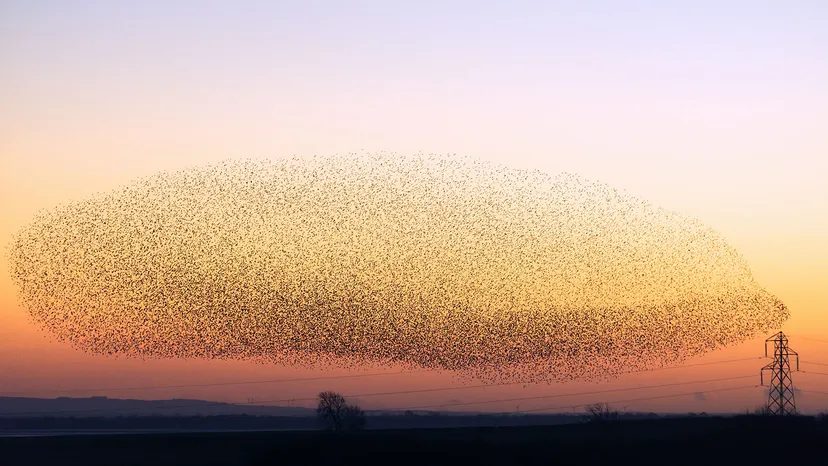
Individually, a European starling is unremarkable. It’s a short, thick bird with dark plumage and a sharp, pointed bill. You’ve seen them. They are practically everywhere. There are more than 200 million of them in North America alone. They chirp their little songs and annoy backyard gardeners and full-time farmers alike.
Collectively, though, they transform.
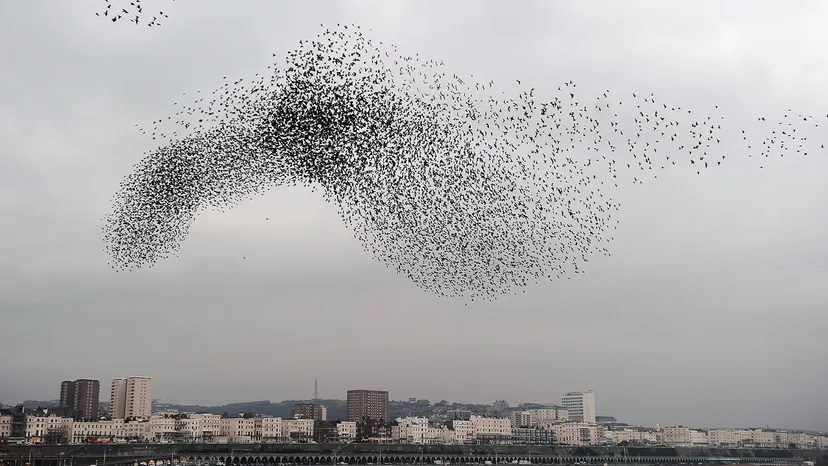
In flight, in flocks that can number in the hundreds of thousands, they become something else entirely. A murmuration is a breath-stealing wonder. It is a pulsating, swooping, living whole. It seems to defy the laws of nature while defining it.
Watching one is to experience firsthand the power and mystery of the natural world.
“I think that the core feeling is a sense of awe,” says Mario Pesendorfer, a postdoctoral research associate at the Institute of Forest Ecology at the University of Natural Resources and Life Sciences in Vienna. “The spatial scale of something that is moving very rapidly — which we are utterly unable to do — and the visual patterning that occurs when a lot of individuals are doing the same thing … really mesmerizes us.”
To scientists like Pesendorfer, murmurations do more than inspire. They spark curiosity. And they spark scientists to figure out how swarming animals — like birds and bees and fish — can better our own lives.
The Secrets Behind Murmurations
In the 1930s, famed ornithologist Edmund Selous suggested that birds moving in murmurations were using some sort of telepathy to transmit their flying intentions. “They must think collectively, all at the same time… a flash out of so many brains,” he wrote in his book, Thought-Transference (or What?) in Birds.
As the years wore on, we found out that’s not quite it. In the 1950s, scientists studying insects and fish and other collective animal behavior posited that group movement is more of a stunningly fast response to others in the flock. Or the school. Or the swarm. It isn’t some innate mind-reading ability. Nor is it a command from a group leader.
It is “the rapid transmission of local behavioral response to neighbors,” as the authors of a 2015 paper published in the journal Proceedings of the National Academy of Sciences wrote.
“There’s two ways that you can elicit large group behavior,” Pesendorfer says. “You can have the top-down control, where you have some kind of leadership, or some kind of top-down mechanism. Think of a rock show. You have the rock star in the front and he starts clapping his hands, and the whole stadium starts clapping.”
“But these murmurations are actually self-organized,” he says. “Meaning that it’s the individual’s little behavioral rules that make it scale up to the large group. In order to understand this behavior, we have to go from the local scale — what is the individual doing, what are the rules that the individual is following? — to the global scale; what is the outcome?”
In 2013, a mechanical and aerospace engineer and her team from Princeton collaborated with physicists in Italy to study murmurations. “In a flock with 1,200 birds, it is clear that not every bird will be able to keep track of the other 1,199 birds,” Naomi Leonard, the Princeton engineer, said back then. “So an important question is ‘Who is keeping track of whom?'”
The Italian physicists used more than 400 photos from several videos to find out. They plotted the position and speed of birds as they flocked. From that, they built a mathematical model that identified the optimal number of flock-mates for each bird to track.
Turns out the magic number is seven: Each bird keeps tabs on its seven closest neighbors and ignores all else. Considering all these little groups of seven touch on other individuals and groups of seven, twists and turns quickly spread. And from that, a whole murmuration moves. The scientists’ findings were published in the journal PLOS Computational Biology in January 2013.
The Three Things in Control
Though it looks coordinated on a large scale, the individual birds are concerned with only three aspects of their flight and the flight of those around them. These factors have been described in several ways, but they’re all very similar. They are, from Pesendorfer:
-
An attraction zone : “Which means, in this area, you’re going to move toward the next guy.”
-
A repulsion zone : “Which means, you don’t fly into his lane, otherwise you both fall.”
-
Angular alignment : “So you got to kind of follow his [a bird’s neighbor] direction.”
“Depending on how you change those three parameters,” Pesendorfer says, “you can get everything from those barrel-looking baseballs that you get in ocean fish, to loose-looking insect swarms, to highly, highly organized fish swarms and murmurations. All in those three little parameters.”
Scientists believe these birds flock in the first place to confuse and discourage predators. They do this through their sheer numbers, the noise such a flock makes, and its motion. Some communication between birds may be happening, too, in murmurations. Say, pointing out good food sources. While some researchers believe simply keeping warm may be another reason for the murmurations.
What may be most stunning to mere mortals is that these birds react so quickly. And do so in such synchronization. If not immediately, within a couple of flaps of a bird’s wing. They move almost as one, in a type of lock-step. Or, as it were, lock-flap.
How?
“Birds have a much higher temporal resolution than we do,” says Pesendorfer. This means that birds take in certain information around them and process it much more quickly than humans. “They see much faster than we do.”
Beyond the Sky: How Starling Swarms Are Reshaping Technology
The 1986 model known as “Boids” changed how we see movement. Craig Reynolds, an MIT-trained computer scientist, created a program that mimicked bird flocking and fish schooling. It wasn’t just code. It was a blueprint for life.
That code went straight to Hollywood. You saw it in Batman Returns (1992). Tim Burton used Reynolds’ algorithms for the bat swarms. The animation looked real because it followed simple rules. Each “bird” reacted to its neighbors. No central command. Just reaction.
But the sky has more to teach us. Specifically, the murmuration.
George Young, lead author on research from Leonard’s group at Princeton, saw the potential in 2013. He told the university that biology holds the key to better robotics. We need to understand what measures of animal group performance work. Then we apply those measures to responsive robot behaviors.
The results are already visible in the sky above us.
Las Cumbres Observatory operates 22 robotic telescopes. They sit on seven sites globally. They coordinate like a single organism. This system is called time domain astronomy. It means we watch space as it changes. Not in still images. In motion.
“When we get to see the big picture as it unfolds, we are able to learn more, learn it faster, and dramatically increase our understanding of the forces that drive the universe.”
This mirrors the starling. The flock sees the predator. The flock evades. The network survives.
From Central Park to Code
The irony is historical. The entire North American starling population stems from roughly 100 birds released in Central Park in the early 1890s. Shakespeare fans did it. They wanted America to have every bird mentioned by the Bard.
Henry IV, Part I inspired the invasion. The character says he’ll have a starling taught to speak only “Mortimer.” To keep his anger in motion.
Today, that anger is motionless. The bird is alive. And its behavior is being coded.
The Wyss Institute at Harvard points to swarm robotics. This field uses starling data. The applications are messy but vital. Search and rescue. Construction. Environmental remediation. Medical applications. Imagine tiny drones entering the body. They swarm a tumor. They act as one unit.
Military use is obvious. Micro-drones released from fighter aircraft. A swarm can overwhelm defenses or map terrain faster than a single probe.
Then there is the road. Self-driving cars working together. Not just avoiding each other. Anticipating each other. Reducing traffic jams by acting like a fluid. A murmuration of metal and glass.
Pesendorfer notes the disconnect. Humans have complicated decision-making processes. We overthink. Starlings do not. They scale up simple rules into complex behavior.
“These models help us understand these types of patterns,” Pesendorfer says.
We aren’t used to looking at simple decision-making processes that scale. We assume complexity requires a complex brain. We are wrong.
The Practicalities of Flocking
If you want to replicate this efficiency, you need to know where to look. And when.
What exactly is a murmuration?
It is the coordinated flocking behavior of starlings. We are talking about groups of hundreds. Or thousands. Or millions. The movement looks like a single, shifting shape. It is fluid. It is chaotic to the eye but ordered by data.
When can I see a murmuration of starlings?
Timing is everything. The season is winter. Specifically, between October and March. The peak happens in December and January. The birds gather to stay warm. They also gather to confuse predators. But for the technologist, it is a data goldmine.
What is the purpose of a murmuration?
Safety. That is the primary driver. Predators strike hard. A single bird is easy to catch. A swirling cloud is not. The sheer numbers confuse the attack vector. It is a defensive strategy. But it is also thermoregulation. Huddling generates heat.
We watch them to learn how to build better systems. Not just telescopes. Not just cars. But systems that adapt. That react. That survive without a commander.
The starling doesn’t care about your algorithm. It only cares about the bird next to it. And in that simplicity, we find our future.