Look closer.
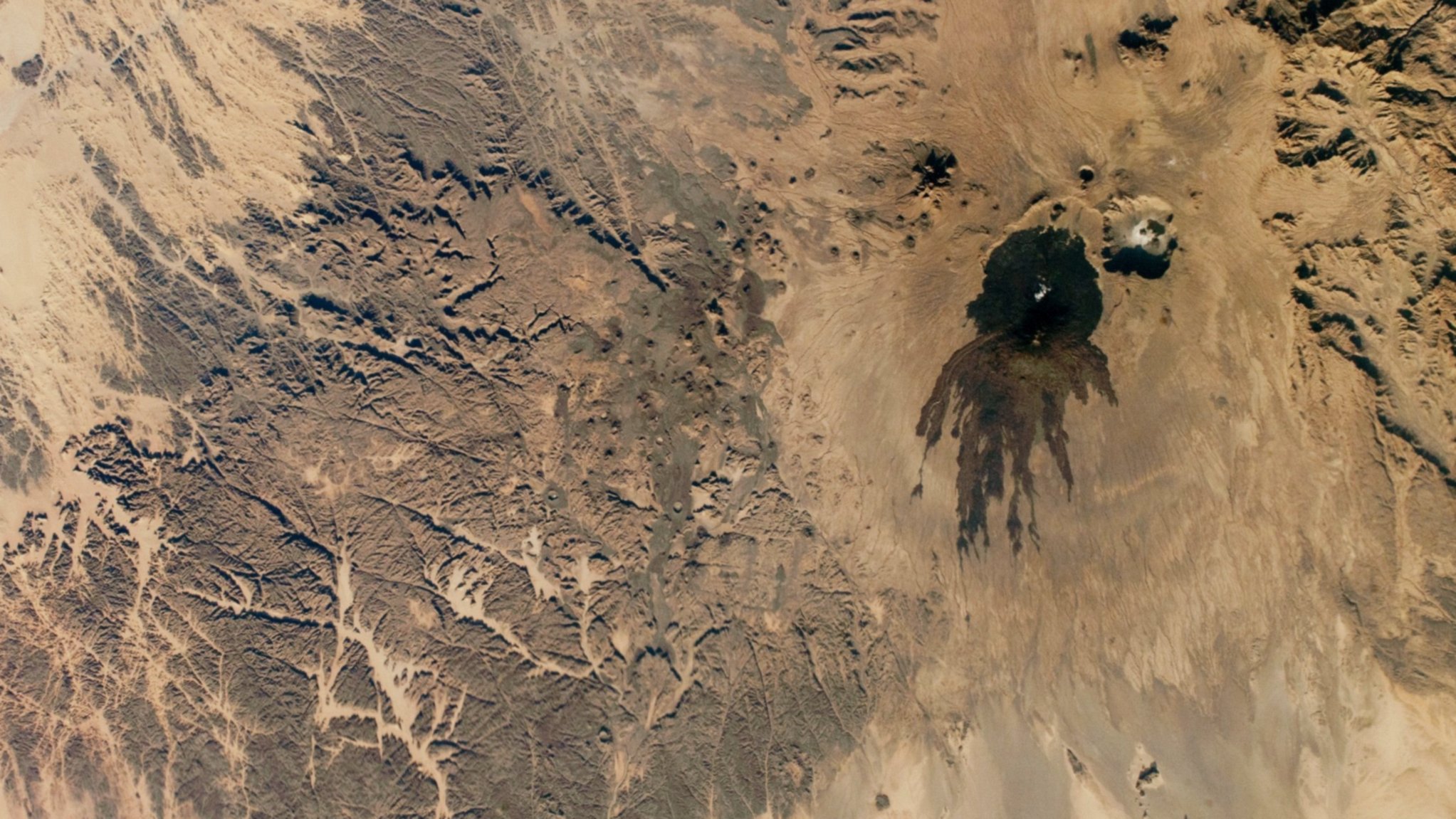
The shadow is real. Dark, jagged, ancient lava stretches across the sand like a bruise on the earth. It clings to the slopes of a volcano that doesn’t really want to talk about being alive. Or dead. It’s complicated.
Near the base lurks something smaller. Something that looks like a skull.
Tarso Toussidé. That’s the name. Or Toussidé. It sits in the Tibesti Mountains, straddling the border between northern Chad and southern Libya, covering roughly 40,000 squ
A Name Like a Warning
The translation hits hard. Roughly: “Which killed the local people with fire.”
Nice imagery. Terrifying, really. But the science offers a shrug. According to the Smithsonian Institution’s Global Volcanism Program, there’s zero proof this mountain has erupted during the Holocene —the last 12,00 years or so.
So maybe nobody actually died from its fire recently.
It stands at 10,71 feet, making it the second-ttallest peak in the range. Still dangerous though. The classification remains “potentially active.” A polite way of saying we aren’t entirely sure.
“It is unclear if it has actuallykilled anyone.”
The ambiguity suits the place.
Layers of Black
The dark mass surrounding the peak is called a massif. It’s not just dirt. It’s layers. Magmatic rock, overlapping like shingles after a long leak, poured slowly from the summit during ancient, effusive eruptions.
Up to 20 miles across at its widest.
Against the pale, wind-carved canyons of the surrounding plateau, the black rock screams for attention. NASA’s Earth Observatory notes that eons of sand-blasting carved those canyons, leaving this dark blob starkly exposed. A reminder of what was here before the sand won.
The Skull
Look southeast. Upper right in the snap.
See the white circle? With the dark patches?
That’s Trou au Natron. A crater. A caldera, if you want the geology degree term. Roughly 3,000 feet deep.
It looks like a face. An eye-socketed, cranium-shaped skull staring down at you.
This particular skull formed more than 1,200 years ago during an explosion so big it punched a hole in the landscape. Inside, it wasn’t always dry. For a time, it held a giant salt lake. Ancient algae lived there. Microorganisms thrived. Then, around the dawn of the Holocene, the water vanished.
Left behind: thick white salt. Two dark cones for eyes. A skull for the ages.
Dust Will Claim It
Toussidé is young compared to its neighbors. The rest of the Tibesti range formed long before this stratovolcano decided to pop up. Probably, the whole area used to match that black hue.
Not anymore.
Wind and sand don’t negotiate. In another 10,00,0 years, the Earth Observatory predicts the massif might just… blend in. Fade away. Return to beige.
It’s only quiet because it’s resting. Small vents, fumaroles, still puff steam from near the top. The European Space Agency says this suggests activity. Technically, yes. It breathes.
Geologists haven’t fully assessed its potential to blow again. Who would blame them for waiting? It’s the middle of nowhere, after all. But the skull is there. The lava is there. Waiting for the next shift.