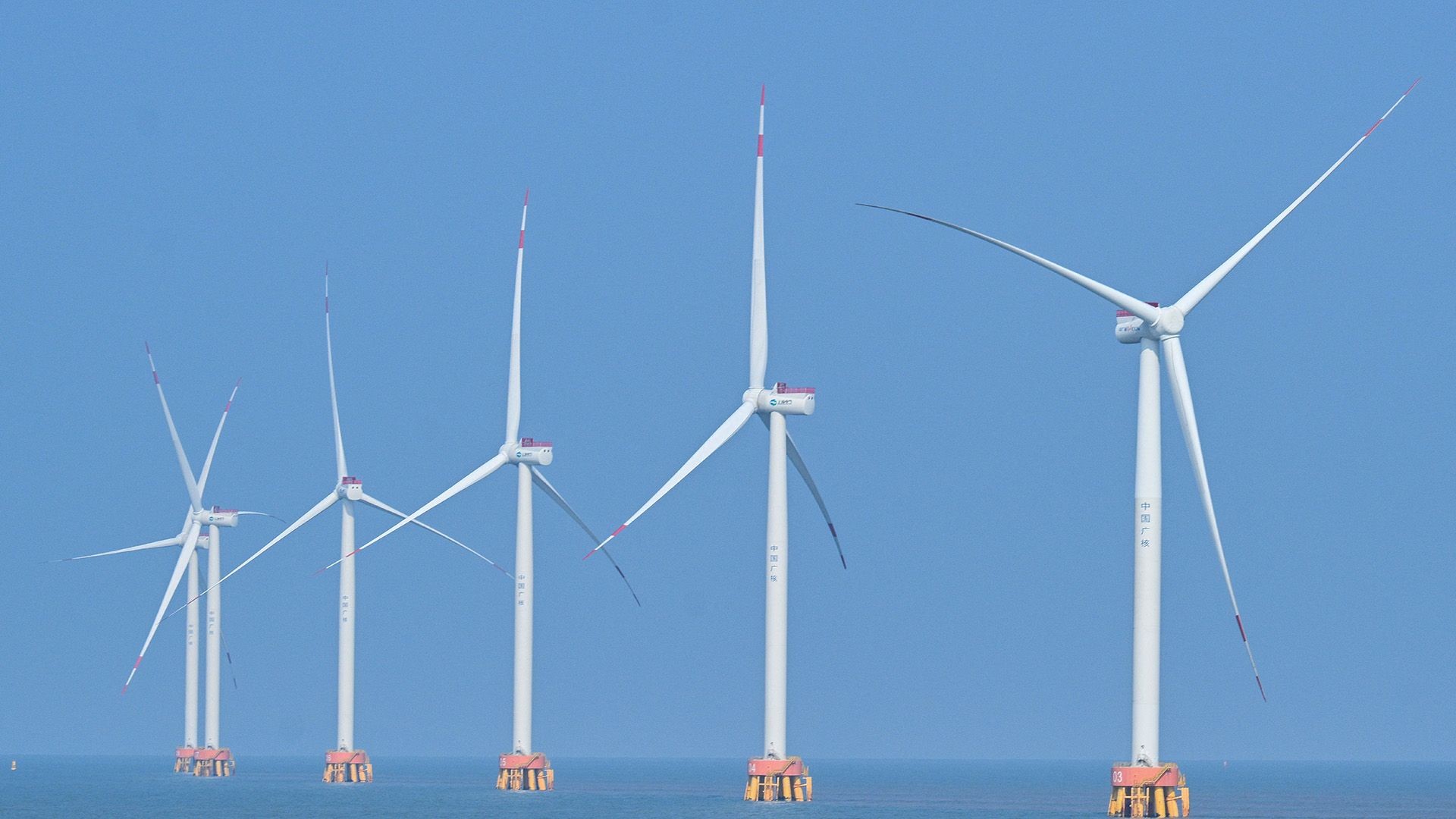
China just bolted the world’s largest floating wind turbine onto the ocean floor.
Or at least the floating platform attached to the turbine did. It’s called Three Gorges Pilot.
Located off Yangjiang in Guangdong province, the 16-megawatt unit completed its installation on May 3. The water there is too deep for the old-school fixed-bottom towers that need to dig straight into the seabed.
Conventional farms get stuck. This one floats.
That changes everything. By sitting on a massive, anchored platform rather than a rigid foundation, the turbine accesses deeper, windier patches of the ocean we usually leave alone.
Engineering for Chaos
CTG Corp built the thing. It sits on a semisubmersible structure.
The rotor spans 252 meters (827 feet). If you stand on the blade tip, you’re looking down from more than 270 meters (886 feet) above the water. That is serious height.
This design follows a similar turbine deployed last year by China Hanganeng Group and Dongfang Electric. But the new model leans harder on structural upgrades. It is meant to break. And keep running.
The platform handles waves higher than 20 meters (66 feet). Wind speeds hit 264 km/h (164 mph). Category 5 hurricane territory.
A complex mooring system holds it all together. Suction anchors, heavy chains, and high-strength polyester lines work with ballast to stop the platform from drifting away. Features are baked into the design to absorb the punch of wind and water, extending the life of the hardware.
The Power Run
Energy gets moved by a 66-kV dynamic subsea cable.
It’s wave-shaped. Flexible conductors. Reinforced armor. It bends with the platform instead of snapping under tension. Most of the assembly happened on land at Tieshan Port. Then it was towed out to the final spot.
At full speed, the turbine spits out 44.65 million kWh per year.
Think about that. The average U.S. home uses 10,50 kWh annually.
Do the math. One turbine powers 4,200 homes.
It is impressive because the integration is a nightmare. Large rotors load the structure unevenly. Stability fights motion. Grid connections offshore are tricky. Floating turbines live in constant motion without losing blade clearance or drivetrain health.
For regions lacking a shallow shelf, this is the door opening to deeper water.