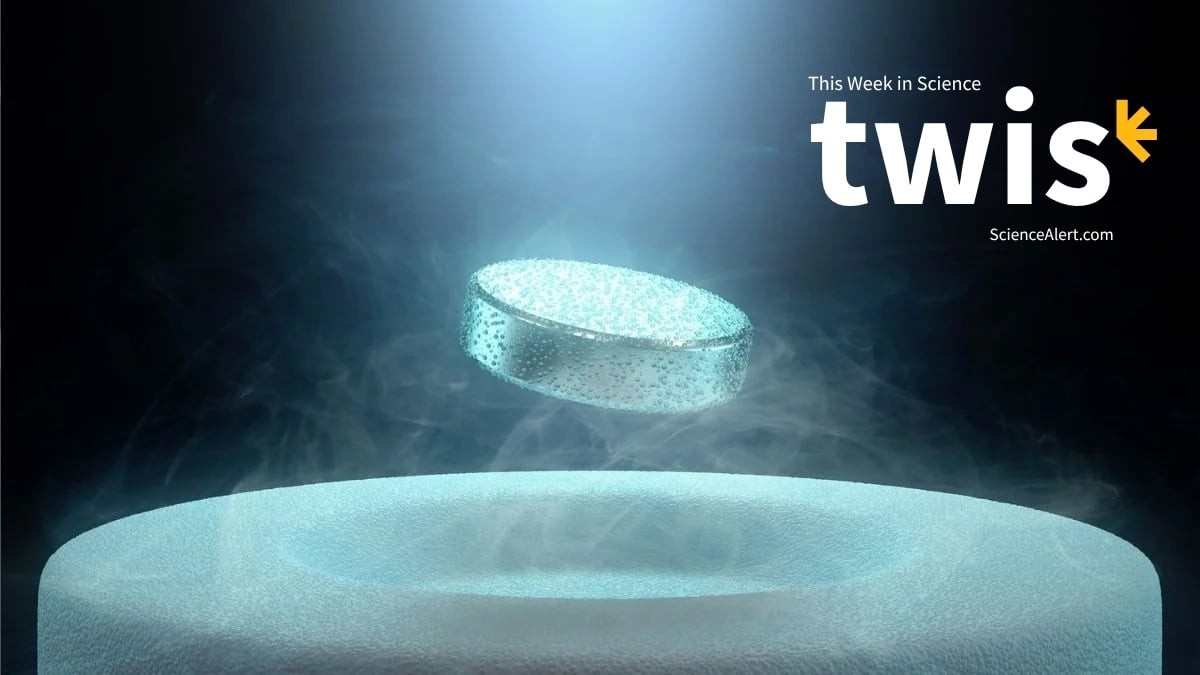
We fix knees. We break records. We reset immune systems. It was a busy week in labs.
Here is what happened.
Gel Beads Quiet Knee Pain
Osteoarthritis is loud. It screams with every step, affecting hundreds of millions globally. We have tried everything for it. Most solutions fall short.
Researchers from Charité – UniversitätsmedizinBerlin found a trick. They inject microscopic gel beads into the knee joint. The target isn’t the cartilage. It’s the new, unwanted nerves and blood vessels that sprout during degeneration. Those structures amplify pain signals. The beads block their blood supply. The pain source starves.
Crucially, the main blood flow to the leg remains intact. The beads dissolve on their own. Over a 12-month trial, knee pain was halved. No major surgery. Just a injection and silence where there was noise before.
A Warm(ish) Record for Superconductors
Superconductors are picky eaters. Or rather, picky thermometers. To work, materials need extreme cold. Or extreme pressure. Often both. This makes them useless for most consumer tech. Imagine if your EV required a diamond anvil to charge. Impractical.
University of Houston physicists changed the bar. They set a new temperature record for superconductivity at ambient pressure. It still requires cold, but less of it. Closer to the real world. We aren’t ready for room-temp wires yet, but the gap narrowed. Slightly.
The closer we get to everyday pressures and temperatures, the closer we are to lossless power transmission.
Resetting the Autoimmune Body
Neuromyelitis optica attacks the brain and spine. Rogue antibodies destroy support cells. The result is often severe disability. Current treatments are expensive and inconsistent. Relapses happen anyway.
Two patients in Italy tried a hard reset. The treatment: allogeneic hematopoietic IRCCS San Raffaeles Scientific Institute. It replaces the patient’s own cells with donor stem cells. It forces the immune system to reboot. To stop attacking itself. Both patients entered remission. It is aggressive medicine for a brutal disease. Does it work for everyone? Probably not. But it works.
Same Mystery on Pluto and Titan
Pluto. Titan. Two completely different places. One orbits Saturn, covered in methane lakes. The other lingers near the sun’s edge, frozen and icy. Both are wrapped in nitrogen-heavy hazes.
JWST found the same chemical signature on both. We don’t know what it is. It doesn’t match known compounds. Solar radiation creates the haze on both worlds. Maybe the same physics creates the same chemistry, regardless of the address. Or maybe we’re missing something obvious.
Light Mimics a Black Hole’s Evaporation
Nothing escapes a black hole. That is the rule. Hawking proposed a loophole in the 1970s. Radiation should leak out. Energy should vanish. We call this Hawking radiation. Seeing it is hard. Seeing its effect —the backreaction where energy loss changes the black hole—was nearly impossible.
Until now. Lorenzo Procopio at Paderborn University used light to simulate the event. They observed the backreaction. The simulated hole lost energy. It evaporated, theoretically. A long-standing theory got its moment in the sun. Well. Its moment in a laser array.
Diet Fixes Gums
Inflammation eats gums. Periodontitis is painful and widespread. We usually brush and floss. But what if the issue comes from the blood?
The fast-mimicking diet restricts calories strictly for several days a month. It stresses the body mildly. In turn, it reduces systemic inflammation. A 6-month trial published in the Journal of Clinical Periodontology tested this. Participants followed the diet. Their gum inflammation dropped. The link isn’t direct. The food doesn’t touch the gums. The blood signals the tissues to calm down. It is a systemic fix for a local problem.
We treat the mouth when the problem starts in the bloodstream.
Science moves fast. Then it moves slowly. This week it did a little of both. We are left with answers for knees and questions for Titan.