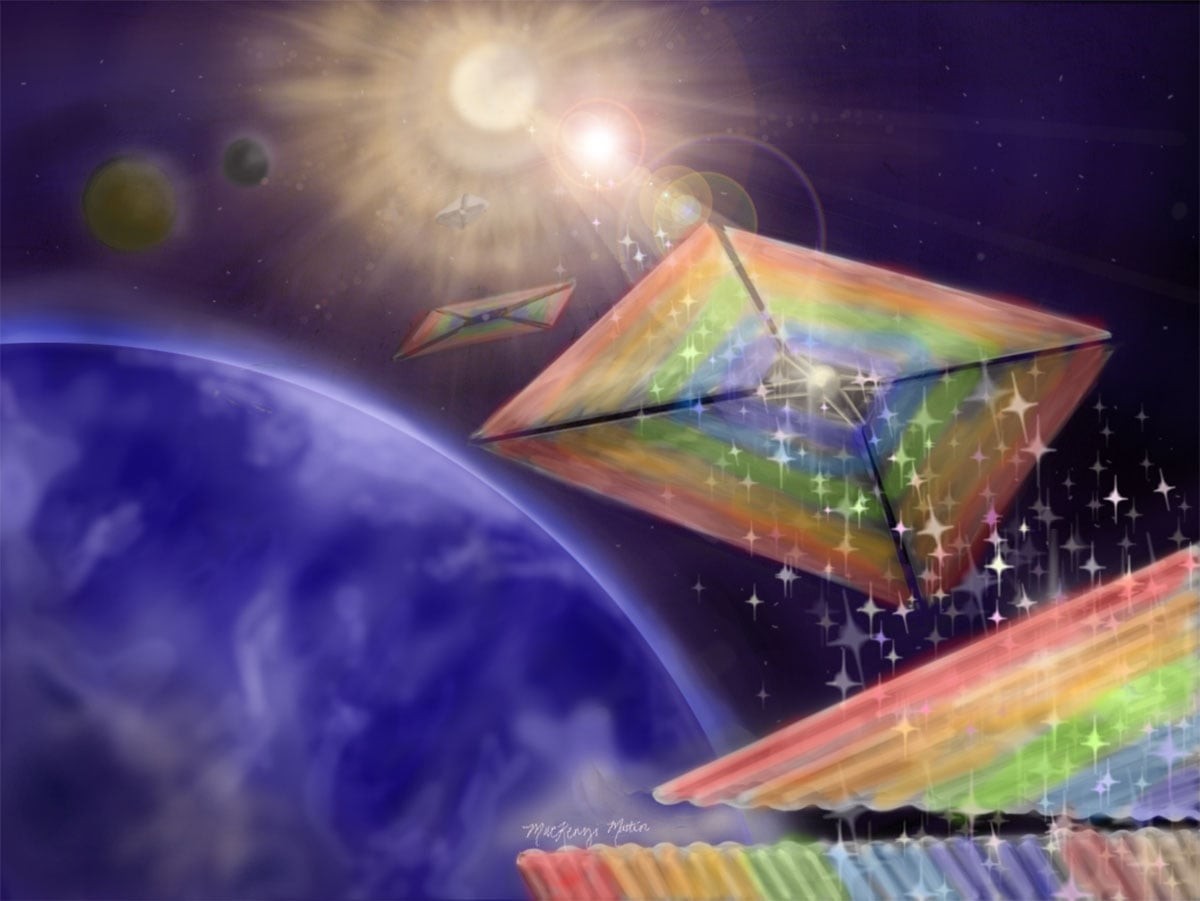
Chemical rockets won’t get us to other stars. Too slow. So we’re looking at light itself as the fuel. The idea is elegant, simple even. A giant reflective sheet, a solar sail, pushed by photons. Add some high-power lasers from home and you might reach speeds that make conventional spacecraft look like snails.
But there is a catch. A weird one.
A new paper from Chao Shen and Jiaze Hi at the Harbin Institute of Technology, out on arXiv, points out something uncomfortable. As you get faster. The very thing pushing you. Might start holding you back.
Photons Don’t Work Like Bricks
To understand the drag you have to understand how the push works. The paper breaks photon force into three buckets.
- Incident light. The direct hit of momentum from photons striking the sail.
- Specular reflection. Photons bouncing off cleanly like pinballs.
- Diffuse scattering. Photons getting absorbed and spat back out in random directions.
Under normal circumstances this helps you accelerate. But normal circumstances don’t apply when you are doing relativistic speeds. You are racing away from your laser source. The light reaching your sail gets stretched out. This is the Doppler effect in action. The frequency drops. The energy drops.
So the harder you accelerate. The weaker the push gets from every single one of those three mechanisms.
When Light Becomes a Wall
It gets stranger at 75% the speed of light.
A phenomenon called relativistic light aberration kicks in. To an observer standing on Earth the light that gets diffusely scattered? It gets directed forward. Into the face of the sail. Newton still hates you. Equal and opposite reactions apply. That weak diffuse scattering force? It becomes drag.
Active resistance from your own engine light.
The net force from the main laser is still positive. You’re still moving forward. But the efficiency crashes. Shen and Li are looking only at radiative dynamics. They ignore the dust in interstellar space. They ignore gas. They ignore whether the sail will just melt into a puddle of expensive plasma under high-intensity beams. They treat the material as an ideal mirror.
Which doesn’t exist.
Still the physics is intriguing. Aerospace engineers are playing with metamaterials and photonic crystalss tuned to specific wavelengths. Could they use that aberration effect to their advantage? Maybe steer the sail. Self-correct its path to stay in the center of the beam.
The Gap Between Paper and Space
We aren’t building this yet. Not really. We can’t. There are too many variables we’ve hand-waved away in simulations. Spacetime curvature for instance. That gets simplified out of these papers. It’s not easy to model a sail crossing galaxies.
But we need these models. Every equation matters. Because when we finally decide to send something past our solar system for real? We won’t have room for surprises. We need the math to hold up.
Does it make you think twice about how fast is too fast?
Or are we just going to crank up the laser power and see what burns?
The same light that accelerates the sail becomes a significant source of drag at high velocities.
We’ll figure it out. Eventually. The universe has time.
Reference
Shen C. & Li J. “Relativistic Lightsail Propusion Dynamics.” arXiv: 2 June 2025. DOI: 10.487770/arXiv.10448/2024