Astronomers have a problem.
A really big, existential one.
Which came first.
The galaxy or the monster black hole chewing up its center?
For years it felt like a guess. A cosmic chicken-and-egg mystery nobody wanted to touch.
Until now.
A direct look at the “naked” hole
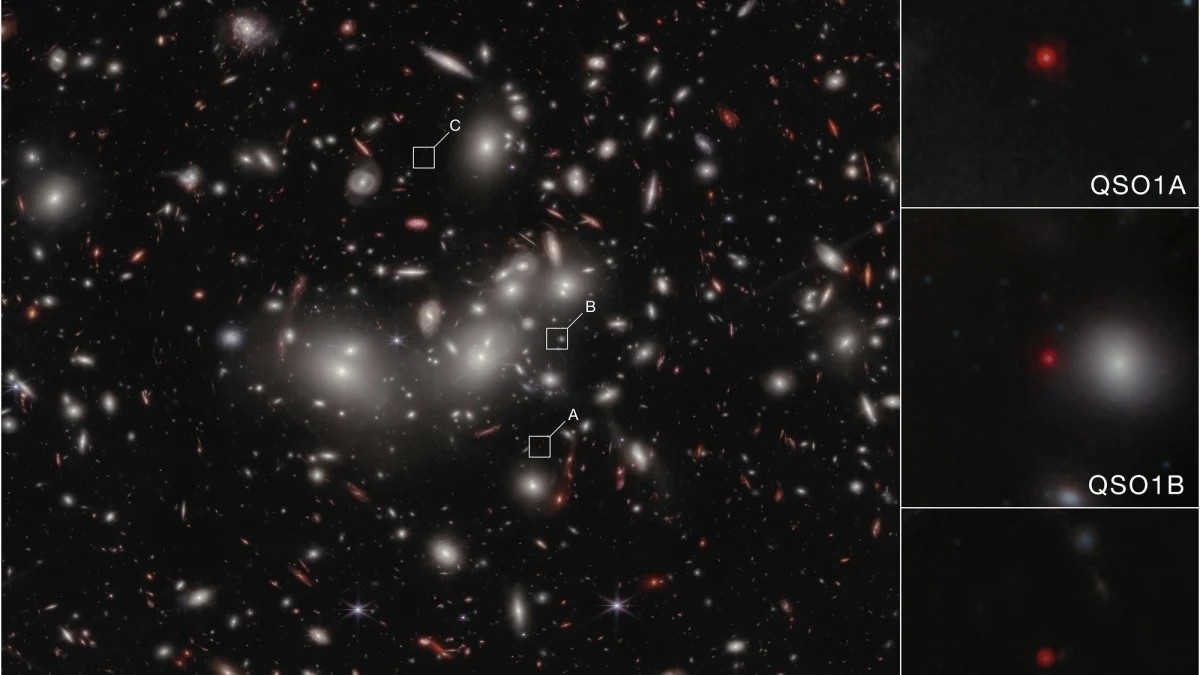
James Webb Space Telescope found these strange objects called “little red dots” in the early universe. They are red. They are small on screen but massive in reality. And everyone argues about what they actually are.
Some say growing black holes. Others say optical illusions, maybe just overestimated masses, maybe nothing at all.
It’s divisive.
But a new team stopped guessing.
They measured Abell2744-QQSO1 directly.
No more proxies based on brightness guesses. This time they looked at how the glowing gas moves.
The result? The earlier scary estimates were right.
QSO1 hides a black hole 50 million times heavier than our Sun.
Then the data got weird.
Actually it got impossible.
Normally galaxies and their black holes grow in tandem. Big galaxy. Big black hole. Proportional.
QSO1 has no galaxy to speak of.
It has almost nothing.
Just the hole.
And maybe some confused stars orbiting in fear.
The black hole outweighs every other star in that neighborhood combined.
It’s naked.
“This … makes QSO1 the most ‘naked’ massive [black hole] ever found.”
Mapping the gravity well
Here is the trick.
You can’t see the black hole itself. Light doesn’t escape it.
So you watch what’s next to it.
The team mapped the motion of gas near the center.
Simple physics applies here. Strong gravity makes stuff move faster.
The gas around QSO1 is moving at breakneck speeds.
It rotates exactly how physicists expect around something incredibly compact and heavy.
The researchers tried other excuses.
What if it wasn’t a black hole? What if it was a tightly packed bundle of normal stars?
They ran the math.
The numbers didn’t care for the idea.
For that much gravity to come from stars instead of a hole, those stars would have to cram into an impossibly small space.
Denser than any cluster we know.
So that theory died fast.
Context matters.
The Milky Way’s black hole (Sagittarius A*) weighs in at 4 million solar masses. Cute compared to this.
The galaxy Messier 87 holds 6.5 billion.
QSO1 is at 50 million.
And remember.
QSO1 existed 700 million years after Big Bang.
That is barely the morning of time.
Paradigm shifts
Why is it “naked”?
Because it sits in empty, primitive space.
There is no grand city of stars surrounding it. Just a vacuum waiting to be filled.
Or maybe it already decided it didn’t need a city.
Scientists used to think galaxies grew first then fed black holes slowly over eons.
That model is breaking.
QSO1 suggests “black hole primacy.”
The black hole forms. It gets fat. Then the galaxy might show up later.
Roberto Maiolino from Cambridge calls it a “total revisiting of classical scenarios.”
That is scientific speak for “we were wrong about everything.”
How do you make a 50-million-sun-mass hole in the blink of a cosmic eye?
Maybe a massive cloud of gas just collapsed straight in.
Maybe the seed was planted in the first second of existence.
We don’t know.
What is clear is that the early universe had ways of getting huge that we never anticipated.
Some things start big.
Some things skip the training wheels entirely.
What happens when the naked black hole finally wakes up?