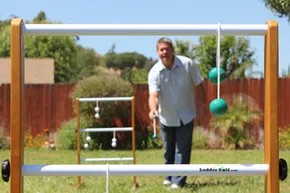
I walked into a backyard barbecue expecting nothing more than lukewarm burgers and awkward small talk. Instead, I found myself holding three heavy, tethered red balls, staring down a plastic ladder while my friends laughed. I had just discovered ladder ball. Or as the rest of the planet calls it, whatever they want. For years, the rest of the world has been tossing tethered golf balls at ladders. I was late to the party, but I stayed for the beer spill that followed my first successful wrap.
It is arguably better than Baggo.
What Is Ladder Ball Called?
If you go to a hardware store and ask for “ladder ball,” you might get a blank stare. You are more likely to hear a dozen other names. The original packaged version is Ladder Golf, a brand name coined by Matt Peterson. Peterson noticed people playing this makeshift game on campgrounds in the 1990s. He saw a gap in the market. In 2003, he launched Ladder Golf, Inc. with two friends.
Since then, the terminology has fractured. You might hear locals call it ladder toss, rodeo golf, or hillbilly horseshoes. Some people say flingy pongy. Others use bola toss or blongo ball. (I still have no idea where that last one came from, and I am too afraid to ask.)
Regardless of the name, it sits comfortably in the lawn game category alongside bocce and cornhole. It is designed for leisure. It is social. It does not require a flat surface, making it perfect for uneven backyards or dusty campgrounds.
How to Play Ladder Ball
The rules are deceptively simple. You stand five paces from the ladder. You aim. You toss. You hope the bolas wrap around the rungs.
But it is not just about how many you can snag. The scoring system introduces a layer of strategy that keeps the game tense. You are not just counting wraps; you are trying to outmaneuver your opponent’s score. The game ends when one player reaches 21 points. If a player scores on their turn and ends up with a lower total than their opponent, they do not get those points. This rule prevents early leads from cementing too quickly and keeps the loser fighting until the very end.
You only need one hand to play. This is essential. It means you can hold your drink in the other hand. It means you do not need to put anything down. It is the ultimate low-friction activity for adults who want to feel competitive without breaking a sweat.
Which Ladder Ball Set Should You Buy?
Price varies wildly depending on what you are buying. I picked up a basic plastic set for $35. You can find sets ranging from $25 to $150. The cost is mostly driven by the material of the ladders.
- Plastic: The cheapest option. Good for casual play. Easy to store.
- Metal: Mid-range price. More durable than plastic. Heavier feel.
- Wood: The premium choice. Most expensive. Looks best in a backyard.
Some sets come with carrying cases. If you plan to
The rules aren’t carved in stone. This is a leisure game, after all. But if you want to play by the most common instructions—specifically those from Ladder Golf, Inc.—you need to know what’s in the box. You get either one or two ladders. They stand about 3 feet tall and 2 feet wide. That’s roughly 1 meter by 0.5 meter. Alongside them, you get six bolas. Two colors. Each bola is a vinyl cord, about a foot long, with a golf ball on each end.
Gameplay stays the same whether you use one ladder or two. The only thing that changes is where you stand.
Set the ladder(s) on the lawn. Establish a toss line. If you have two ladders, they can serve as each other’s toss lines. The active player must stay behind this line. It’s typically five paces out. Or 15 feet, which is 4.5 meters. Some instructions say 25 feet. That’s huge. Bola colors vary by brand. Let’s say they’re red and blue. One player grabs all three red bolas. The other takes all three blue.
Flip a coin for who goes first. Let’s say it’s the red player. From behind the toss line, they toss each red bola at the ladder. It’s allowed to bounce off the ground first. The goal is simple: wrap each one around a rung.
(Variation: Bolas that bounce don’t count.)
Red tosses all three. Then Blue is up. Six tosses make a round.
(Variation: Red tosses one, then Blue tosses one. Alternating until all six are thrown.)
You can toss any way you want. Underhand is standard, though. Keep the balls separate as you toss so they hit the ladder spread out. Ready to hang. An effective method is holding one ball in your hand while the other dangles. Then gently arc the bola toward the rung you’re going for.
When I played, I just aimed in the general direction of the ladder and hoped something stuck. But if you’re playing to win, you need to hit a specific rung. You want a specific number of points. This is probably the most complicated aspect of the game.
How to Score in Ladder Ball
Not all ladder rungs are equal. The top rung is worth three points. The middle rung is worth two. The bottom rung is worth one.
The goal is to be the first player to reach 21 points without going over. If you score higher than 21, the toss is discarded. Say you had 19 points. You toss. You wrap a bola around the top rung. You’re now at 22. That toss doesn’t count. You keep retrieving bolas and tossing until someone makes the score.
(Variation: Scoring over 21 brings your point total down to 11, 13, or 15. Yikes.)
More important, a bola only counts if it is wrapped around a rung at the end of the round. If Blue ends up knocking his own bola off the ladder on a subsequent toss, that bola doesn’t score any points. If Blue knocks a red bola off the ladder, that one doesn’t count, either. So aiming for an opponent’s bola is good strategy. Aiming for your own is not.
A red bola and a blue bola on the same rung cancel each other out. If at the end of a round there’s one red and two blue bolas on the third rung, Blue gets three points. Red gets none.
(Variation: All bolas on a rung count. In the above example, Red would score three, and Blue would score six. This can speed the game up.)
If both players make it to 21 at the end of a round, an overtime round commences. In overtime, there is no point limit. But a player needs to be ahead by at least two points at the end of the round to win. Overtime rounds continue until one player finishes a round ahead by two.
You can also play ladder ball in teams of two. It’s not much different. Team members simply alternate tossing by round. You don’t necessarily need two ladders for team play. Most sets come with two, though. You might as well use them. It saves time. No running back and forth for the bolas between rounds.
Plus, with one player from each team at opposing ladders, it raises the level of trash talk. Which is critical in any lawn game. Spilling beer while celebrating is optional. Apparently, it’s good for the lawn. Who knew?
Slingin’ Snakes?
No one knows who came up with ladder ball in the first place. But the best story goes back to classic cowboy days in Mexico and the American West. The tale has bored cowpokes tossing snakes at trees, trying to wrap them around branches. Not sure why they wouldn’t have tossed the bolas cowboys used to bind the legs of cattle on the run. But the snake story sounds better anyway.