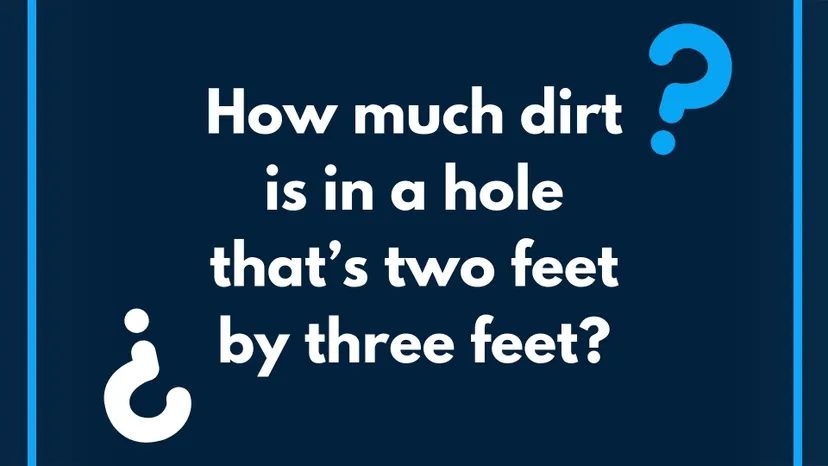
It’s one of those classic brain teasers that tricks you into overthinking. You hear the setup, your brain starts spinning wheels, and by the time the punchline hits, you’re just nodding in defeat. The answer? None. It’s a hole.
Simple, right? Or is it?
We’ve all been there. A group of friends around a table. Someone throws out a riddle that seems deceptively straightforward. The room falls silent. People lean in. And then the reveal happens. The answer was sitting right in front of us the whole time.
The Power of Wordplay
This specific riddle is a masterclass in linguistic misdirection. It relies on a double meaning that’s easy to miss until it’s pointed out.
When we hear the word “none,” we think of absence. Nothingness. Zero. But in this context, it’s being used as a proper noun. Or rather, a title.
“None” isn’t just a lack of something. It’s the name of the thing itself.
Think about other riddles like this. They work because they force you to abandon your logical framework and accept a playful, absurd reality. It’s not about finding the correct answer in a traditional sense. It’s about recognizing the joke.
Why We Love Bad Riddles
There’s a certain joy in being fooled. It’s a low-stakes way to engage with language. We like to feel clever. And when we aren’t, it’s funny. Especially if the joke is on us.
This isn’t about intelligence. It’s about flexibility. Can you drop your assumptions? Can you let go of the idea that the answer has to be complex?
The riddle doesn’t care about your GPA. It doesn’t care about your degree in linguistics. It just wants you to laugh.
The Cultural Impact of Simple Humor
We live in a world of over-complicated information. Every click leads to another page. Every question has a five-step tutorial. We’re exhausted by depth.
Sometimes, we just want surface-level fun. A quick hit of dopamine. A riddle that resolves in seconds.
This particular joke has circulated for decades. Maybe longer. It’s part of the oral tradition of playgrounds and family vacations. It’s the kind of thing you hear from an uncle who’s had one too many beers at Thanksgiving. And yet, it still works.
Why? Because it’s honest. It’s not trying to be profound. It’s not trying to teach you anything. It’s just playing.
Beyond the Hole
But let’s look closer. Is it really just about the word “none”?
Consider the structure. The question implies a container. A space. A void. And the answer fills that space with a word that means empty.
It’s self-referential. The answer describes its own emptiness.
That’s clever. It’s not just a pun. It’s a paradox.
A hole is a space that is defined by what is missing.
“None” defines a space by what is missing.
The riddle is a loop. It closes in on itself. And when you step back from it, it feels satisfying. Not because you solved it, but