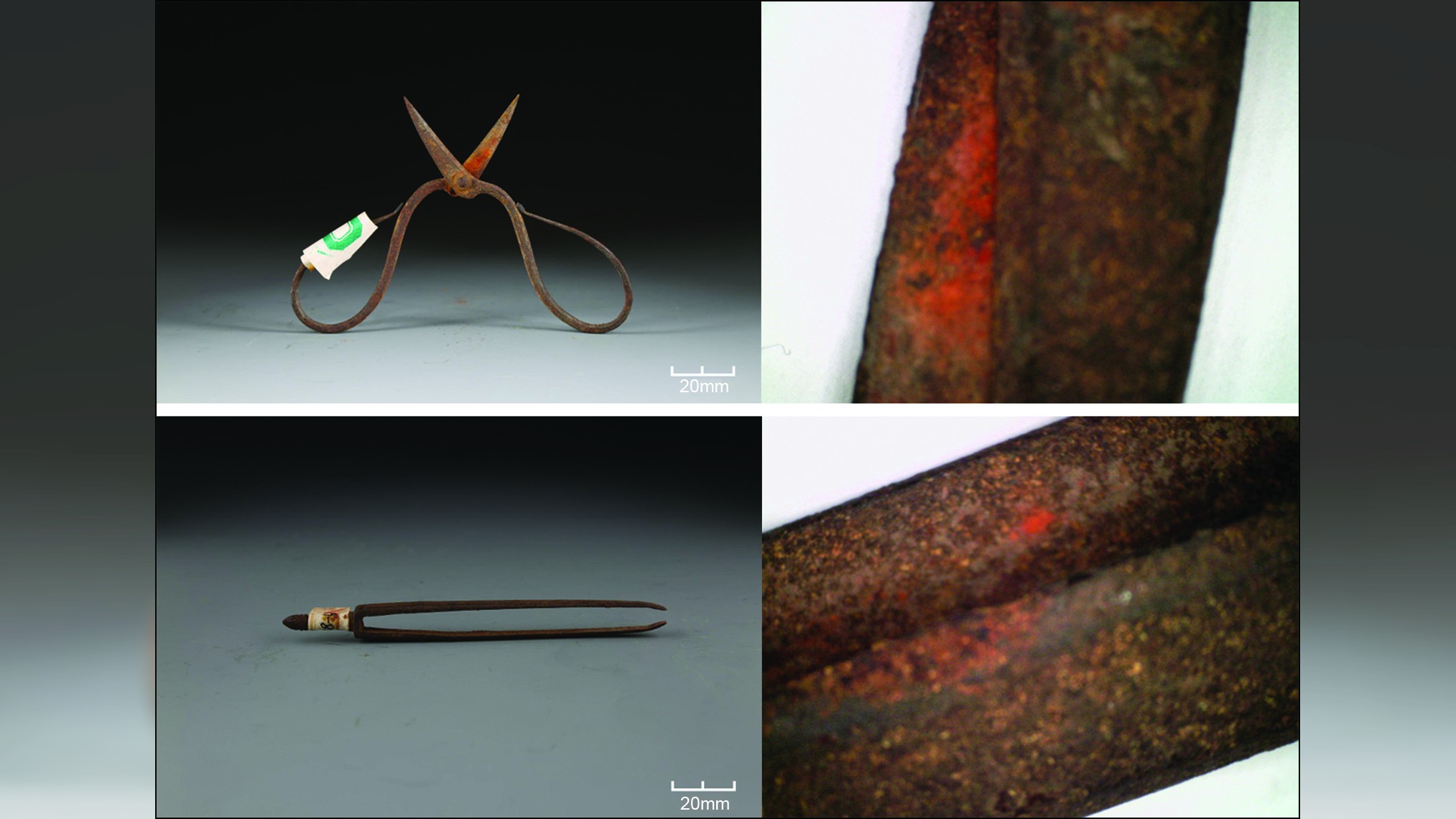
Iron. Old iron. Rusted after six hundred years underground. But if you shine a laser at the crust left on Ming Dynasty surgical tools, the past talks back. It tells us about pain. And how we stopped caring about it.
A team led by archaeologist Congcang Zhao found something no one had physically proven before. The first chemical proof of a topical anesthetic. It was sitting on a pair of scissors and some tweezers. Recovered decades ago from the tomb of Xia Quan, a surgeon buried in Jiangyin.
“Six centuries ago… today we have read the traces… left on those instruments.”
They used X-ray fluorescence to confirm the tools were just iron. Nothing special. Then they switched to micro-Raman spectroscopy. This beams lasers at microscopic residues to scatter photons. It’s how you get a molecular fingerprint.
The residue said it all. They found oils, fats. But mostly the cyano functional group. That means hydrogen cyanide. Specifically, they found traces of aconitine.
This is where it gets dark. Aconitine comes from the Aconitum plant. Chinese wolfsbane. Monkshood. It is extremely poisonous. One bite could kill you. Why put it on a wound? Because it stops pain. Brilliant, terrible trade-off.
The Ming doctors weren’t dumb. They knew how to handle it. They didn’t just grind the plant. They detoxified it.
How? With acidic stuff. Mung beans. Vinegar. Even the urine of young boys. Sounds grim now, but back then it worked. It turned a deadly toxin into a safe, numbing powder or liquid.
The residue wasn’t everywhere. It was concentrated on the cutting parts of the tools. The tips of the scissors. The gripping ends of the tweezers. This wasn’t accidental splatter. This was intentional use. A surgeon would apply the numbing juice, hold the skin taut with the tweezers, and cut. Minor surgery, but done with precision.
We often forget how scary surgery was before modern medicine. Did you think it wasn’t?
Zhao calls it a balance of drug potency and safety. Practical. Effective. The anesthetic likely splashed on the iron, never washed off properly, and slowly corroded into that rust-colored clue.
It’s the first time we have seen the chemicals directly. Medical texts hinted at it for centuries. Now we see the physical evidence. A 600-year-old snapshot of someone choosing safety over sheer brutality.
The tools are iron. The plants are wild. The chemistry is precise. And the patients? They probably slept through the worst of it.