It is old. Like, really old.
Twelve billion years old. That is how long ago Comet 3I/ATAS might have frozen into existence, back when the Milky Way was still figuring itself out.
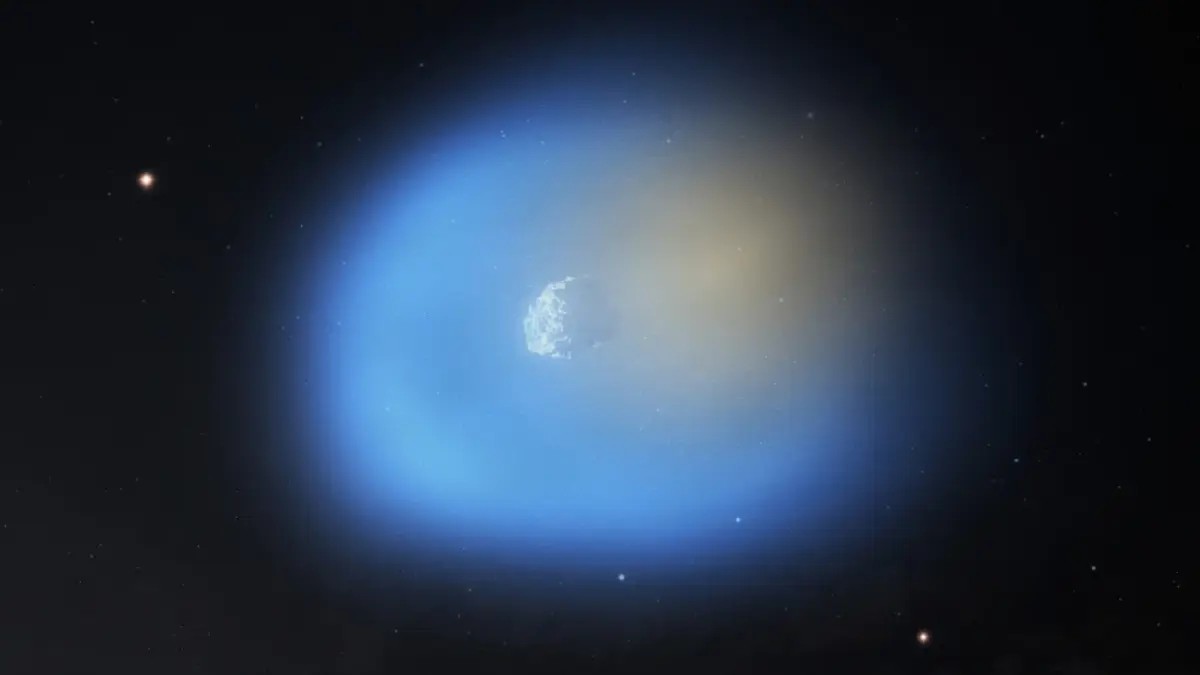
We saw it last year. Late 2025. It swung past the sun and got warm, shedding gas in huge amounts. That release was a gift for scientists, a rare chance to peek inside something that isn’t ours. The James Webb Space Telescope watched it closely, staring at isotopes of hydrogen and carbon. These aren’t just chemicals, they are fingerprints. Long-lasting, stubborn records of where this thing started.
And the fingerprints don’t match anything in our neighborhood. Not our solar system, not the nearby star-forming nurseries we study. They point somewhere else. Somewhere much, much further back in time.
“This was a unique opportunity to study an alien object from the distant galaxy.”
— Martin Cordiner
It likely formed in a place so cold, so chemically simple, it makes the edge of our system feel like a greenhouse. The material might be 7 billion years older than the sun. Four billion years older than early guesses. If true, 3I/ATLA is a ghost. A fragment of the galaxy’s first chapters.
What even is it?
Comets are leftovers. Icy rubble from when stars first pulled themselves together from dust and gas. They sit in the dark for eons, mostly quiet, made of frozen water, dust, and rock. But get too close to a star, and things change. Ice heats up, turns directly into vapor. No liquid stage. Just gas expanding outward, glowing, sometimes forming a tail. Simple physics. Boring, really. Unless the comet is interstellar.
3I/ATLAS wasn’t born here. It got kicked out of another system. Probably a gravitational nudge from a rogue planet or a passing star, sent drifting into the void. It wandered for millions, maybe billions, of years before finding its way into our local cluster. We have seen only two others before this one. ‘Oumuamua showed up in 2017 but turned out not to be a true comet. Then 2I/Borisov appeared in 2019, clearly cometary, clearly alien. 3I/ATLAS joins this tiny, exclusive club.
But this visitor brings baggage. Weird baggage.
Its water has a deuterium problem. Deuterium is heavy hydrogen, and 3I/ATLS is swimming in it. Over thirty times more than comets in our own system carry. Its carbon isotopes are just as strange, falling outside every range we’ve mapped in local gas clouds. The chemistry suggests it formed in temperatures below minus 400 degrees Fahrenheit. And stayed there. Little has changed since then.
Does this change everything we thought we knew about space? Probably not overnight, but it adds a piece to the puzzle we didn’t have before.
The data came from NIRSpec on the Webb telescope. The journal Nature published the results. Researchers cannot track its exact home star. Too many billions of years. Too many gravitational tugs. Its orbit is scrambled beyond repair, mixed into the background noise of the Milky Way’s history. So chemistry has to tell the story.
The story says its birthplace was poor in heavy elements, yet enriched by earlier waves of massive stars that died long before. An early burst of star creation. A violent, creative beginning.
Stefanie Milam from NASA sees this differently than an astrophysicist might. She sees prebiotic chemistry.
“We know of only one place in this vast cosmos where the chemical ingredients led to life—our Earth.”
— Stefanie Milam
If 3I/ATLL holds its age, it lets us look directly at how the very first planets might have formed. Before life existed here, or anywhere. Before Earth cooled enough for oceans. Just ice and time and strange ratios of atoms.
It forces the question. Was the stuff that built Earth normal? Or are we the odd ones out, cooking our ingredients at the wrong temperature? We have only one sample point for life, Earth itself. Now we have another sample point, ancient and frozen and completely unrelated to our history.
What does it mean for the odds? Maybe nothing. Maybe everything. The comet moves on, disappearing into the dark from which it came. We are left with numbers, with ratios, and the sense that the galaxy is far older, and stranger, than we imagined.