It might not be a planet at all.
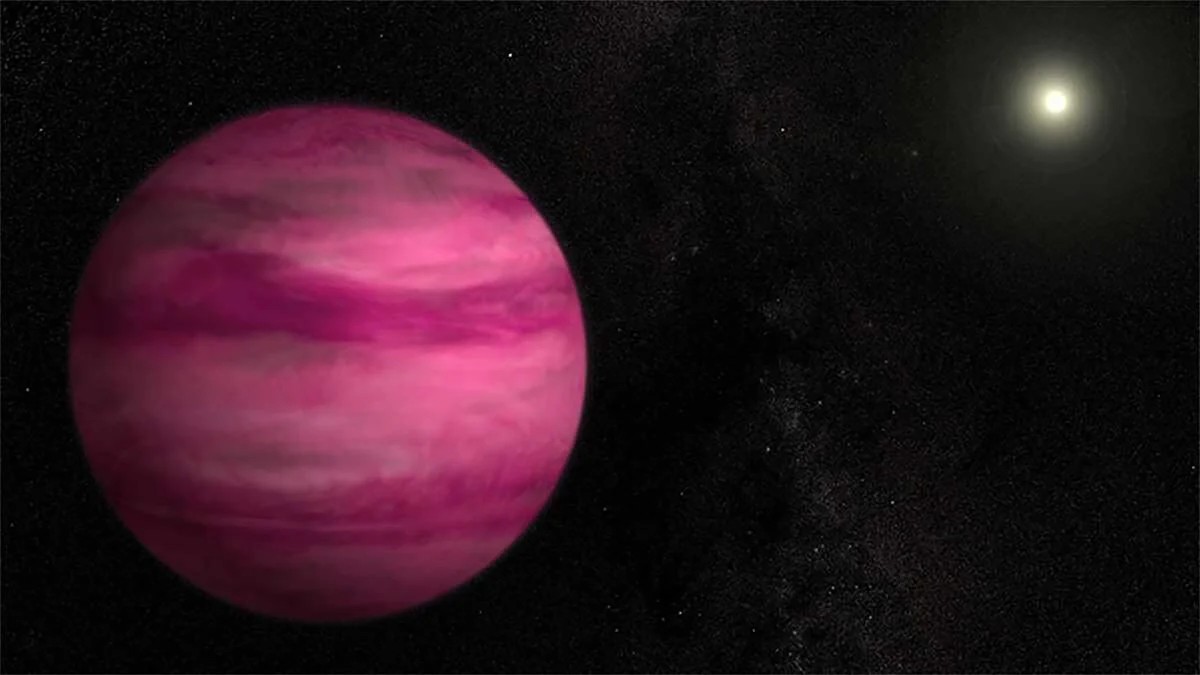
Or maybe it is. The object in question, GJ 504b, sits 57 light-years away from Earth, circling a sun-like star. It looks pink. At least, that is what the data suggests.
NASA’s James Webb Space Telescope got its first real look at it. No more guessing based on brightness alone. For the first time, scientists split its light into a spectrum to read its atmosphere directly. A team led by Aneesh Baburaj of Northwestern University did the heavy lifting. Their findings landed in The Astronomical Journal.
What they found?
Salt clouds.
Not the kind you eat dinner with. Forget Himalayan rock salt or table salt. This is atmospheric chemistry on a grand scale.
We are talking about temperatures around 550°F. Hot? Yes. But cold? In exoplanet terms, yes. Most gas giants scream heat when they form. GJ 504b has been around for 2.5 to 4 billion give-or-take. It has had time to cool off.
Previous theory said salt clouds could exist in this temperature range—400°F to 1,20°F—but 15 years passed without anyone spotting them. GJ 5040b changes that.
“Salt clouds are unusual,” Baburaj told Mashable.
What exactly makes these clouds?
Alkali metal compounds likely. Maybe potassium chloride. Or perhaps manganese sulfide. Gases cool down in the atmosphere, condense into solid microscopic grains, and float around scattering light. Just like water vapor forms rain here, but with extreme ingredients instead.
Does this mean the world actually shines pink?
Sort of.
The light from its star filters through these salt grains. The atmosphere adds a warm, faint pinkish tint to the spectrum. It is subtle.
The big mystery remains: What even is this thing?
Astronomers still aren’t sure.
Is it a massive planet, roughly 25 times heavier than Jupiter? The chemistry leans that way. The object holds more heavy elements, like carbon, than the star it orbits. That signature usually means it formed in a gas-and-dust disk, like planets do.
Or is it a brown dwarf?
A failed star. Too small to fuse nuclear power, too big to be a standard planet.
The salt clouds fit both scenarios. The age fits both. The data is detailed now, better than ever before, yet the classification hangs in the balance.
It is a pink haze in a distant sky, filled with drifting minerals. We have a name for it now, effectively, even if we cannot agree on its species.
Maybe we’ll figure it out soon. Or maybe the salt clouds are just beautiful mysteries on their own.