Illegal wildlife trade is messy. It’s dirty money, corrupt politicians, and biodiversity burning up while we look away. Prosecutions are almost nonexistent.
Alexandra Thomas and Louise Gibson don’t like that. At the ZSL Wildlife Forensic Lab in London, they are trying to fix the gap between crime and consequence. Their method is visual, stark, and hard to ignore.
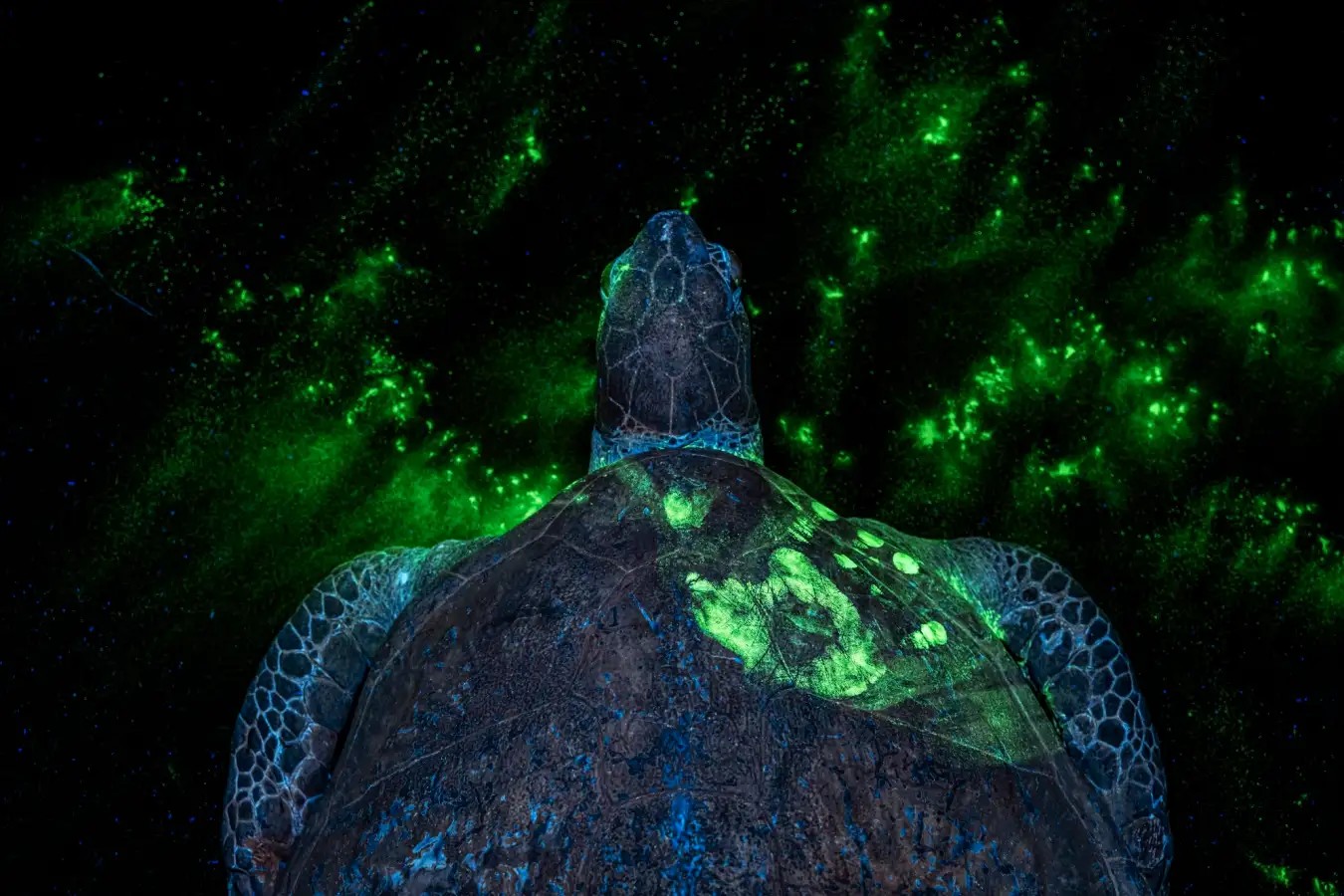
This is the winner. Britta Jaschinski’s photo of a dead green sea turtle (Chelonia mydas ). See that glowing handprint? That’s not paint. It’s forensic fluorescent powder under ultraviolet light. It catches poachers. It catches traffickers.
The same UV setup finds blood. It finds gunpowder. It finds things criminals want buried.
The handprint itself remains classified, who left it and how. That secrecy is the point. Evidence is evidence until it hits the courtroom.
The Prince Albert II of Monaco Foundation called this image the overall winner this year. And for good reason. It looks like crime scene drama, but it’s conservation science.
Jaschinski knows what she is shooting. Elephants, rhinos, pangolins — they vanish into supply chains that feed organized crime.
“It fuels corruption. It risks pandemics,” Jaschinski says. Animals don’t just die; the trade vector jumps diseases to humans. The industry is huge. The stakes are lethal.
Sergio Pitamitz ran the prize committee. He likes Jaschinski’s restraint. No gore for gore’s sake. No shock tactics. Just clarity. A photo that tells a jury what happened without screaming for attention.
The rest of the competition had its own moments.
Henley Spiers won the ocean category. A wedge-tailed shearwater (Ardenna pacifica ) diving into a football field-sized swarm of lanternfish.
It missed.
The bird resurfaced empty-handed. It circled. It tried again. Lanternfish make up to 65% of deep-sea vertebrate biomass. They are the most numerous creatures we share this planet with. And we barely see them.
Then there was Vadim Makhorov in the polar category. His photo shows Pacific walruses (Odobenus rosmarus divers ) huddled on the southern coast of Ratmanov Island. Russia. Far east.
These are big animals. Males hit four meters. One and a half tonnes of muscle and bristle. Only females visit the sand for breeding. The males? They live here. On the rock.
Maud Delaflotte came second for changemaker work. Black soldier flies (Hermetia illucens ). Not glamorous. Insect protein. Feeding livestock bugs instead of soya or fishmeal.
It might smell. It might look strange. But it saves the forests. It cuts the carbon.
The turtle glows in the dark now. The traffickers do not. We just need the system to pay attention.
Will they? Maybe. The UV light works. The question is whether anyone is holding the bulb steady. 🌊📸