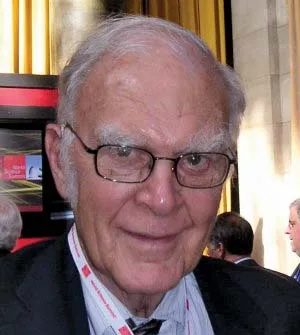
It starts with a thought experiment. A young chemist named F. Sherwood Rowland imagines a world where the air we breathe isn’t just inert. It’s reactive. Dangerous, even.
Rowland was born in Delaware, Ohio, in 1927. He wasn’t looking for fame. He was looking at the chemistry of the atmosphere. By the early 1970s, he was teaching at the University of California, Irvine. His colleague was Mario Molina. They were curious about chlorofluorocarbons, or CFCs. These were everywhere. Refrigerators. Air conditioners. The propellants in spray cans.
They seemed stable. Harmless. But Rowland and Molina asked a simple, terrifying question: What happens when they rise?
The Chemistry of Destruction
The answer lay in the stratosphere. High above, solar radiation hits CFC molecules. The bonds break. Chlorine atoms are released.
Here is the critical detail that changed everything. One chlorine atom doesn’t just destroy one ozone molecule. It acts like a key in a lock, repeating the cycle. It tears apart ozone, regenerates, and destroys another. And another. A single atom can eliminate thousands of ozone molecules before it is finally removed from the atmosphere.
Ozone protects us. It blocks ultraviolet radiation. Without it, the skin cancer rates would skyrocket. Ecosystems would collapse.
Rowland and Molina published their findings in Nature in 1974. The scientific community was skeptical. CFCs had been around for decades. No one had seen the damage yet. But the math was sound. The mechanism was clear.
From Theory to Global Ban
Skepticism is part of science. But evidence accumulates. In 1976, the National Academy of Sciences reviewed the data. They agreed. The threat was real.
Three years later, the United States banned CFCs in aerosol sprays. It was a small step. A necessary one. But the problem was global. CFCs don’t respect borders.
The mid-1980s brought undeniable proof. Scientists discovered a massive hole in the ozone layer over Antarctica. It wasn’t just thinning. It was disappearing. The Rowland-Molina hypothesis was confirmed.
This wasn’t just an academic victory. It led to the Montreal Protocol in 1987. Nations came together. They agreed to phase out the production of ozone-depleting substances. It remains one of the most successful international environmental treaties in history.
Rowland didn’t stop there. He continued to work on atmospheric chemistry. He was elected to the National Academy of Sciences in 1978. He spent his career at UC Irvine, shaping the next generation of scientists.
Mario Molina and Paul Crutzen shared the 1995 Nobel Prize in Chemistry with him. They were recognized for their work on ozone depletion. Rowland died in 2012, in Corona del Mar, California.
But the air is different now. The hole is slowly healing. The ozone layer is recovering. It’s a slow process. It takes decades for the atmosphere to reset. But the direction is clear.
We changed our chemistry to save our shield. It wasn’t easy. It required proof. It