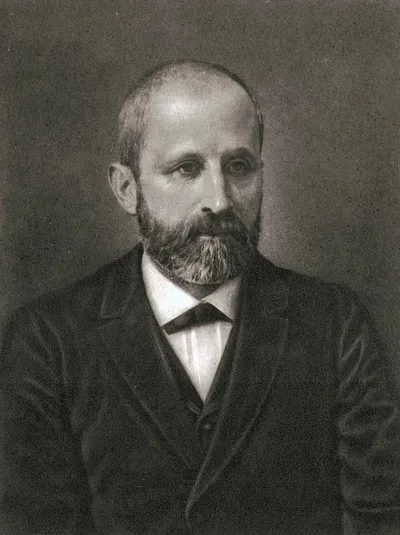
He was looking for protein. That was the goal in 1869. Friedrich Miescher, a young Swiss researcher at the University of Tübingen, was trying to isolate the building blocks of cells. He didn’t have the modern tools we use today. No sequencers. No microscopes capable of seeing the double helix. He had pus. Specifically, pus from surgical bandages, rich in white blood cells. It wasn’t glamorous. It was gross. But it was where the nucleus lived.
When he treated those cells with alkaline solutions, he expected to find the proteins he was hunting. Instead, he found something else. A substance that clung to the nucleus. It was rich in phosphorus. It was rich in nitrogen. It didn’t behave like the proteins of the time. Miescher called it nuclein. He had stumbled onto what we now know as deoxyribonucleic acid, or DNA.
How Friedrich Miescher Discovered Nucleic Acids
The discovery wasn’t a lightning bolt moment. It was a slow, methodical unraveling. Miescher was working under Ernst Hoppe-Seyler, a prominent physiologist. The team was interested in cell metabolism. They wanted to understand how cells burn energy and build structure.
Miescher isolated the nucleus from white blood cells. He extracted the substance inside. He tested it. It contained phosphorus. Proteins typically contain nitrogen, sulfur, and carbon. They don’t usually pack phosphorus in such high concentrations. This was an anomaly. A chemical outlier.
By 1874, Miescher had refined his technique. He separated nuclein into its components: a protein part and an acidic part. The acid component was the new discovery. It became known as nucleic acid. It wasn’t until much later, in the 20th century, that scientists would understand its role in heredity. Miescher didn’t see the future. He saw a weird chemical. But that chemical held the code for life.
Why His Work Matters for Modern Science
Most people think of DNA discovery as a mid-20th-century event. Watson and Crick. Rosalind Franklin. The 1950s. That narrative ignores the groundwork laid decades earlier. Miescher’s isolation of nucleic acid was the first step. Without that initial identification, the later structural breakthroughs would have had no subject.
He didn’t just find a substance. He proved it existed in the nucleus. He showed it was distinct from protein. In an era where protein was believed to be the carrier of genetic information, this was a quiet revolution. He provided the material evidence that genetics had a physical basis.
From Basel to the First Physiological Institute
After his work in Tübingen, Miescher returned to his hometown of Basel. He became a professor. He didn’t stop at DNA. He looked for nucleic acid in other tissues. He found it in salmon sperm. It was abundant there. High concentration made it easier to study. This confirmed that nucleic acid wasn’t a fluke of white blood cells. It was widespread.
He also worked with protamine. A protein often found bound to nucleic acids in sperm. The relationship