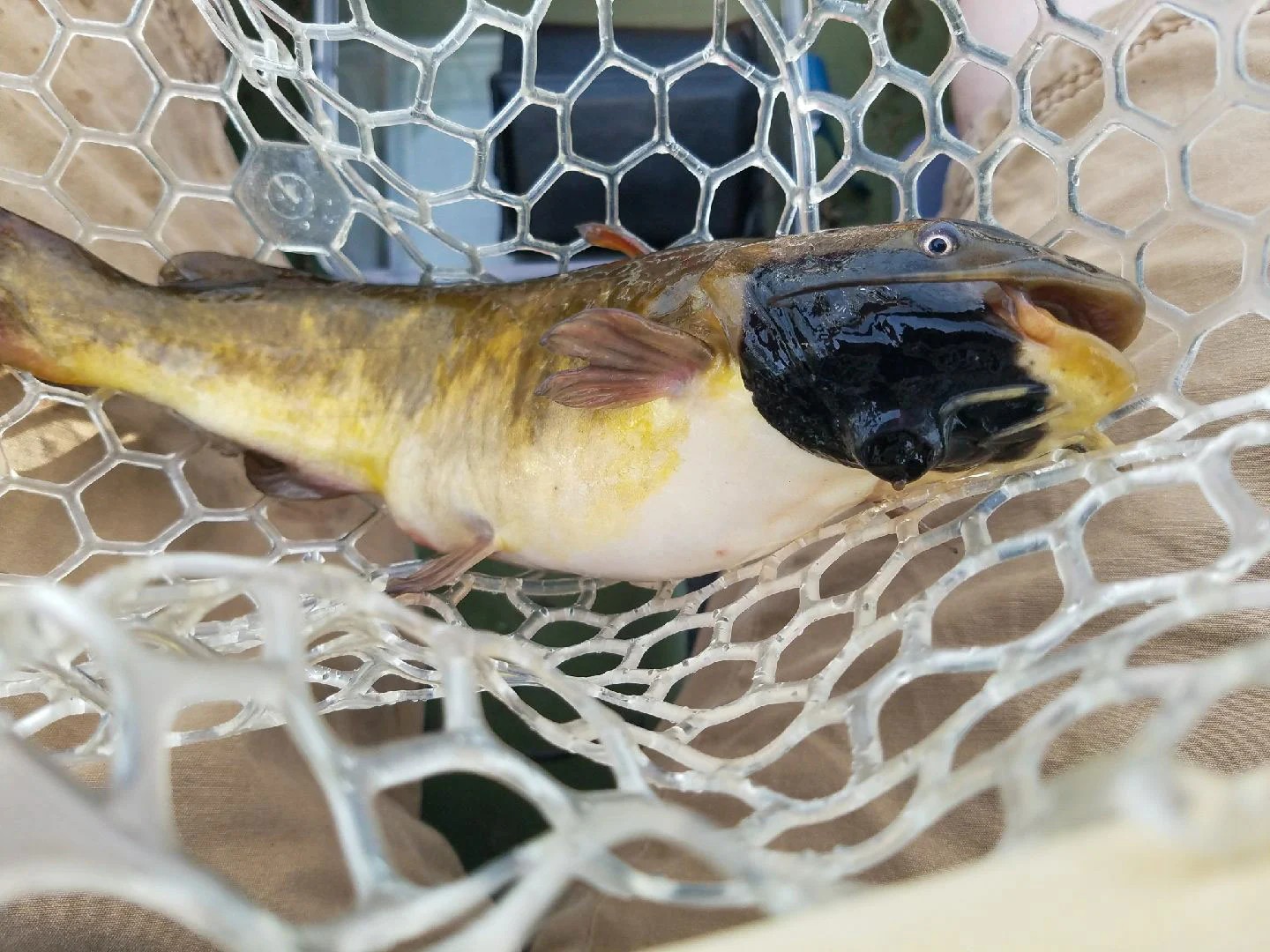
A contagious melanoma has been found in brown bullhead catfish.
It moves from host to host like a parasite.
This marks the first known transmissible cancer in a freshwater animal.
Vermont researchers published the findings in Nature. They describe a disease where living cancer cells escape their original fish and infect others. It’s not a mutation caused by sun exposure. It’s an infectious agent.
At first, biologists saw raised black lesions on fish across New England and Canada. They assumed it was pollution or a standard infection. They were wrong. The genetic data told a stranger story.
How Did This Contagious Cancer Start?
Anglers started noticing sick brown bullhead catfish (Ameiurus nebulosus ) around 2012 in Lake Memphremagog. This cross-border lake sits between Vermont and Quebec. By 2104, nearly a third of the examined fish had these tumors.
“Initially, we suspected a virus or a contaminant,” said Julie Dragon, co-leader of the study at the University of Vermont (UVM). “But that wasn’t panning out.”
Since brown bullhead are indicator species, the team expected to find toxins. Instead, they found clonally transmissible melanoma.
Genetic sequencing revealed the truth.
The tumor DNA was far more similar to other tumor samples than to the fish carrying them. Hundreds of thousands of genetic variants were shared among tumors but absent in the healthy host tissue. This is the hallmark of a contagious cancer.
There are only four recognized types of transmissible cancers in the animal kingdom. Three are in marine or terrestrial species. This is the first in a fish.
The others include:
– Facial tumor disease in Tasmanian devils.
– Venereal tumors in dogs.
– Leukemia-like cancers in bivalve mollusks.
What Spreads the Melanoma?
Researchers aren’t 100% sure yet.
Mark Henderson, a co-leader at UVM’s Rubenstein School, noted that transmission seems to happen in larger, spawning-age fish. Spawning behavior involves close physical contact in shallow water. That contact could allow tumor cells to pass between individuals.
Biology might help, too. Bullhead lack scales. They spend time on the lake bottom. Sediment there could contain free-floating cancer cells that enter the fish through their skin.
Pollutants or hormonal shifts might weaken the immune system. Arsenic levels are elevated inside the cancer cells. But cause and effect are not proven. Arsenic is natural in New England soil. High concentrations exist in Vermont’s Northeast Kingdom and Maine—the same areas where this cancer appears.
Is It Dangerous to Humans?
No.
Lake Memphremagog supplies water to 175,00+ people. The disease poses no threat to them. Human immune systems reject fish cancer cells. Handling the fish is safe.
But Henderson isn’t eating them.
“Personally, I wouldn’t eat the ones with tumor,” he said. About 30% of the catfish in the lake are afflicted.
Where Else Does This Transmissible Cancer Exist?
The disease is not contained to Lake Memphremagog.
Sampling in Vermont, New Hampshire, Maine, New Brunswick, and Massachusetts detected similar issues. “We’ve found it in a few other ponds and lakes,” said Peter Emerson, a Vermont state biologist.
Many of these locations have pristine water. They are far from landfills.
Environmentalists had worried about toxins from the Coventry Landfill. The data doesn’t support this. Cases are spread evenly. They don’t cluster near the landfill in South Bay. Water quality tests show low pollutants in Lake Champlain, where the cancer has not been seen.
Elevated arsenic is linked geographically. But whether arsenic causes the mutation, weakens the immune system, or just accompanies it remains unclear.
Did Thoreau See This Before?
The disease might be older than we think.
Julie Dragon suspects transmissible cancers are underreported because scientists aren’t looking for them.
History offers a clue.
Henry David Thoreau wrote in his journals about a catfish with a “very large velvet-black spot” in July 1852 on the Concord River. Six years later, he saw another in the Assabet River. It had an “inky-black kind of leprosy” covering nearly half its head.
Researchers are now surveying Massachusetts waterways to see if this is a historical pattern or a recent outbreak.
Why This Matters
Studying how transmissible cancer spreads reveals limits on normal cellular behavior.
“By studying how cancers survive and spread outside the host, we learn what keeps cancers contained,” Dragon said. “It’s an opportunity to look at the evolution of cancer.”
Some transmissible cancers kill hosts. Facial tumor disease wiped out 90% of some Tasmanian devil groups. Others persist for thousands of years without eliminating their hosts, like the canine tumor.
We don’t know the long-term ecological cost for brown bullhead yet. Fish with severe disease can survive for years. Reproduction rates? Survival odds? Population trends? Unknown.
But the discovery changes our understanding of disease boundaries. Cancer isn’t always just broken internal cells. Sometimes, it’s something that jumps.
The lake is calm. The fish are swimming. The cells are spreading.