They are coming for the wine region. Then they come for the homes.
More than 300,000 Europeans are packing up and running. The cause? A wall of fire tearing through Spain and France. It is a catastrophe wrapped in heat.
France is facing its worst inferno in twenty years. Madrid, Spain’s capital, officials claim it is worse than anything they have ever recorded. How did we get here? Follow the thermometer. It hit 40C (104°F). Again and again. The continent cooked itself into a tinderbox.
The Gironde Inferno
Look at Gironde. Near Bordeaux. This is ground zero for France.
Over 200,000 lives upended in 72 hours.
The flames don’t care about history or vineyards. They tore through forests. They burned fields. 420 square kilometers (162 sq mi) gone. In less than four days. That is four times the area of Paris.
And the fire is still hungry.
It sits just 15km (9 miles) from the southern edge of Bordeaux. You can almost smell the ash. It is terrifyingly close.
Fire Thunderstorms: When Nature Turns Against Itself
This is not just smoke and heat. It is a weather event of its own.
These massive blazes have spawned “pyrocumulonimbus” clouds. Sounds scientific. It is simple physics gone wrong.
The fire heats the air. The air rises. Fast. It carries smoke, ash, and water vapor straight up into the stratosphere. There, it cools. Condenses. Becomes a cloud. If the heat is intense enough, that cloud becomes a thunderhead.
And thunderheads bring lightning.
Lightning starts new fires. Ahead of the main front. Behind the main front. Anywhere. It makes the flames unpredictable. Dangerous. Unstoppable in the traditional sense.
“We don’t have enough people. And enough trucks.” — Jean-Luc Gleyze, Gironde Official
Fighting Back With Water and Dirt
So, how do you stop a fire that creates its own weather?
You get big.
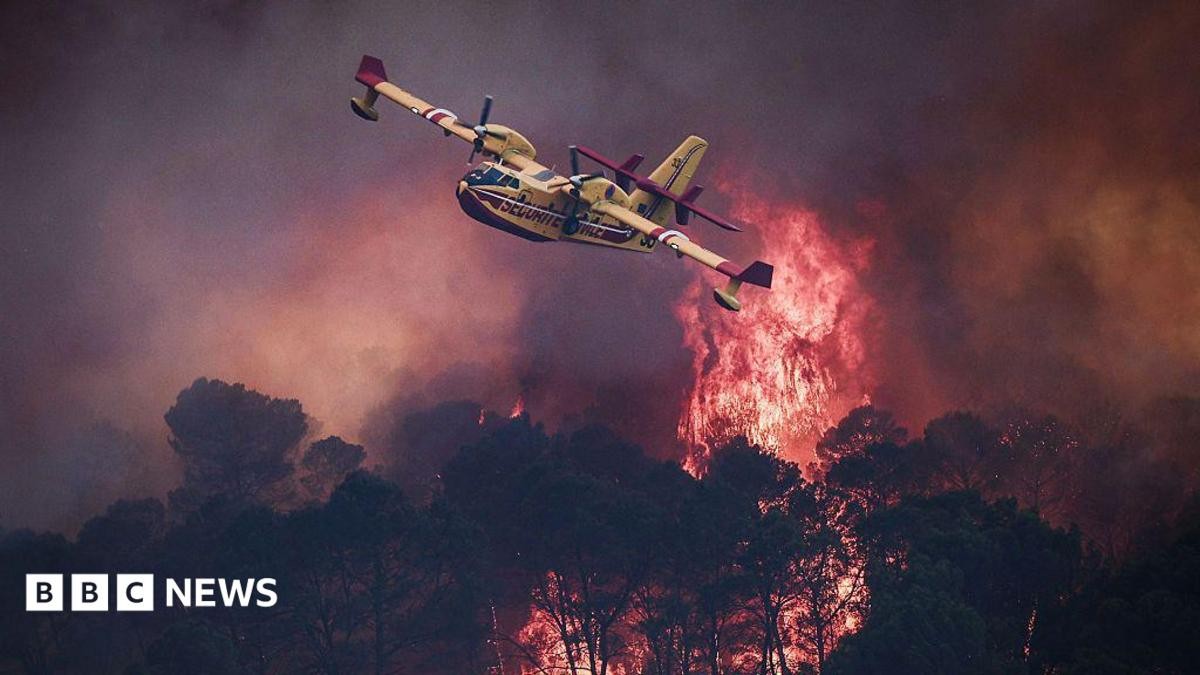
French firefighters are launching Canadair planes. These beasts scoop 6,000 liters of water from lakes or oceans. They do it in 12 seconds. Then they drop it directly on the inferno.
It is a continuous shuttle. High altitude patrols. Low altitude drops. Fire retardant lines laid along the fire’s edge. Ground crews attacking the perimeter with shovels and hoses. It is chaotic. It is exhausting.
In Gironde alone, the counter-offensive involves:
* 2,500 firefighters
* 1,500 military personnel
* 1,200 police and gendarmes
That sounds like a lot. Jean-Luc Gleyze says it isn’t enough. The scale of the fire outpaces the human response.
The Firebreak Strategy
Where machines fail, heavy metal steps in.
Around Lacanau, bulldozers and excavators are working around the clock. They are carving firebreaks. Massive gaps in the landscape. Up to 100 meters (328 feet) wide in some spots.
A firebreak strips away the fuel. No vegetation means no burn. It stops the advance. It is a desperate line in the dirt.
Spain is doing the same. Their teams are using identical techniques. The Spanish fires have burned roughly 770 sq km (297 sq mi) outside Madrid. An area larger than the capital itself.
They are tracking to become the worst in two decades.
The heat hasn’t broken. The wind hasn’t shifted. And the maps are turning red.
What happens next? Nobody knows. The fire doesn’t follow plans.