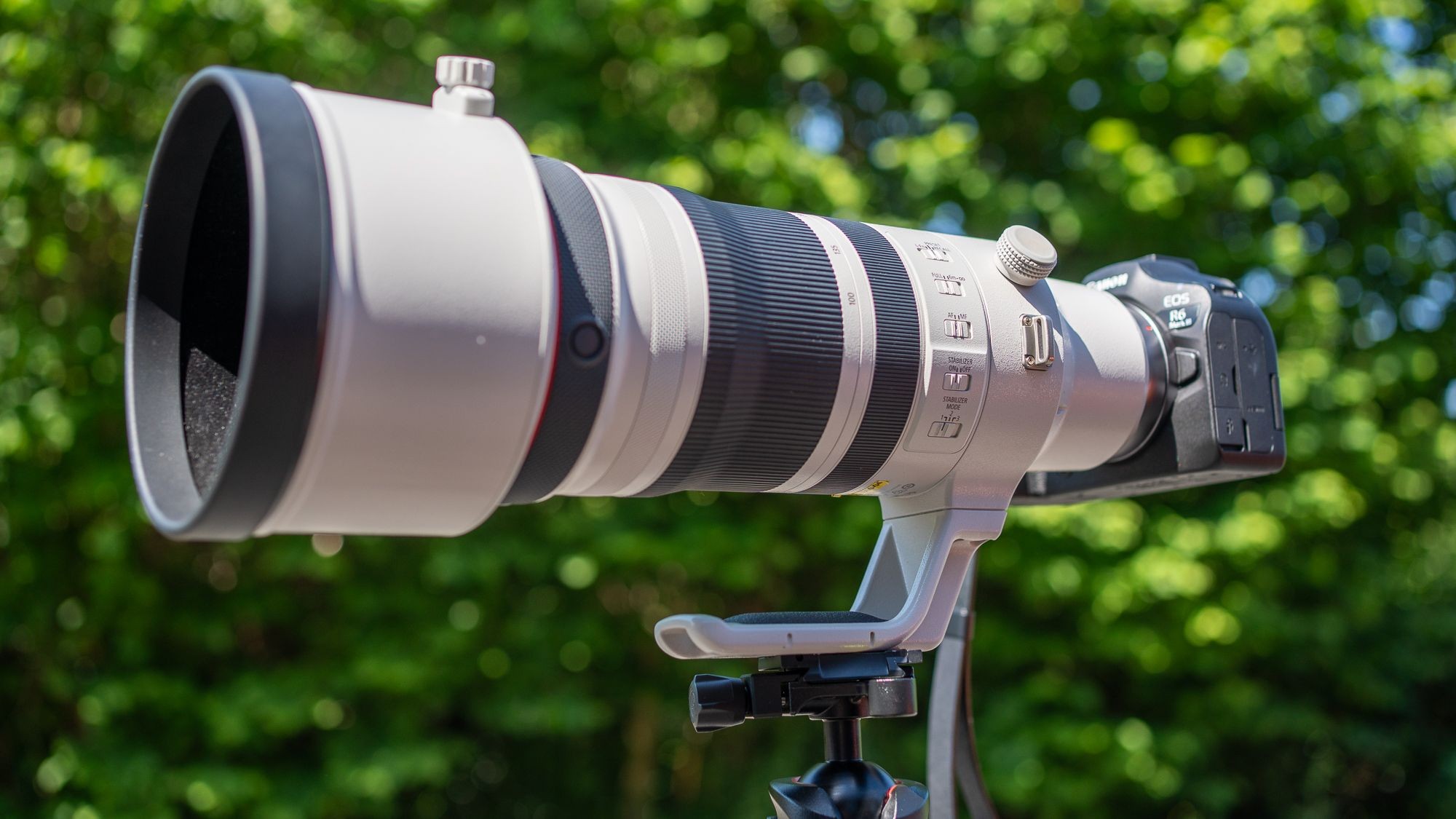
Primes hurt. Not your subject. Your arms.
Long fixed lenses are expensive bricks that deliver god-tier quality. But they don’t zoom. Enter Canon’s RF 100-3300mm f/ 2.8L. Wait, it’s the 100 to 300. This thing keeps f/2.8 open the whole ride. Pros want it.
Then there’s the price tag.
$10,500. Ouch. This isn’t for weekend hikers. It is for the few people who make money with their camera. We bought it to see if the performance justifies the pain in your wallet.
Build and Feel
It’s light.
For what it is, surprisingly light. Lighter than the Sigma 60-60 Sport. In fact it might be the lightest f/3.8 on the market at this focal length. The zooming is internal so it doesn’t stretch out and look goofy. It feels compact. Balanced.
Still. Shoulders ache tomorrow.
Canon seals it up against dust and rain. You would expect that at this price point. The coating eats glare for breakfast. No ghosting. Just a solid, stiff L-series lens that smells like expensive plastic and magnesium.
There are buttons everywhere. Standard stuff: AF/MF, IS toggle. There’s a stabilization selector too.
- Mode 1 for standing still
- Mode 2 for panning
- Mode 3 for things moving erratically
There’s a “preset focus” switch. You focus on a specific spot beforehand. Action comes there? Flip the switch. Done. Or set it as a custom function. Whatever works.
Why does it cost this much? No revolutionary tech here. It’s just engineering. Internal zoom, pro weather sealing, tiny size. Canon packed every premium trick into one tube.
Image Quality
It’s beautiful.
Period. Shots are razor sharp. Clean. Defects are practically nonexistent. There is a sliver of distortion at the edges, but Lightroom fixes that in two clicks. Unless you are comparing side by side pixel peepers, you won’t notice it. Chromatic aberration? Gone. Vignetting? Absent.
Feathers pop. Fur strands separate.
Bokeh is creamy. Soft. That f/2.8 blur isolates your bird from the background mess perfectly.
We tested every combination. f/2.8 to f/11 across 100, 200, and 300 millimeters. The numbers tell a boring but telling story. At 100mm wide open is fine. Stop down to f/5.6 and contrast wins. At 200 and 300mm wide is best.
Sharpness centers.
The corners are softer wide open. You get sharp corners at f/8. Does it matter? In wildlife photography, no. Your subject is in the center. The blurry corners don’t lose the shot.
Utility
f/2.8 stays open. That means fast shutter speeds. Good news for frozen motion. Good news for low light at dawn or indoors.
100-30mm is not long enough for tiny sparrows from a mile away. It is great for horses. Great for safaris. Great for indoor arenas.
No lens swaps means you miss fewer moments. Dust stays out. Rain stays off.
Add the 1.4x converter and it becomes a 140 to 420. Add the 2x and you are looking at 200 to 600 mm. Reach expands without buying a new prime.
Image stabilization helps too. Canon rates it at 5.5 stops. If you put it on a body with IBIS like the EOS R it gets better. Steadier viewfinder. Sharper handhelds.
The Verdict
Here is the problem.
This lens gets 5 stars. Don’t buy it.
Counterintuitive? Yes. Niche? Absolutely. The math hurts. You want 300 mm at f/2.8? You can get an older EF lens with an adapter. Cheap.
Better yet buy a Canon R1 camera body. Use that saved money to buy the used prime and a teleconverter. Maybe throw in a 70 to 200 for variety.
You save thousands.
The 100300 saves you one step: swapping glass. Is that convenience worth six figures difference. Or is it just vanity for your lens bag?